
This blog post explores the Civil Rights era of the 1950s and 60s, emphasizing the geopolitical context that influenced the movement. It discusses the role of the Cold War, the impact of Soviet propaganda on American racial policies, and the pivotal events that galvanized the fight for racial equality, particularly focusing on the tragic case of Emmett Till.
The Civil Rights era, primarily occurring in the 1950s and 60s, is a significant chapter in American history that many have studied throughout their education. While figures like Martin Luther King Jr. are often at the forefront of this narrative, this lecture aims to explore the Civil Rights movement from a different perspective, focusing on the geopolitical context that shaped its development.
Following World War II, the United States emerged as a global superpower, experiencing unprecedented economic expansion. This period saw a shift in demographics, with many Americans moving to the suburbs and the middle class growing significantly. However, alongside this economic transformation, there were profound cultural and social changes, particularly regarding the demand for racial equality.
A critical question arises: why did the Civil Rights movement gain momentum in the 1950s and 60s? Historically, there were numerous individuals and organizations advocating for black rights long before this period, such as Frederick Douglass and W.E.B. Du Bois. Despite their efforts, significant change did not occur until the mid-20th century. Understanding this timing requires a broader analysis beyond domestic factors.
Historians have increasingly recognized the importance of examining the Civil Rights movement within a geopolitical framework. After World War II, the United States and the Soviet Union emerged as rival superpowers, each promoting their ideologies—capitalism and communism, respectively. The Soviet Union actively criticized the United States, highlighting its racial injustices to undermine its image as a leader of democracy.
The Soviet Union launched a campaign to expose American racism, using propaganda to depict the U.S. as hypocritical. Posters illustrated the brutality of racial violence, such as lynchings, juxtaposed with symbols of American democracy like the Statue of Liberty. This propaganda aimed to sway global opinion and attract nations to communism by showcasing the United States' racial inequalities.
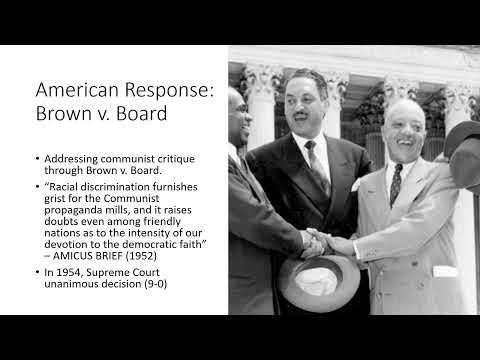
The U.S. government recognized the threat posed by Soviet propaganda. For instance, the Supreme Court's decision in Brown v. Board of Education (1954) was influenced by the need to counteract claims of racial discrimination that fueled communist critiques. The Court's ruling that "separate but equal" was inherently unequal was not only a legal victory but also a strategic move to bolster America's image abroad.
A pivotal moment in the Civil Rights movement was the tragic murder of Emmett Till in 1955. Till, a 14-year-old boy from Chicago, was brutally killed in Mississippi after allegedly offending a white woman. His open-casket funeral, which displayed the horrific nature of his death, galvanized public outrage and became a rallying point for civil rights activists. The acquittal of his murderers by an all-white jury further highlighted the systemic racism in the United States, providing ammunition for Soviet propaganda.
In the wake of Till's death, various civil rights organizations mobilized to combat racial injustice. The Montgomery Bus Boycott, sparked by Rosa Parks' refusal to give up her seat, exemplified the growing activism. Many participants, including young students, were inspired by Till's story, linking their struggle for equality to his tragic fate.
The Civil Rights movement was not solely a product of internal dynamics within the United States; it was significantly influenced by the geopolitical context of the Cold War. The federal government's actions during this period were often motivated by a desire to counteract Soviet propaganda rather than a genuine commitment to racial equality. The legacy of Emmett Till serves as a reminder of the systemic injustices that prompted a generation to fight for change. As we reflect on this history, it is crucial to recognize the victims of racial violence and the ongoing struggle for equality, understanding that those in power may not always prioritize justice for all.
In summary, the Civil Rights era was a complex interplay of social movements and geopolitical pressures, highlighting the need for continued vigilance and activism in the pursuit of equality.



















