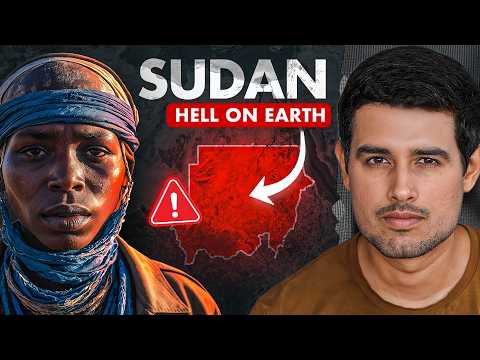
Sudan is facing the world's largest humanitarian crisis due to a civil war between the Sudanese army and the Rapid Support Forces (RSF). This conflict, fueled by ethnic tensions, control over gold resources, and foreign involvement, has led to massive casualties, displacement, and starvation. Despite Sudan's wealth in natural resources, greed and power struggles have devastated the country, creating a dire need for international aid and peace efforts.
According to the United Nations, Sudan is currently experiencing the world's largest humanitarian crisis. Thousands have been killed, millions displaced, and horrific scenes of violence and ethnic cleansing have emerged, particularly in the city of El-Fasher. Satellite images analyzed by Yale University's Humanitarian Research Lab revealed mounds of dead bodies and blood-soaked areas, indicating systematic ethnic cleansing of indigenous non-Arab tribes.
Sudan is located in Northern Africa, south of Egypt, bordered by Libya, Chad, the Central African Republic, and the Red Sea, which separates it from Saudi Arabia and the Middle East. The country has a population of approximately 50 million, with about 70% identifying as Arab Muslims and the remaining 30% comprising African tribes such as Fur, Zaghawa, Berti, and Nuba. Nearly all are Sunni Muslims, with only 1-2% following Christianity or traditional African religions.
Despite being the third-largest gold producer in Africa, with over 60,000 kg produced annually, Sudan remains one of the poorest countries globally. This paradox is largely due to rampant gold smuggling, which deprives the government of revenue and finances armed groups, fueling ongoing conflict.
Sudan gained independence from British-Egyptian rule in 1956 but has been plagued by military and authoritarian governance. General Omar Hassan al-Bashir seized power in 1989 and ruled for 30 years, during which the country suffered economic crises, corruption, inequality, and civil wars. In 2011, South Sudan seceded, further destabilizing the region.
In 2019, widespread protests demanded democracy, leading to the overthrow of al-Bashir by two military generals: Army General Abdel Fattah Al Burhan and Rapid Support Forces (RSF) leader General Mohamed Hamdan Dagalo. A caretaker government was formed, but in October 2021, Al Burhan dissolved it, consolidating power alongside Dagalo.
Tensions escalated between Al Burhan and Dagalo over integrating the RSF into the Sudanese army, with disputes over leadership roles and control of gold mines. On April 15, 2023, these tensions erupted into civil war. Initially, the army controlled more resources, including fighter jets, but the RSF gained ground, capturing Khartoum and the presidential palace before the army recaptured them in March 2025. By June 2025, the RSF controlled significant western regions, including Darfur and Kordofan.
The country is now effectively divided, with the RSF controlling the west and the army the north and east, raising the possibility of partition.
The conflict has resulted in over 150,000 deaths and displaced more than 10 million people. Infrastructure such as schools and hospitals has been destroyed, and starvation is widespread, particularly in Darfur and Kordofan, where 375,000 people were reported starving to death by September 2025. Diseases like cholera, dengue, and malaria are rampant, exacerbating the crisis.
Sudan's average annual income was already low at $750 in 2022, and the war has plunged it further into poverty.
The war has revived ethnic conflicts, especially in Darfur. In 2003, non-Arab tribes protested against the Arab-dominated government, leading to the formation of the Janjaweed militia by al-Bashir, which committed mass killings and displacement of African ethnic groups. General Dagalo, now RSF leader, was involved in these atrocities.
The Janjaweed was rebranded as the RSF in 2013, continuing the same ideology. Reports from El Geneina and El Fasher indicate ongoing ethnic cleansing of non-Arab tribes by the RSF, with thousands killed and mass graves discovered. The RSF aims to transform Darfur into an Arab region by targeting indigenous African communities.
The Sudanese army has also been accused of war crimes, including airstrikes on civilian areas.
Sudan's strategic location as a bridge between Africa and the Middle East and its control over major trade routes and natural resources have attracted foreign interest. Countries such as Russia, China, Turkey, the UAE, Iran, Egypt, and Saudi Arabia have been implicated in supplying weapons and support to both sides.
The UAE is accused of providing sophisticated Chinese drones to the RSF and allegedly receiving gold in exchange. Iran and Egypt support the army, while Russia's Wagner Group reportedly supplies missiles to the RSF.
Multiple peace talks have failed. The RSF has agreed to a three-month humanitarian ceasefire proposed by the US, Egypt, the UAE, and Saudi Arabia, but the army has not accepted it. The international community has largely failed to provide adequate aid, with only a fraction of the required $4.2 billion received.
Sudan's crisis is a tragic consequence of greed and power struggles among a few individuals, devastating a resource-rich but impoverished nation. The ongoing conflict, ethnic cleansing, and foreign interference have created a humanitarian disaster that the world has largely ignored. Immediate international attention and aid are crucial to prevent further loss of life and to pave the way for peace and democracy in Sudan.
The story of Sudan is a stark reminder of how internal divisions, resource exploitation, and geopolitical interests can combine to create one of the most severe humanitarian crises of our time.