
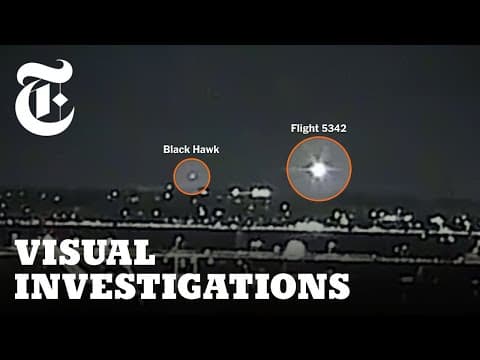
This blog post examines the tragic collision between American Airlines Flight 5342 and an Army Black Hawk helicopter over the Potomac River, analyzing the air traffic control challenges, communication failures, and the resulting changes in airspace regulations.
On a clear night in Washington D.C., a tragic incident unfolded that would claim the lives of 67 people. American Airlines Flight 5342 collided with an Army Black Hawk helicopter over the Potomac River. This blog post delves into the circumstances leading up to the disaster, examining air traffic control communications, flight paths, and the systemic issues that contributed to this catastrophic event.
The collision occurred on a Wednesday night, and the last messages from the air traffic control tower at Reagan National Airport provide critical insights into the events leading up to the disaster. To understand why this collision happened in a highly controlled airspace, investigators analyzed various materials, including:
The investigation revealed a troubling system that placed pilots on tight, crisscrossing flight paths. The Federal Aviation Administration (F.A.A.) described the staffing situation at the control tower as abnormal, with one controller managing both helicopter and plane traffic. This dual responsibility significantly increased the risk of miscommunication and oversight.
Compounding the issue was the reliance on antiquated monitors that updated altitude data every four to five seconds. This delay in information could lead to critical gaps in situational awareness for the air traffic controller, especially in a congested airspace like that of Reagan National Airport, one of the busiest in the United States.
The complexity of the airspace was further heightened by intersecting runways used for both takeoffs and landings, along with a continuous stream of military helicopters. Experts noted that these factors created a challenging environment for air traffic control, increasing the likelihood of conflicts between aircraft.
As Flight 5342 began its descent toward Reagan National, the air traffic controller instructed the pilot to change runways from the main runway, No. 1, to Runway 33. This runway is shorter and typically used by smaller planes, requiring a more complex approach from the east side of the Potomac River.
Two and a half minutes later, the Black Hawk helicopter, on a training mission, was approximately seven and a half miles away, flying at a lower altitude along the river. The controller alerted the Black Hawk to be aware of Flight 5342, which was preparing to land.
At this point, visual separation was in effect, meaning the pilot of the Black Hawk was responsible for avoiding other aircraft rather than relying solely on the air traffic controller's instructions. The Black Hawk was operating in a designated corridor for helicopter traffic, where it was required to maintain an altitude below 200 feet. However, this corridor intersected with the flight path of planes landing on Runway 33, creating a dangerously narrow margin of safety.
As the Black Hawk continued its approach, a conflict alert sounded in the control tower, indicating that the two aircraft were too close. Despite this warning, the controller asked the Black Hawk if it could see Flight 5342 and directed it to fly behind the plane. The Black Hawk requested visual separation again, indicating a lack of clarity in the situation.
On the radar, the Black Hawk was displayed at 200 feet, while Flight 5342 was at 400 feet, suggesting a 200-foot margin. However, as both aircraft converged at 300 feet, an audible gasp was heard in the control tower moments before the collision occurred.
The causes of the collision remain under investigation. Key factors include:
In the aftermath of the disaster, the F.A.A. implemented immediate changes to enhance safety in the area. These changes included:
A pilot based at Reagan National described the airspace as exemplifying the pressures that are pushing the U.S. air safety system to its limits.
The collision between American Airlines Flight 5342 and the Army Black Hawk helicopter serves as a stark reminder of the complexities and challenges faced in modern air traffic control. As investigations continue, the aviation community must reflect on these findings to prevent future tragedies and ensure the safety of all who travel through our skies.



















