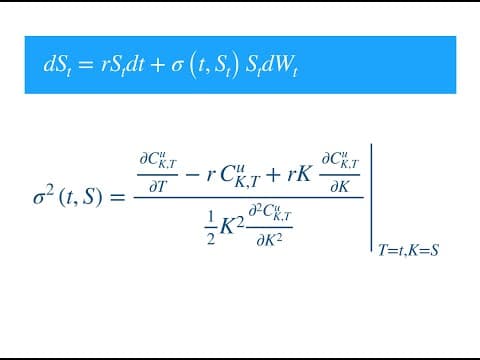
This blog post explores the Dupire local volatility model, its derivation, and its implications for option pricing. It contrasts the model with the Black-Scholes assumptions, discusses the significance of local volatility, and highlights its connection to stochastic volatility and implied volatility. The post also covers the derivation of the Dupire PDE and its relationship with the Fokker-Planck equation, providing a comprehensive understanding of the model's applications in financial markets.
In this blog post, we will delve into the Dupire local volatility model, a significant advancement in option pricing that modifies the traditional Black-Scholes assumptions. This model, named after its creator, is essential for understanding how volatility behaves in financial markets, particularly in relation to time and stock price.
The Dupire local volatility model presents a straightforward yet profound modification to the Black-Scholes model, which assumes constant volatility. Instead, the local volatility model posits that volatility is a function of both time and the stock price. This adjustment allows for a more accurate representation of market behaviors, particularly in the presence of varying implied volatilities across different strikes and maturities.
The Black-Scholes model relies on several key assumptions:
However, empirical observations often reveal that financial asset returns do not conform to a Gaussian distribution. Instead, they exhibit higher peaks and fatter tails, indicating that extreme returns occur more frequently than the normal distribution would suggest. Additionally, volatility tends to change over time, influenced by market dynamics such as supply and demand for options.
When plotting implied volatility against strike prices and maturities, we observe a volatility surface that is not flat, contradicting the Black-Scholes assumption. The strike dimension of this surface is referred to as the smile curve, while the maturity dimension is known as the term structure of volatility. These anomalies prompt a reevaluation of the Black-Scholes assumptions, leading to the development of models like the local volatility model.
The Dupire partial differential equation (PDE) is derived by considering the market prices of call options as a function of strike and maturity. This PDE incorporates local volatility as one of its coefficients, contrasting it with the evaluation PDE, which relates option prices to stock prices and time.
The Dupire PDE shares similarities with the Fokker-Planck equation, which describes the dynamics of probability densities over time. By establishing a connection between these two equations, we can better understand how local volatility behaves in relation to the underlying asset's price dynamics.
The local volatility model allows for volatility to be a deterministic function of time and stock price, rather than a stochastic function. This specification can effectively match current market prices of options, although it may struggle with future price dynamics. For instance, if the volatility surface exhibits a steep smile curve for short maturities, it is likely to flatten as maturity increases, indicating that local volatility relies heavily on current market conditions without accounting for future changes.
Local volatility can take various functional forms, such as:
These parametric models, while useful, may not provide a perfect fit to market data. In contrast, the nonparametric approach used in the Dupire model allows for a more flexible fitting of the volatility surface based on observed option prices.
The Dupire model enables the pricing of options that are not directly quoted in the market, allowing for consistent pricing of exotic options based on the calibrated local volatility surface. This capability is particularly valuable for traders and risk managers who need to assess the value of complex derivatives.
Calibrating the local volatility model involves using market prices of options to infer the local volatility function. This process requires careful consideration of the implied volatility surface and its derivatives with respect to strike and maturity. The calibration ensures that the model accurately reflects current market conditions, although it may require frequent adjustments as market dynamics evolve.
The Dupire local volatility model represents a significant advancement in option pricing theory, addressing the limitations of the Black-Scholes model. By allowing volatility to vary with time and stock price, the model provides a more accurate framework for understanding market behaviors and pricing options. Future discussions will explore the connections between local volatility, stochastic volatility, and implied volatility, further enhancing our understanding of these critical concepts in financial markets.