
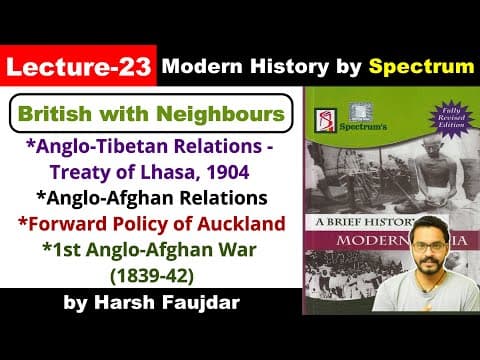
This blog post explores the complex historical relations between British India and its neighboring countries, focusing on the Anglo-Tibet relations leading to the Treaty of Lhasa in 1904 and the First Anglo-Afghan War from 1839 to 1842, highlighting the geopolitical strategies and outcomes of these interactions.
In this blog post, we delve into the intricate historical relations between British India and its neighboring countries, specifically focusing on the Anglo-Tibet relations and the First Anglo-Afghan War. We will explore the significant events leading to the Treaty of Lhasa in 1904 and the dynamics of British influence in Afghanistan from 1839 to 1842.
The relationship between Britain and Tibet has always been complex, primarily due to Tibet's unique political structure and its strategic location. Tibet was governed by a theocracy, where religious leaders, known as Lamas, held power. However, ultimate control over Tibet rested with China, specifically under the Qing Dynasty.
Tibet's geographical position made it strategically important for the British, especially given the rising influence of Russia in the region. The British were keen on establishing friendly relations with Tibet to counter Russian expansionism. However, their attempts to forge commercial ties were largely unsuccessful.
During this period, reports emerged suggesting that Russia was supplying arms to Tibet, raising concerns in British India. In April 1903, the Russian government assured the British that they had no interest in Tibet, yet the British were wary of the growing Russian influence.
In response to these geopolitical tensions, Lord Curzon, the Viceroy of India, decided to take proactive measures. He dispatched a small force of Gurkhas, led by Colonel Younghusband, to Tibet in December 1903. The objective was to persuade the Tibetan authorities to sign an agreement with the British. However, when Tibet resisted, Younghusband's forces began to capture key locations, including Lhasa in 1904.
The culmination of these military actions was the signing of the Treaty of Lhasa in 1904. This treaty stipulated that Tibet would pay 7.4 million rupees to the British for war damages, with annual payments of 1 lakh rupees. Additionally, the British gained control over Tibet's foreign affairs and established trade marts in key locations. The treaty was later revised, reducing the payment to 2.5 million rupees and allowing the British to withdraw from the Chumbi Valley after three years.
The narrative shifts to Afghanistan, where the British sought to establish friendly relations in response to the increasing Russian influence in Persia (modern-day Iran). The early 19th century saw a significant shift in power dynamics, with Russia gaining control over important Persian territories.
Under Governor-General Lord Auckland (1836-1842), the British adopted a forward policy aimed at protecting British India from potential Russian incursions. The strategy involved strengthening ties with Afghanistan to create a buffer state against Russian advances.
In pursuit of this policy, the British signed the Treaty of 1838, known as the Tripartite Treaty, with the Afghan ruler Shah Shuja and the Sikh leader Ranjit Singh. The treaty aimed to restore Shah Shuja to power, as the then-Afghan Amir, Dost Mohammad, was not cooperating with British interests. However, the political landscape shifted when both Russia and Persia withdrew their influence from Afghanistan.
Despite the changing circumstances, the British proceeded with their plans, leading to the First Anglo-Afghan War in 1839. The British forces entered Kabul in August 1839, and Dost Mohammad surrendered in 1840. However, Shah Shuja's unpopularity among the Afghan people led to widespread rebellion against British rule.
The British faced significant resistance, culminating in the assassination of their commander in Kabul. In 1841, they were forced to negotiate a new treaty, agreeing to withdraw and recognize Dost Mohammad as the legitimate ruler of Afghanistan. The war ended in 1842, marking a significant setback for British ambitions in the region, with heavy losses incurred.
The historical relations between British India and its neighboring countries, particularly Tibet and Afghanistan, reveal the complexities of colonial geopolitics. The Treaty of Lhasa and the First Anglo-Afghan War illustrate the challenges faced by the British in asserting their influence amidst rising regional powers. These events laid the groundwork for future conflicts and shaped the political landscape of South Asia.
Understanding these historical contexts is crucial for comprehending the ongoing geopolitical dynamics in the region today.



















