
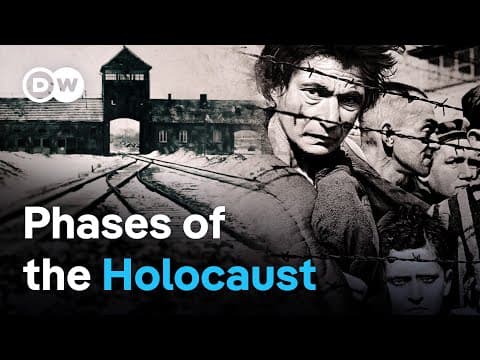
This blog post explores the five critical stages leading to the Holocaust, detailing the systematic persecution of Jews and other marginalized groups in Nazi Germany, from the rise of Hitler to the implementation of the 'Final Solution'.
The Holocaust remains one of the darkest chapters in human history, marked by the systematic extermination of six million Jews and millions of others deemed undesirable by the Nazi regime. This blog post delves into the five decisive stages that led to this atrocity, highlighting the gradual escalation of anti-Semitic policies and violence from the rise of Adolf Hitler to the implementation of the 'Final Solution'.
In the 1920s, Europe was home to approximately nine million Jews. However, by January 27, 1945, when the Soviet army liberated the Auschwitz concentration camp, a horrific crime had unfolded, resulting in the murder of millions. Historian Aya Zarfati notes that after the war, two out of every three Jews in Europe were dead. The question arises: how could such a tragedy occur?
On January 30, 1933, Adolf Hitler was appointed Chancellor of Germany. This marked the beginning of the Weimar Republic's decline into a totalitarian state. The Nazis immediately began excluding Jews from society, employing terror tactics through the SA storm troopers. In April 1933, a nationwide boycott of Jewish businesses was initiated, and Jewish civil servants were removed from their positions. Historian Matthias Haß explains that this marked the beginning of a systematic approach to anti-Semitism, which had deep historical roots but was now becoming government policy.
The Nuremberg Laws, enacted on September 15, 1935, further institutionalized discrimination against Jews. These laws prohibited marriages and extramarital relations between Jews and non-Jews, stripping Jews of their civil rights and increasing societal exclusion. Zarfati emphasizes that these laws defined Jews as an inferior race, paving the way for future atrocities. Haß adds that the laws imposed numerous restrictions on Jewish life, isolating them from the broader society.
The November Pogroms, also known as Kristallnacht, occurred on November 9, 1938, when Nazis incited violence against Jewish communities. Synagogues were burned, and Jewish-owned businesses were vandalized. This marked a significant escalation from discrimination to open violence, with estimates suggesting that over 1,300 Jews were murdered during this period. Zarfati notes that this event signaled to German Jews that their lives were in grave danger, while Haß describes it as a shocking turning point in Nazi anti-Jewish actions.
The invasion of Poland on September 1, 1939, marked the beginning of World War II and the expansion of Nazi atrocities. As German troops advanced, millions of Eastern European Jews became victims of the regime. Jewish assets were seized to finance Germany's military efforts, and mass deportations began. Haß highlights the role of the Einsatzgruppen, mobile killing squads responsible for the systematic murder of Jews in occupied territories, which resulted in nearly a million deaths within six months.
On January 20, 1942, high-ranking Nazi officials convened at the Wannsee Conference to discuss the 'Final Solution' to the so-called Jewish question. This meeting formalized plans for the industrial-scale extermination of Jews, with minutes from the meeting indicating that approximately eleven million Jews were targeted for extermination. Zarfati asserts that this meeting was crucial for the organization of mass murder, while Haß describes the systematic processes established for deportations and killings, exemplified by the operations at Auschwitz, where up to 6,000 people were murdered daily.
In October 1946, the Nuremberg Trials were held to bring Nazi war criminals to justice. Twelve Nazis were sentenced to death, and seven received prison sentences for crimes against humanity. In memory of the victims, the UN declared January 27 as the International Day of Commemoration in Memory of the Victims of the Holocaust, a day observed worldwide to honor those who perished in the Nazi camps.
The Holocaust was not an isolated event but rather the culmination of a series of calculated steps taken by the Nazi regime to dehumanize and exterminate Jews and other marginalized groups. Understanding these five decisive stages is crucial for remembering the past and ensuring that such atrocities are never repeated.



















