
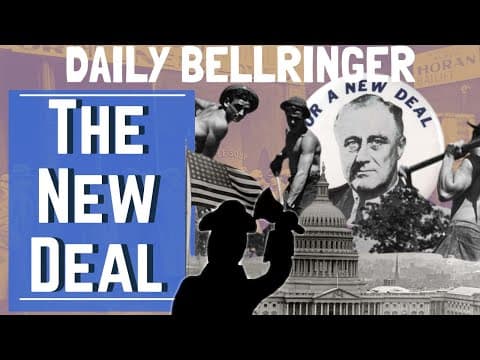
The New Deal, initiated by Franklin D. Roosevelt during the Great Depression, aimed to restore confidence in banks, reduce unemployment, and provide economic aid through various programs. It included significant legislation such as the Emergency Banking Relief Act, the Social Security Act, and labor relations reforms, sparking ongoing debates about its effectiveness and the expansion of federal government power.
The Great Depression of the 1930s was a period marked by severe economic hardship in the United States and around the world. Millions of people faced unemployment and struggled to survive during these challenging times. In the election of 1932, Democrat Franklin Delano Roosevelt (FDR) campaigned on a promise to improve the U.S. economy, ultimately defeating the incumbent Republican president Herbert Hoover, who was widely blamed for the economic crisis despite his attempts to implement policies to mitigate the depression.
Upon his inauguration in March 1933, Roosevelt wasted no time in addressing the economic turmoil. He called Congress into a special session, which became known as the "Hundred Days," running from March to mid-June 1933. During this period, FDR and Congress collaborated to pass a series of legislative measures aimed at combating the depression and providing economic relief to Americans. These initiatives collectively became known as the New Deal.
One of the first areas the New Deal targeted was the banking system, which had lost the trust of many Americans following the stock market crash of 1929. In response to widespread panic, FDR declared a bank holiday, temporarily closing all banks. Congress quickly passed the Emergency Banking Relief Act, designed to restore public confidence in the banking system.
On March 12, 1933, FDR delivered the first of his famous Fireside Chats, a series of radio broadcasts where he communicated directly with the American people. In this initial chat, he explained how the Banking Relief Act would allow the government to inspect the finances of every bank, permitting only those deemed healthy to reopen. As a result, banks gradually reopened, and rather than withdrawing their savings, many Americans began to deposit money again.
The New Deal also focused on the staggering unemployment rate, which reached nearly 25 percent by 1933, with approximately 13 million Americans out of work. To address this crisis, FDR and Congress established various programs aimed at creating jobs and improving the nation’s infrastructure. These initiatives, often referred to as FDR's "alphabet soup," included:
The New Deal also included programs aimed at assisting American farmers who were suffering from severe drought conditions. These programs offered financial aid to prevent farm foreclosures and regulated crop prices to stabilize the agricultural sector.
While many Americans welcomed the New Deal policies, others criticized them. Some argued that the government was expanding too much and that FDR was assuming powers beyond what a president should hold. Conversely, some believed that the New Deal did not go far enough and called for more extensive aid.
Despite the criticisms, the midterm elections of 1934 saw New Deal Democrats secure a majority in Congress, leading to what became known as the Second New Deal.
The Second New Deal introduced additional programs, including:
Beyond banking and job creation, the New Deal also addressed labor relations. The National Labor Relations Act (Wagner Act) of 1935 granted workers the right to join unions and engage in collective bargaining. Additionally, the Fair Labor Standards Act of 1938 established a minimum wage of 25 cents per hour, setting a precedent for future labor laws.
The New Deal remains a historically controversial topic. Historians and economists continue to debate its effectiveness in alleviating the Great Depression and the extent to which it expanded the federal government's role in American life. Questions persist regarding the necessity of the programs established during this era and their relevance in today's society.
In conclusion, the New Deal was a pivotal moment in American history, characterized by significant legislative efforts to combat economic despair and reshape the relationship between the government and its citizens. Through various programs and reforms, FDR sought to restore hope and stability during one of the nation's darkest periods.



















