
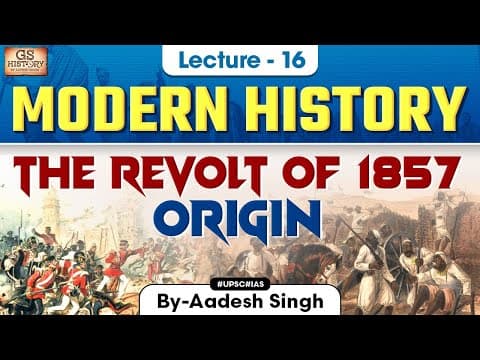
The Revolt of 1857, also known as the First War of Independence, was a significant uprising against British colonial rule in India. This blog post explores the various political, economic, administrative, and social-religious causes that led to the revolt, its beginnings, key leaders, and its eventual failure, setting the stage for future resistance against British rule.
The Revolt of 1857, often referred to as the Sepoy Mutiny or the First War of Independence, marked a pivotal moment in Indian history. This uprising began on May 10, 1857, in Meerut and spread across northern and central India, from Punjab in the north to the Narmada in the south, and from Bihar in the east to the Rajputana region in the west. To fully grasp the significance of this revolt, it is essential to understand the myriad causes that led to it.
The Revolt of 1857 was not the result of a single cause but rather a culmination of various factors that had been brewing over the years. These can be categorized into political, economic, administrative, and social-religious causes.
The British East India Company was aggressively expanding its power and prestige in India, often at the expense of Indian rulers. The introduction of policies such as the Subsidiary Alliance and the Doctrine of Lapse led to the annexation of several Indian states, creating widespread fear among Indian rulers that they could be next. This fear prompted many rulers to join the revolt against British rule.
The economic policies of the British East India Company were primarily profit-driven, leading to the destruction of the Indian economy. The introduction of exploitative land revenue systems, such as the Permanent Settlement, Ryotwari System, and Mahalwari System, placed immense financial burdens on peasants. Many were forced into debt, leading to widespread poverty. Additionally, British policies favored British goods over Indian products, crippling local artisans and merchants. The imposition of high tariffs on Indian goods while keeping British imports at low tariffs further exacerbated the economic distress.
Corruption was rampant within the British administration, leading to widespread dissatisfaction among the Indian populace. The British officials were often seen as foreign rulers, and their administrative practices were alien to the local population. The language barrier and the lack of representation in governance fueled resentment against British rule.
The British viewed Indians as inferior and often disregarded their cultural and religious sentiments. The activities of Christian missionaries, who sought to convert Indians, were perceived as a direct threat to Indian religions. Laws such as the Religious Disabilities Act of 1856, which allowed converts to inherit ancestral property, further inflamed tensions. Additionally, social reforms imposed by the British, such as the ban on Sati and the promotion of widow remarriage, were seen as intrusive and disrespectful to Indian traditions.
The immediate cause of the revolt was the introduction of the new Enfield rifle, which required soldiers to bite into cartridges greased with animal fat, including that of cows and pigs. This was offensive to both Hindu and Muslim sepoys, leading to widespread anger and the belief that the British were attempting to undermine their religions. The situation escalated when sepoys in Meerut revolted on May 10, 1857, after several incidents of discontent had already surfaced.
The revolt began in Meerut and quickly spread to other parts of northern and central India. Key incidents leading up to the revolt included the execution of sepoy Mangal Pandey in Barrackpore for refusing to use the greased cartridges. Following the Meerut uprising, sepoys marched to Delhi, where they declared Bahadur Shah Zafar, the last Mughal emperor, as their leader.
Several prominent figures emerged during the revolt:
Other notable leaders included Kunwar Singh in Bihar, Khan Bahadur Khan in Bareilly, and various regional leaders who rallied their communities against British oppression.
Despite the initial successes of the revolt, it ultimately failed by 1859, as the British were able to suppress the uprising and re-establish their control over India. The reasons for the failure included lack of unified leadership, inadequate resources, and the British military's superior organization and technology. The Revolt of 1857, however, marked a significant turning point in Indian history, laying the groundwork for future movements against British colonial rule. The importance of this revolt and its long-term consequences will be explored in further detail in subsequent discussions.



















