
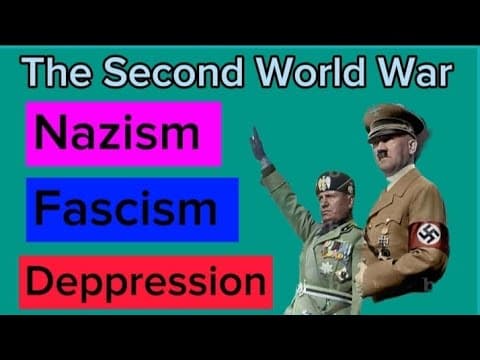
This blog post explores the economic and political conditions that led to the rise of Nazism and Fascism during the interwar period, focusing on the Great Depression, the appeal of fascist ideologies, and the key figures involved in these movements.
The interwar period, marked by significant economic turmoil and political upheaval, set the stage for the rise of Nazism and Fascism in Europe. This blog post delves into the factors that contributed to these movements, particularly focusing on the Great Depression and the socio-political climate of the time.
The Great Depression, which lasted from 1929 to 1933, was a severe global economic downturn that had far-reaching effects on nations worldwide. It was characterized by a significant decline in economic activity, leading to massive bank failures, high unemployment rates, and dramatic drops in Gross Domestic Product (GDP). Economists define an economic depression as a prolonged period where GDP declines by more than 10%.
The primary cause of the Great Depression was the collapse of international trade, exacerbated by restrictive trade practices among nations. This economic crisis affected countries differently, with non-industrialized nations suffering more severely than their industrialized counterparts. The prices of raw materials and foodstuffs plummeted, while manufactured goods did not experience the same level of decline.
The political ramifications of the Great Depression were profound. It created an environment ripe for militaristic and authoritarian regimes to gain power. In Germany, the economic crisis facilitated the rise of Adolf Hitler and the Nazi Party, while in Japan, militarists capitalized on the discontent to strengthen their hold on power.
Fascism, derived from the Latin word "fascis," symbolized authority and unity, drawing inspiration from the ancient Roman Empire. It emerged as an authoritarian movement that attracted various social groups, including shopkeepers, entrepreneurs, and the unemployed, particularly in the wake of World War I.
The aftermath of World War I created widespread dissatisfaction due to social and economic dislocations. Many individuals faced unemployment and uncertainty, making them susceptible to the promises of fascist leaders. Hitler's National Socialist Party, despite its name, was not socialist in ideology but aimed to attract the working class by promising jobs and stability.
Fascism is characterized by extreme nationalism, militarism, and the glorification of strong leaders. It emphasized the importance of a unified state under a single party system, often suppressing dissent and controlling communication to propagate its ideology. The fascist narrative often included the belief in the superiority of certain ethnic groups, particularly in Hitler's Germany, where the Aryan race was deemed superior.
Benito Mussolini, initially a socialist journalist, founded the Fascist Party in Italy in 1919. He advocated for a strong, unified nation and garnered support by promising jobs and protection from communism. The Fascists marched on Rome in 1922, leading to Mussolini's appointment as Prime Minister, marking the beginning of fascist rule in Italy.
In Germany, the Treaty of Versailles imposed harsh restrictions on the nation, leading to widespread resentment and economic hardship. The Weimar Republic, seen as weak and ineffective, faced significant political discontent, paving the way for the Nazi Party's rise to power.
Adolf Hitler, who became the leader of the Nazi Party, capitalized on the fears of communism and the desire for national pride. His imprisonment following a failed coup attempt in 1923 allowed him to articulate his vision in his book, "Mein Kampf," which outlined his ideas on nationalism and racial superiority.
In Spain, General Francisco Franco established a right-wing authoritarian regime after the Spanish Civil War, receiving support from Nazi Germany and Italy. While Franco's regime exhibited some fascist characteristics, it lacked a cohesive fascist ideology.
Japan's militaristic government in the 1930s shared similarities with European fascism, characterized by aggressive nationalism and militarism. However, it operated within a different social and political context, making it distinct from European fascist movements.
The interwar period was a critical time that shaped the political landscape of Europe and beyond. The economic devastation of the Great Depression, combined with the social and political discontent following World War I, created fertile ground for the rise of fascism and Nazism. Understanding these historical contexts is essential for comprehending the complexities of these ideologies and their impact on world history.



















