
This blog post explores the critical contributions of the Royal Army Medical Corps (RAMC) and various nursing services during World War I, highlighting their evolution, challenges, and the integration of both professional and volunteer personnel in medical care for soldiers and the wounded.
World War I was a time of unprecedented challenges for medical services, particularly in the context of battlefield injuries and the need for effective medical care. This post delves into the essential roles played by the Royal Army Medical Corps (RAMC) and various nursing services, illustrating how they adapted to the demands of war and contributed to the care of soldiers.
The RAMC was the backbone of the British Army's medical care system, responsible for the health of soldiers and the treatment of the wounded. The RAMC's logo featured the staff of Asclepius and a serpent, symbols of ancient Greek medicine, and its motto was "Faithful in Adversity."
Initially, the RAMC comprised 9,000 men in 1914, but by 1918, this number surged to 113,000. The corps included a diverse range of personnel, from doctors and surgeons to ambulance drivers and orderlies, who performed essential tasks such as cleaning and maintaining medical facilities. Some RAMC orderlies were conscientious objectors, seeking to contribute to the war effort without engaging in combat due to moral beliefs.
The RAMC faced the daunting task of addressing the new and horrific types of wounds that emerged during World War I. They played a crucial role in the evacuation chain, ensuring that wounded soldiers received timely medical attention. Their efforts were vital in managing the health crises that arose on the battlefield.
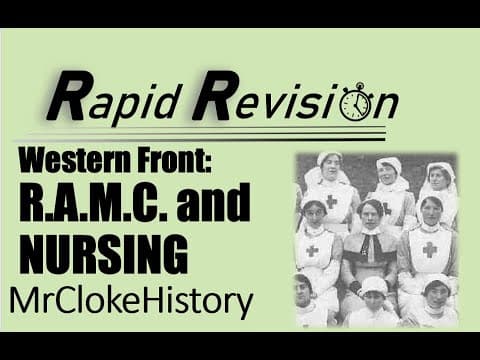
The nursing services during World War I were characterized by a blend of civilian and military roles. Nurses often operated under military orders, blurring the lines between civilian and military service.
One of the primary nursing groups was the QAIMNS, which consisted of professional and well-trained nurses. In 1914, there were only 700 nurses in this service, but by 1918, their numbers had increased to 23,000. These nurses provided critical care at hospitals and field stations near the front lines. Despite their professionalism, they faced challenges from enthusiastic amateurs who joined their ranks, but they quickly adapted by training and integrating these volunteers into effective nursing roles.
Another significant group was the Voluntary Aid Detachments (VADs), composed of volunteer nurses who supported the QAIMNS. Starting with 5,300 volunteers in 1914, the total number of VADs serving reached 38,000. These women were financially self-sufficient and often came from more affluent backgrounds. Initially tasked with menial duties, they gradually took on more complex nursing responsibilities as they gained experience from their professional counterparts. They faced many of the same risks as the trained nurses, contributing significantly to the medical workforce.
The First Aid Nursing Yeomanry (FANY) was another group of volunteers, primarily upper-class women who aimed to provide medical assistance. Although they were founded with the romantic notion of transporting the wounded by horseback, this idea proved impractical. Instead, they operated ambulances and trucks, and even a mobile bath lorry. By 1918, only 116 FANY members were active in France, making their overall impact relatively minor compared to other medical services.
The medical services during World War I required a diverse array of both professional and volunteer personnel. The RAMC was essential in providing general healthcare and assistance to the wounded, while the QAIMNS formed the professional core of nursing services. The VADs played a crucial role in supplementing the nursing workforce, and the FANY, though limited in number, contributed to the overall effort.
Understanding the contributions of these groups highlights the importance of both men and women in the medical services during the war. For those interested in the specifics of their operations, further exploration of the evacuation chain is recommended, as it illustrates the critical work performed by these dedicated individuals in the face of adversity.



















