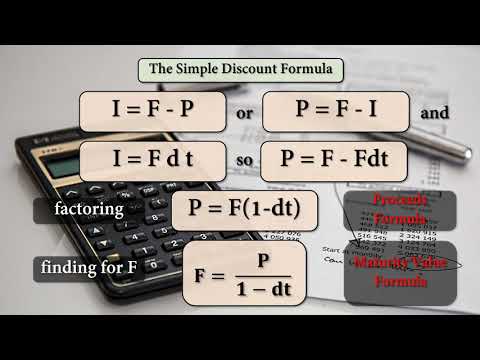
This blog post explores the simple discount formula in investment mathematics, detailing its components, formulas, and practical examples to illustrate how to calculate present value and simple discount effectively.
In this blog post, we will delve into the fourth subtopic under simple interest: the simple discount formula. This formula is essential for calculating the present value of a future amount, which is a crucial concept in investment mathematics.
The term "discount" refers to the process of computing the present value (P) of a given future amount (F). The relationship between these values can be expressed as:
D = F - P
Where D represents the discount. In the context of borrowing money, interest is charged for the use of funds, and when this interest is deducted in advance, it is referred to as a simple discount.
The simple discount formula can be derived from the simple interest formula, which is:
I = PRT
Where:
For the simple discount formula, we need to rearrange the variables to express the discount rate (D), the future value (F), and the present value (P). The formulas are as follows:
Discount Rate (D):
D = I / (F * T)
Future Value (F):
F = I / (D * T)
Present Value (P):
P = F - I
or
P = F * (1 - D * T)
These formulas allow us to compute the present value, future value, and discount rate based on the known variables.
In simple interest calculations, the principal (P) is given by:
P = F / (1 + RT)
In contrast, for the simple discount formula, the proceeds (P) can be calculated as:
P = F * (1 - DT)
Where:
Problem: Discount 25,000 pesos for 3 years and 6 months at a 10% simple discount.
Solution:
Using the formula for present value:
P = F * (1 - DT)
Substituting the values:
Calculating:
P = 25,000 * (1 - (0.10 * 3.5))
= 25,000 * (1 - 0.35)
= 25,000 * 0.65
= 16,250 pesos
Problem: If 12,300 pesos is due at the end of 5 years at an 8% simple discount, find the proceeds and the simple discount.
Solution:
Using the same formula:
P = F * (1 - DT)
Substituting the values:
Calculating:
P = 12,300 * (1 - (0.08 * 5))
= 12,300 * (1 - 0.4)
= 12,300 * 0.6
= 7,380 pesos
To find the simple discount (I):
I = F - P
I = 12,300 - 7,380
I = 4,920 pesos
Problem: Mr. Chrysostomo received 65,000 pesos from a credit union and promised to pay 68,000 pesos in October of the same year. If interest was deducted in advance, what was the discount rate?
Solution:
First, calculate the interest (I):
I = F - P
I = 68,000 - 65,000
I = 3,000 pesos
Next, find the discount rate (D):
D = I / (F * T)
Where T = 0.5 years (from April to October).
Calculating:
D = 3,000 / (68,000 * 0.5)
= 3,000 / 34,000
= 0.0882 or 8.82%
Problem: Mr. Rodriguez wishes to have 100,000 pesos payable in 5 years. What sum should be borrowed now if the discount rate is 18%?
Solution:
Using the present value formula:
P = F * (1 - DT)
Substituting the values:
Calculating:
P = 100,000 * (1 - (0.18 * 5))
= 100,000 * (1 - 0.9)
= 100,000 * 0.1
= 10,000 pesos
The simple discount formula is a vital tool in investment mathematics, allowing individuals and businesses to determine the present value of future cash flows. By understanding and applying this formula, one can make informed financial decisions regarding loans, investments, and savings. If you have any questions or need further clarification, feel free to reach out in the comments section.