
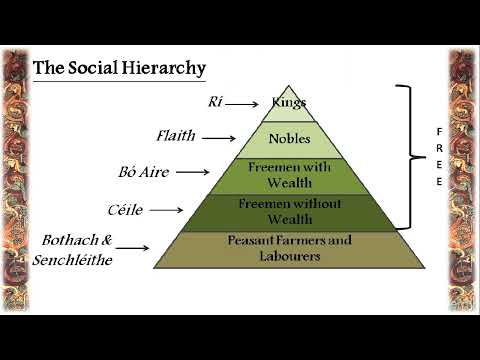
This blog post explores the social hierarchy in early Ireland, detailing the distinctions between free and unfree classes, the roles of various grades, and how wealth and relationships influenced status.
The social structure of early Ireland was complex and can be categorized into two main groups: the free classes and the unfree classes. This hierarchy played a significant role in shaping the lives and interactions of individuals within society.
The free classes were further divided into several grades, each representing different levels of wealth and status. Here’s a breakdown of these grades:
At the bottom of the free classes were the Kayla, who were men with little or no property. They represented the lowest tier of the social hierarchy and had limited influence in society.
Above the Kayla were the bow arrow wealthy free men. This group owned property and had a greater degree of influence compared to the Kayla. Their status was defined not just by ownership but also by their ability to lend goods to those of lesser wealth.
Next in the hierarchy were the flower or noble grades. This group included individuals of higher social standing, leading up to the re, or king, who was the chieftain at the top of every tour (a local community or tribe).
The hierarchy continued to ascend through various grades of kings, from the re tour to the king of the big tour, and further to the kings of the five provinces. At the pinnacle of this hierarchy was the Arduino heron, the highest authority in early Irish society.
Within the free classes, there was also a higher division known as the med. This group referred to the privileged classes, which included certain grades of the flower, the people of the arts, and the wealthiest among the unfree classes.
In contrast to the free classes, the unfree classes were composed of individuals who had limited rights and freedoms. This group included:
These individuals were akin to peasant farmers or menial agricultural laborers. They worked the land but had little control over their circumstances.
At the bottom of the social pyramid were the feuders, who were dependent slaves. They had the least amount of freedom and were often bound to serve those of higher status.
Early Ireland operated as a renter economy, where individuals of greater wealth would loan goods to those of lesser wealth. This system created a dynamic of dependency and established social status. Wealth was not solely defined by ownership but also by the ability to lend resources, such as stock, land, and cattle.
When a wealthier individual provided stock to a lower-grade individual, it created a client-master relationship. The client was expected to owe tributes, rents, hospitality, and loyalty to the master. This relationship was crucial in determining one's social standing. The more individuals one could afford to support, the higher their visible status became.
In summary, status in early Ireland was determined by several factors:
This complex interplay of factors meant that some individuals enjoyed greater freedoms than others, while some were entirely unfree. The social hierarchy of early Ireland was not just a reflection of wealth but a nuanced system that shaped the lives of its people.



















