This article breaks down the wide zone running play in football, tracing its coaching roots from the Houston Texans in 2009 to college and professional teams. It explains the fundamental rules, player responsibilities, and strategic nuances, emphasizing the importance of reading the line of scrimmage rather than the force player. Through detailed examples and film analysis, readers gain a comprehensive understanding of this synchronized offensive scheme.
Football fans and aspiring coaches often hear about various running plays, but the wide zone running play stands out for its strategic depth and synchronization. This article explores the wide zone play, drawing from experiences and coaching philosophies dating back to the Houston Texans in 2009, and illustrates how this play functions at different levels of football.
In 2009, the Houston Texans' coaching staff included notable figures such as Kyle Shanahan, John Benton, Gary Kubiak, Alex Gibbs, and Mike Shanahan. This group is recognized as the foundational tree of the wide zone and zone offense in football.
During the Texans' training camp that year, a strict philosophy was enforced: no pulling of offensive linemen was allowed. Alex Gibbs, a key proponent of this approach, was so committed that he declared he would walk off the field if any lineman pulled during practice. This strict adherence to philosophy highlights the discipline and understanding required to execute the wide zone effectively.
The wide zone is a running play characterized by its simplicity in rules but complexity in execution. The fundamental principle is that the offense never reads the force player (the defender responsible for containing the outside edge). Instead, the running back reads the line of scrimmage to determine where to run.
This aiming point ensures the running back's path is straight down the line for about five steps, maintaining a consistent trajectory unless forced to adjust.
When facing an odd front defense, the blocking scheme is straightforward:
This approach maintains gap integrity and widens the edge rather than trying to capture it, differentiating wide zone from stretch or outside zone plays.
The running back initiates the play with a rocker step opposite the direction of the run. This step aligns his shoulders on a 'train track' path toward the aiming point.
The purpose of this step is to deliver the defense to the offensive line, allowing linemen to provide clear, defined reads through their head placement. Head placement is crucial because it signals to the running back where the running lane will open.
The running back maintains his path for five steps, reading the first and second down linemen's movements. On the fifth step, he plants his foot and accelerates vertically based on the linemen's head placement and the created running lane.
To fully grasp the wide zone play, it helps to observe it in action across different levels of football:
College Football: Dwayne Ledford's teams at North Carolina State and Louisville provide excellent examples of wide zone execution. Ledford is regarded as one of the best coaches for teaching this play in college football.
Professional Football: The 2018 Los Angeles Rams under coach Sean McVay (not from the Shanahan coaching tree) also run wide zone plays, showcasing variations and adaptations at the NFL level.
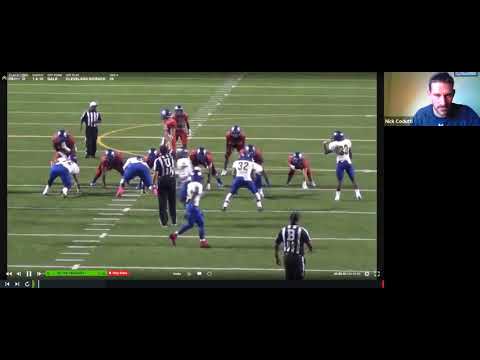
High School Football: Recent high school game films demonstrate how the wide zone principles are taught and executed even at the grassroots level.
Wide zone is often described as one big dance. Every player, from the offensive linemen to the running back, must be synchronized in their movements and reads. The offensive line's head placement and blocking angles communicate vital information to the running back, who must trust these cues to make his cut and accelerate.
The wide zone running play is a testament to disciplined coaching and precise execution. Rooted in philosophies from legendary coaches and adapted across football levels, it emphasizes reading the line of scrimmage, maintaining gap integrity, and synchronized teamwork.
Understanding the wide zone requires studying film, appreciating the blocking schemes, and recognizing the running back's path and reads. Whether you're a player, coach, or fan, this insight into the wide zone enriches your appreciation of football's strategic depth.