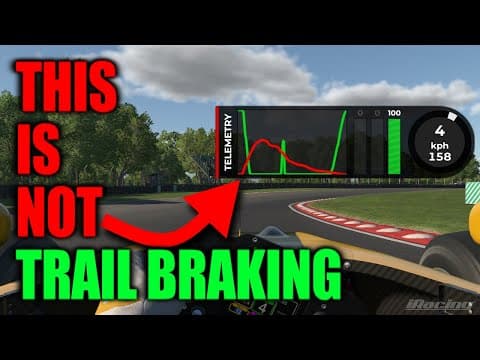
This blog post explores the concept of trail braking in driving, emphasizing the importance of understanding car rotation. It explains the difference between turning and rotation, how to identify rotation while driving, and the significance of car choice in mastering trail braking techniques.
Trail braking is a crucial technique in driving that can significantly enhance a driver's performance on the track. However, many drivers struggle to grasp the concept of rotation, which is essential for effective trail braking. In this post, we will delve into the differences between turning and rotation, how to identify rotation while driving, and why your choice of car matters when learning to trail brake.
Often, the terms "turning" and "rotation" are used interchangeably, but they refer to different aspects of driving.
Understanding this distinction is vital because it allows drivers to unlock the extra grip that comes from managing tire slip effectively.
Recognizing rotation in your driving is essential for mastering trail braking. There are two primary methods to identify rotation:
One subtle way to identify rotation is by observing how the scenery accelerates while cornering. When coaching students, I often emphasize this visual cue. As you corner, look for a slight acceleration in the scenery moving across your field of vision. This change is subtle, so it may take practice to notice it consistently.
To help you understand this better, watching onboard footage can be beneficial. By analyzing the footage, you can determine whether a driver is effectively trail braking based on the scenery's movement.
Another method to identify rotation is through the force feedback in the steering wheel. This can be more challenging to detect without a direct drive wheelbase, but it is still valuable to understand what to expect.
When effectively rotating the car, particularly in a right-hand turn, you may feel the steering wheel become slightly lighter and even pull you towards the left. This sensation is due to the self-aligning torque created by the slip angle of the tires and the car's suspension geometry. The lighter your grip on the steering wheel during entry, the easier it will be to feel this self-aligning force.
Using replay cameras can also help you check if you are rotating the car effectively. In replays, you can observe the rear tires stepping out and taking a different path through the corner compared to the front tires. This difference can be subtle and varies depending on the car being driven.
When learning to trail brake, the choice of car plays a significant role. Different cars have varying optimal slip angles, which affect how they handle during trail braking.
High Slip Angle Cars: Some cars and tires provide optimal grip at a higher slip angle, making it easier for drivers to experiment with rotation without exceeding the optimal slip angle too quickly.
Low Slip Angle Cars: Conversely, cars with a lower optimal slip angle can make it more challenging to learn trail braking, as drivers may push beyond the optimal slip angle more easily.
For beginners, it is advisable to practice trail braking in a car that allows for a larger optimal slip angle. This approach will enable you to find and feel the rotation more comfortably, enhancing your learning experience.
If you find yourself struggling with trail braking despite watching numerous instructional videos, consider revisiting the technique in a car that facilitates easier rotation. Understanding the nuances of rotation and how to identify it while driving is crucial for mastering trail braking.
For those looking to accelerate their learning, consider enrolling in an online course like iRacing Fundamentals, which covers essential concepts and techniques to help you improve your driving skills and achieve a higher iRating.
By grasping the principles of rotation and practicing effectively, you can unlock the full potential of trail braking and enhance your overall driving performance.