
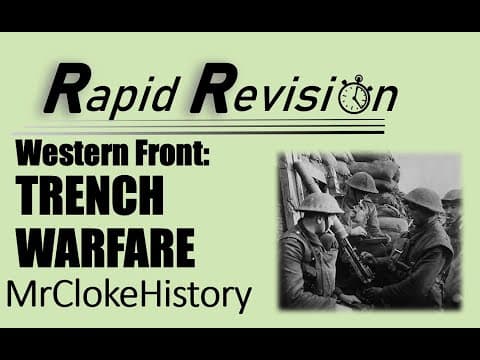
This blog post explores the origins and conditions of trench warfare during World War I, detailing the failure of the Schlieffen Plan, the structure of trenches, the experiences of soldiers, and the types of sources historians use to study this period.
This blog post provides a comprehensive overview of trench warfare during World War I, focusing on its origins, the conditions faced by soldiers, and the types of sources historians utilize to study this significant period in history.
To understand why World War I devolved into trench warfare, it is essential to recognize that this was not the anticipated method of combat. The Schlieffen Plan, devised by Germany in 1905, aimed to quickly defeat France by bypassing their defenses through neutral Belgium. The expectation was that the Belgian Army would offer little resistance, allowing German forces to outflank French defenses and capture Paris swiftly.
However, the reality of 1914 was starkly different. The German Army encountered unexpected and fierce resistance from the Belgian forces, which delayed their advance. This delay allowed the British Expeditionary Force to cross the English Channel and join the fight. Consequently, a race to the sea ensued, with both sides attempting to outflank each other until they reached the English Channel, where neither could advance further.
The German forces, while initially successful, were ultimately halted by the French Army at the Battle of the Marne, leading to a stalemate. By the end of summer 1914, both sides had dug in, resulting in the extensive trench systems that characterized the Western Front.
The trenches were not merely ditches; they were complex systems designed for defense. A typical British trench layout included:
These trenches stretched from the Belgian coast to the Swiss border, forming a continuous line of defense. Spotter planes were used to monitor troop movements, and artillery was often directed at these fixed positions, making life in the trenches perilous.
Life in the trenches was characterized by misery and danger. Contrary to popular belief, soldiers did not spend all their time in the frontline trenches; they typically spent only about 15% of their time there. The majority of their time was divided between command or support trenches and areas further behind the lines.
Despite this, the dangers were significant. Soldiers faced constant threats from artillery, as well as health risks due to the unsanitary conditions. The trenches were muddy, uncomfortable, and often infested with disease. The combination of these factors made the soldiers' health and well-being a critical concern.
Understanding trench warfare and the experiences of soldiers relies heavily on various types of sources. Historians categorize these sources into three main types:
Each type of source has its strengths and limitations, and historians must critically evaluate them to construct an accurate narrative of trench warfare.
Trench warfare during World War I was a complex and harrowing experience for soldiers, characterized by a stalemate that resulted from the power of defensive weapons. The conditions in the trenches were dire, leading to significant health risks and daily dangers. Understanding this period requires a careful examination of various sources, each contributing to a fuller picture of the realities faced by those who fought in the trenches.
This overview serves as a foundation for further exploration into the medical practices and challenges faced by soldiers during this tumultuous time in history.



















