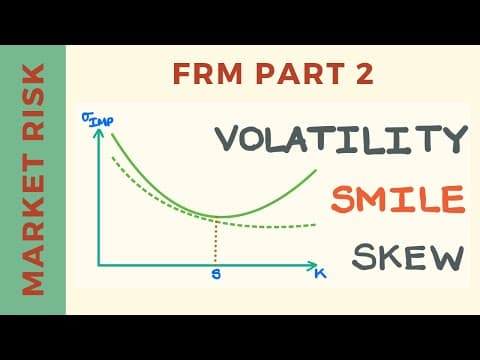
This blog post explores the concepts of volatility smile and skew, essential for understanding implied volatility in options pricing. It discusses the implications of these concepts on market behavior, particularly in relation to extreme price movements and the assessment of risk in financial markets.
In this blog post, we will delve into the concepts of volatility smile and volatility skew, which are crucial for candidates preparing for the FRM Part 2 exam. These concepts help in understanding implied volatility and its implications in the options market.
Implied volatility is a key input in the Black-Scholes model, which is widely used for valuing European call options. The model requires six inputs, five of which can be directly observed or reliably forecasted. However, the implied volatility input is unique because it is not directly observable. Instead, it is adjusted to ensure that the model price matches the market price of the option.
Implied volatility is defined as the volatility input that equates the model price of an option to its market price. Here are four important aspects to remember about implied volatility:
Volatility smile refers to the pattern of implied volatility as it relates to the strike price of options for a given expiration date. It illustrates how implied volatility changes with different strike prices. To visualize this, we can plot implied volatility against strike prices:
In the market, two primary patterns are observed:
The downward sloping skew is particularly relevant in equity options markets. Institutional investors often hedge against downside risks by purchasing OTM put options. This heightened demand for OTM puts drives up their prices, leading to increased implied volatilities. Conversely, OTM calls may see lower demand, resulting in decreased implied volatilities.
If market sentiment is bullish, demand for OTM calls may rise, leading to increased implied volatilities for those options, resulting in a smile pattern. Conversely, if the market sentiment is bearish, the downward sloping skew will prevail.
Understanding implied volatility is essential for assessing the probabilities of extreme price movements in the underlying asset. The Black-Scholes model assumes a log-normal distribution for the asset price at a future time. However, market-derived implied volatility can suggest different probability distributions.
When comparing the two distributions:
In summary, understanding volatility smile and skew is crucial for analyzing market behavior and assessing risk in options trading. These concepts provide insights into market sentiment and the probabilities of extreme price movements, which are essential for effective risk management in financial markets.