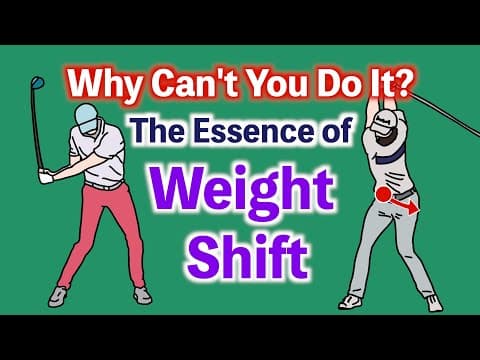
This blog post delves into the science of weight shift in golf, addressing common misconceptions and providing insights from professional golfers. It explains the mechanics of efficient weight transfer, the role of ground reaction force, and offers practical tips for golfers to enhance their swing distance. By understanding these concepts, golfers can improve their technique and performance on the course.
The reason your swing distance isn't improving might be a misunderstanding of weight transfer. Even trainers often misunderstand weight transfer and ground reaction force. These terms are full of misconceptions. This article scientifically analyzes the movements of top professionals like Rory McIlroy and Kyle Berkshire, referencing numerous scientific papers to thoroughly explain the essence of the fastest and most efficient weight transfer. This is a must-read not only for golfers but also for trainers.
One common debate in golf is whether to shift weight to the right or rotate around the center without moving right. Generally, it's often said to shift weight to the right, but this expression alone can be misleading. Many interpret it as moving the pelvis to the right, which is not the case. The weight shift to the right naturally happens as the body rotates around the spine. Both McIlroy and Berkshire rotate almost around the center without shifting their pelvis to the right. However, if you measure foot pressure, you'll clearly see the weight shifting to the right foot.
To understand this mechanism, consider the upper body. When checking the weight distribution of the upper body alone, the arm's weight shifts slightly forward of the torso center. The spine is not in the center of the torso but positioned toward the back. As you take the back swing around the spine, the torso moves, and the center of gravity shifts diagonally backward to the right. This is the true mechanism of weight shift. Instead of sliding the pelvis to the right, the upper body, especially the chest, rotates to the right, causing the center of gravity to shift diagonally backward to the right.
In the takeaway, there's only a slight shift to the right, but not a big movement. Just before the club head reaches the top, the weight shift begins, moving slightly down to the left. As the pelvis rotates, the club head transitions into the downswing. When the arms reach around 45°, the pelvic rotation slows down, especially for Berkshire. From this point until just after impact, the pelvic rotation almost stops. The left foot pushes off strongly, and the club head accelerates rapidly. At the moment of impact, Berkshire's left foot lifts off the ground, and in the follow-through, the swing's momentum causes further rotation of the pelvis and chest.
To achieve efficient weight transfer and torso rotation, it's crucial to rotate around the center with the spine as the axis. Many golfers think they are rotating around the center, but often the torso tilts, leading to common errors. This involves postural reflexes, where the body unconsciously adjusts to stabilize the center of gravity. For instance, when holding a heavy ball, your posture naturally adjusts to maintain balance. This reflex can cause the upper body to tilt diagonally forward, which can be mistaken for improper weight shifting.
To practice efficient weight transfer, place a line on the mirror using tape. Practice the takeaway while keeping your body from shifting away from that line. This way, you can immediately notice if your body tilts as you take the back swing. According to research measuring pro golfers' foot pressure, pressure increases around the ball of the left foot at the very start of the takeaway. However, this pressure is not due to pushing off with the left foot but rather a reaction force from rotating right around the spine.
When shifting weight to the left, the weight shift begins just before reaching the top of the swing. The pressure on the outer edge of the right foot near the heel increases, while pressure on the left foot decreases rapidly. This does not mean you should push off with your right foot; instead, you should unload the left foot. By relaxing the left hip, knee, and ankle, the body naturally moves downward to the left. Practicing this movement can help you master the weight shift.
Ground reaction force is often described as a factor that generates power during the swing. However, it does not directly act at the moment of impact. Instead, it enhances the overall energy efficiency of the swing. The peak of ground reaction force usually passes by the time the ball is struck. Understanding this concept clarifies why placing too much weight on the right foot is not ideal. If the center of gravity shifts directly over the right foot, the weight shift to the left becomes slower.
After shifting weight downward to the left, the club head accelerates primarily through the left foot push-off leading into impact. This push-off creates a braking effect that accelerates the rotation of the pelvis and the overall swing. However, applying too much braking force can slow down swing speed. The ideal finish for a standard driver shot is where the weight is firmly on the left foot, while long drive players may finish supported by both feet due to their wider stance.
Understanding the nuances of weight shift in golf is crucial for improving swing distance and overall performance. Both shifting weight to the right and rotating around the center are correct interpretations, and mastering these movements can significantly enhance your technique. By practicing the right techniques and understanding the role of ground reaction force, golfers can optimize their swings and achieve better results on the course. In the next video, we will explore how to use the core to efficiently transfer energy from the legs to the arms, diving deeper into the science of the X factor. Stay tuned for more insights and tips to elevate your golf game.