
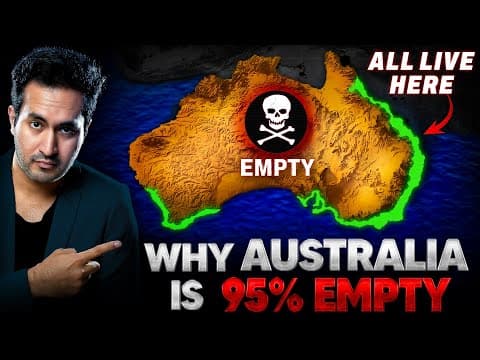
Australia, the sixth largest country in the world, is largely uninhabited due to historical events, geographical challenges, and climatic conditions. The indigenous population faced severe decline due to colonization, diseases, and wars, leading to a concentration of the current population in just a few cities.
Australia is the sixth largest country in the world, so vast that it could fit two countries the size of India within its borders. Yet, astonishingly, 95% of Australia is largely uninhabited. This blog post explores the reasons behind this phenomenon, delving into historical, geographical, and climatic factors that contribute to the sparse population.
To understand the population distribution in Australia, consider this: 90% of the population resides in just 0.22% of the land area. This concentration is primarily found in five major cities: Sydney, Brisbane, Perth, Adelaide, and Melbourne. As one moves away from these urban centers, the chances of survival decrease significantly due to the harsh conditions of the interior regions.
The story of Australia’s emptiness is deeply rooted in its history, particularly the impact of British colonization. Originally inhabited by Aboriginal peoples, the arrival of British settlers marked the beginning of a dark chapter in Australian history. The British, seeking to exploit new lands, established a penal colony in 1788 at Botany Bay, modern-day Sydney.
With the British came diseases that the indigenous population had no immunity against, such as smallpox, measles, and bronchitis. These diseases decimated the Aboriginal population, with reports indicating that in Sydney alone, 50% of the population succumbed to smallpox within a year of the British arrival. The British, who had access to vaccines, did not provide any assistance to the dying indigenous people, leaving them to perish.
Initially, the British settlers took only a small portion of land, but as time progressed, they began to fence off larger areas, restricting the Aboriginal peoples' access to their traditional hunting grounds and water sources. This led to forced labor and severe oppression, culminating in violent conflicts that lasted for over a century. By 1900, the indigenous population had plummeted from millions to just 30,000 to 75,000.
The situation worsened during World War I and World War II, where many Australians were conscripted to fight, further diminishing the population. The British colonial policies, including the White Australia Policy of 1901, restricted immigration from non-white countries, ensuring that the population remained predominantly white and further marginalizing the indigenous peoples.
Beyond historical factors, Australia’s geography plays a significant role in its low population density. The country is divided into three major landforms:
Australia experiences extreme weather patterns, including droughts, floods, and cyclones. Approximately 70% of the country is desert, which severely impacts agricultural productivity, costing the economy around $1.1 billion annually. The eastern regions, while more fertile, are prone to flooding and cyclones, making survival difficult.
Today, Australia has a population of approximately 26 million, but only 3.8% of this number consists of indigenous Australians, amounting to about 1 million people. This figure is lower than the population of an average town in India, highlighting the drastic decline of the native population over the centuries.
The reasons behind Australia being 95% empty are multifaceted, involving a tragic history of colonization, the impact of diseases, wars, and geographical challenges that make survival difficult in most parts of the country. Understanding this history is crucial to grasping the current demographic landscape of Australia, where the majority of the population is concentrated in a few urban areas, leaving vast regions uninhabited.
This exploration of Australia’s emptiness reveals not only the consequences of historical events but also the ongoing challenges posed by its unique geography and climate.



















