
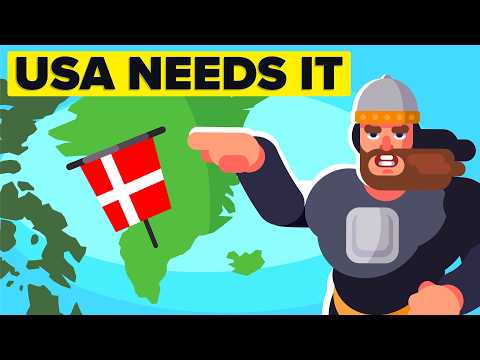
Greenland, the world's largest non-continental island, is mostly covered in ice and sparsely populated. Its history involves Inuit migrations, Norse settlements led by Eric the Red, and eventual Danish control starting in the 18th century. This article explores Greenland's early inhabitants, Norse colonization, Inuit-Norse relations, and how Denmark came to own Greenland, including the island's strategic importance and future prospects.
Greenland is a vast island, over 80% covered with snow and ice, making it one of the least densely populated places on Earth. Despite being the largest non-continental island globally, it has a population of only about 56,000 people, resulting in a population density of just 0.14 people per square kilometer. Interestingly, Greenland is owned by Denmark, but the story behind this ownership is complex and rooted in centuries of history.
Greenland was not always the icy, isolated island we know today. The first people to set foot on Greenland were the Inuit, who arrived around 2500 BC. They did not arrive by boat but crossed a natural ice bridge formed by the frozen waters of the Thule Channel, connecting the Canadian Arctic Islands to Greenland. This migration allowed the Inuit to establish a foothold on the island.
Historians believe the earliest migrants eventually died out, but several waves of migration followed. The modern-day Greenlanders descend from the Thule people, who settled Greenland around 1100 to 1200 AD.
Before the Thule people settled Greenland, another group arrived led by the Norwegian outcast Eric the Red. In 982 AD, Eric was expelled from a community in Iceland for killing a man. He sailed westward across the frozen northern seas and discovered Greenland.
Eric the Red returned to Iceland in 985 AD and promoted Greenland as a lush, fertile land, naming it "Greenland" as a clever marketing tactic despite most of the island being ice-covered. He then led a group of Norwegians back to Greenland and established two settlements: the West and East Settlements. These communities grew to about 2,000 to 3,000 people, with around 280 farms.
Eric's son, Leif Erikson, later arrived and introduced Christianity to the settlers. By 1126, Greenland had its own bishopric.
The Norse settlers tried to live as they did in Norway, bringing domesticated animals and farming practices. However, Greenland's harsh climate and terrain made farming difficult. The Inuit, adapted to the Arctic environment, lived off hunting and fishing, settling temporarily along the coast and moving as resources fluctuated.
Relations between the Norse and Inuit were strained. The Norse did not adapt to the environment as effectively as the Inuit and did not adopt Inuit survival techniques or tools. This lack of adaptation, combined with hostile relations, likely contributed to the disappearance of the Norse population in Greenland by around 1500.
In the 16th and 17th centuries, Dutch and English whalers began trading with Greenlanders, but no major colonization efforts occurred due to Greenland's icy conditions.
In 1721, Hans Egede, with permission from the Denmark-Norway kingdom, established a trading company and Lutheran mission in Nuuk, Greenland's capital. Denmark declared a trade monopoly on Greenland in 1776, barring other foreign powers from landing on its coast. This monopoly lasted until 1950, with some exceptions involving the United States.
The United States showed intermittent interest in Greenland. In 1867, Secretary of State William Seward, after purchasing Alaska, considered acquiring Greenland and Iceland. His strategic plan was to surround Canada with U.S. territories, potentially encouraging Canada to join the United States.
Today, Greenland remains an autonomous territory within the Kingdom of Denmark. Its strategic location and natural resources have made it increasingly important geopolitically. The island's future may involve greater autonomy or changes in its political status, but its historical ties to Denmark remain a significant part of its identity.
Greenland's story is one of survival, exploration, and complex cultural interactions. From the Inuit migrations and Norse settlements to Danish control and modern geopolitical interest, understanding why Greenland is part of Denmark requires appreciating this rich and multifaceted history.



















