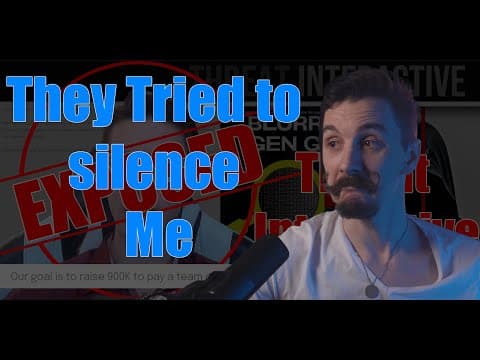
This blog post critiques Threat Interactive's approach to game development discussions on YouTube, highlighting issues of misinformation, manipulation, and the importance of transparency in educational content.
In a recent turn of events, my latest video was taken down due to copyright claims and allegations of using a third-party API for uploads. As I appeal this decision, I find it necessary to address the actions of Threat Interactive, who has worked diligently to have my content removed. While I could easily blame him for this, I believe his actions only reinforce the validity of my arguments. In this post, I will explore the misleading tactics employed by Threat Interactive and the implications for the gaming community.
Threat Interactive has emerged as a controversial figure in the gaming community, riding the wave of discontent among gamers and positioning himself as a moral authority. However, his approach raises questions about sincerity and the accuracy of the information he presents. As an educator, I cannot stand by while someone exploits the community for clicks under the guise of righteousness.
Threat Interactive seemingly appeared out of nowhere, capitalizing on the frustrations of gamers. He has criticized other creators, labeling them as ignorant, while promoting his own content as the solution to the industry's problems. For instance, he has taken aim at Digital Foundry, whose factual breakdown of anti-aliasing stands in stark contrast to Threat Interactive's fear-mongering narratives.
Despite my criticisms, I must acknowledge that Threat Interactive has a knack for getting his videos noticed and does share some valuable information. However, the issue lies not in the information itself but in the spin he places on it. His videos often contain lengthy explanations of concepts that could be simplified, leading to confusion rather than clarity.
One of the primary concerns with Threat Interactive's content is the way he presents technical information. For example, he dedicates significant time to discussing Level of Detail (LOD) techniques, framing them as obscure knowledge that only he possesses. In reality, these concepts are well-known in the industry and can be explained succinctly.
Threat Interactive's obsession with anti-aliasing exemplifies his misleading tactics. He claims to seek funding for a new anti-aliasing solution, yet his arguments often lack a fundamental understanding of the technology. Anti-aliasing is a process that smooths out the jagged edges of images, and while it can introduce blurriness, it is a necessary compromise in rendering graphics. His assertion that he can create a blur-free anti-aliasing solution is akin to claiming to create water that isn't wet.
Game development is a complex process that involves numerous trade-offs. Developers often prioritize graphical fidelity over frame rates, leading to decisions that may frustrate players. However, this is not a sign of incompetence; rather, it reflects the challenges of balancing various aspects of game design.
Technologies like DLSS and FSR have emerged as solutions to the performance issues faced by modern games. These technologies allow developers to enhance graphics without sacrificing frame rates, yet Threat Interactive often dismisses them without providing constructive alternatives. His approach seems to be more about generating outrage than fostering understanding.
In conclusion, while Threat Interactive possesses some knowledge about game development, his methods are often misleading and manipulative. His videos, framed as educational, serve more to generate clicks than to inform. The gaming community deserves transparency and honesty, especially from those who claim to be educators.
As someone who values education and integrity, I encourage viewers to critically evaluate the content they consume. If you are interested in more industry insights and genuine discussions about game development, please let me know in the comments. Thank you for reading, and I hope to see you in the next post.