
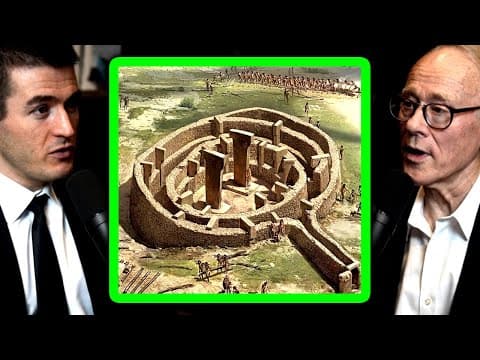
Göbekli Tepe, located in Turkey, is the oldest known megalithic site, dating back 11,600 years. It challenges previous understandings of human civilization, suggesting that complex societies existed before the advent of agriculture. The site has sparked significant archaeological interest and has implications for our understanding of early human culture and the development of agriculture.
Göbekli Tepe, a site in Turkey, has emerged as a focal point for understanding early human civilization. This ancient site, dating back approximately 11,600 years, is considered the oldest known megalithic structure, predating other significant sites by thousands of years. Graham Hancock, a prominent researcher and author, has dedicated much of his work to exploring the implications of Göbekli Tepe and its surrounding region.
Hancock's interest in lost civilizations began in the late 1980s and continued through the 1990s. His extensive research culminated in the publication of his book "Underworld" in 2002, which documented his underwater explorations for ancient structures. However, it was the discoveries at Göbekli Tepe that reignited his passion for this subject.
Göbekli Tepe's significance lies not only in its age but also in its architectural complexity. The site features massive T-shaped pillars arranged in circular enclosures, with the largest pillars reaching heights of 18 feet and weighing around 20 tons. These structures are believed to have been constructed by hunter-gatherers, challenging the notion that agriculture was a prerequisite for complex societal development.
The Turkish government and archaeologists have recognized the potential of Göbekli Tepe to attract tourism and further archaeological exploration. The site has led to the identification of what Turkish archaeologists are calling the "Stone Hills Civilization," characterized by semi-subterranean circular structures and megalithic pillars. This civilization appears to have existed before the construction of Göbekli Tepe, suggesting that the site was the culmination of a long process of cultural development.
The timeline surrounding Göbekli Tepe is crucial to understanding its context. The Younger Dryas, a period of climatic change, began around 12,800 years ago and ended approximately 11,600 years ago. The construction of Göbekli Tepe coincides with the end of this period, indicating a significant cultural shift. During this time, the people who built Göbekli Tepe transitioned from a hunter-gatherer lifestyle to one that incorporated early agricultural practices.
Göbekli Tepe was initially overlooked by archaeologists in the 1960s, who mistook the finely cut stones for remnants of a later civilization. It wasn't until the involvement of the German Archaeological Institute and the work of Dr. Klaus Schmidt that the true significance of the site was recognized. Ground-penetrating radar revealed that much of Göbekli Tepe remains buried, suggesting that further discoveries could reshape our understanding of early human history.
Interestingly, while Göbekli Tepe was constructed by hunter-gatherers, evidence of agriculture began to emerge around the time the site was decommissioned and buried. This raises questions about the relationship between the development of agriculture and the construction of monumental architecture. The site served as a time capsule, preserving the cultural practices of its builders while agriculture began to take root in the surrounding areas.
The findings at Göbekli Tepe challenge established narratives about the development of human civilization. The idea that complex societies could exist without agriculture contradicts long-held beliefs in archaeology. Hancock points out the hypocrisy in the acceptance of agricultural dissemination from Anatolia to Western Europe while simultaneously dismissing the notion of lost civilizations.
Göbekli Tepe stands as a testament to the ingenuity and complexity of early human societies. Its discovery has opened new avenues for research and understanding of our ancestors. As excavations continue, the potential for uncovering more about the Stone Hills Civilization and its impact on the development of agriculture and society remains vast. The mysteries of Göbekli Tepe not only enrich our historical narrative but also invite us to reconsider the origins of civilization itself.



















