
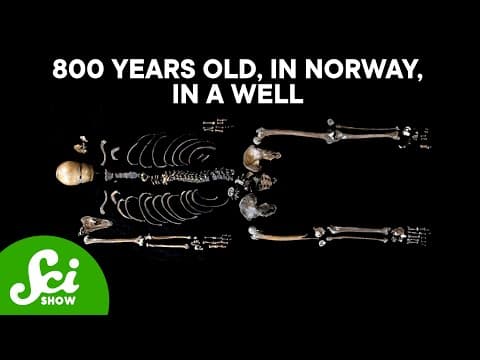
The story of Well-Man, a skeleton found in Sverresborg Castle, reveals insights into medieval Norway through carbon dating, DNA analysis, and Norse sagas, suggesting he may have been a victim of political conflict during King Sverre's reign.
In central Norway, the remains of the medieval Sverresborg Castle, built around 1180 CE, hold a dark secret. During excavations in the 1930s, a corpse was discovered at the bottom of a well within the castle walls. This skeleton, later dubbed "Well-Man," had sustained serious injuries, leading to speculation about his dramatic demise. However, thanks to modern science and ancient texts, we can piece together the story of this unfortunate individual.
The body of Well-Man was first unearthed in 1938, approximately five meters down a well and covered with large stones. At that time, the identification of the skeleton was limited due to the lack of scientific methods available. Consequently, Well-Man remained an anonymous figure, simply known as the skeleton found in the well.
Decades later, as plans to turn Sverresborg Castle into a tourist destination emerged, researchers prioritized the study of Well-Man. In 2014, they attempted to relocate and analyze the skeleton, recovering only a portion of it. Despite the fragmentary nature of the remains, significant insights were gained.
Researchers employed various techniques to glean information about Well-Man. By examining skeletal features, they estimated his age and biological sex. The pelvic region was particularly informative, indicating that Well-Man was a male aged between 30 and 40 at the time of his death.
One of the key advancements since the initial discovery was the ability to use radiocarbon dating to estimate the time of death. This method, which analyzes the decay of carbon-14 isotopes, suggested that Well-Man died between 1154 and 1285 CE. Although this range is broad, it provides a crucial timeframe for understanding his life and death.
A subsequent study in 2024, which considered dietary factors, refined this estimate to between 1153 and 1277 CE, indicating a likely consumption of seafood.
Further excavations in 2016 revealed more disturbing details about Well-Man's fate. Notably, his left arm was missing, although fingers associated with that arm were found. His skull, discovered detached from the body, exhibited severe blunt force trauma, suggesting that these injuries occurred before he was thrown into the well.
In 2024, researchers conducted a genetic analysis comparing Well-Man's DNA with that of ancient and modern Norwegians. This study revealed that he hailed from a population in southern Norway, with genetic traits indicating he had blue eyes, fair skin, and blond or light brown hair. However, obtaining uncontaminated DNA proved challenging due to the skeleton's handling over the decades.
The story of Well-Man does not end with scientific analysis. Ancient Norse sagas, which recount events from medieval Norway, provide a narrative that aligns with the findings about Well-Man. These sagas, originating around 1060 CE, detail the reign of King Sverre, who faced conflict with the Baglers, a faction aligned with the Roman Catholic Church.
In 1197, the Baglers attacked Sverresborg Castle, burning structures and reportedly throwing a dead man into a well, filling it with stones. This act may have been an attempt to poison the water supply, making the castle uninhabitable for King Sverre and his followers. Given the timing and circumstances of Well-Man's death, it is plausible that he is the individual mentioned in these sagas.
An intriguing aspect of this narrative is the potential identity of Well-Man. While he may have been a victim of the Baglers, his southern DNA raises questions about whether he was one of King Sverre's men or a Bagler himself. This ambiguity adds depth to the historical context, leaving us with an unresolved mystery about his true allegiance.
The story of Well-Man exemplifies the intersection of archaeology, genetics, and historical storytelling. The findings from his skeleton not only corroborate the accounts found in Norse sagas but also highlight the enduring nature of Scandinavian storytelling traditions. Through modern science, we have been able to uncover the life and death of a man who, despite his tragic end, has become a part of legend. Well-Man's tale serves as a reminder of the rich history that lies beneath our feet, waiting to be discovered and understood.



















