
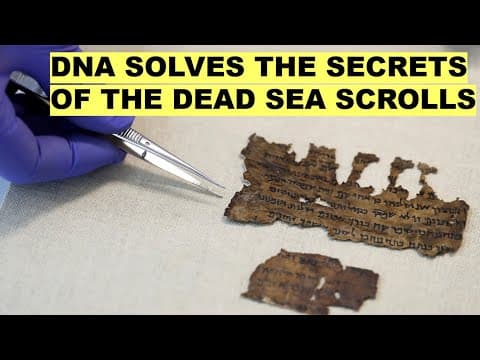
Recent DNA analysis of the Dead Sea Scrolls has revealed their origins, suggesting they were created by various groups rather than a single sect. This research challenges previous assumptions about the scrolls' isolation and highlights the diverse cultural landscape of ancient Judea.
In the arid sun-scorched cliffs overlooking the Dead Sea, a secret lay hidden for two millennia. In 1947, a young Bedouin shepherd searching for a lost goat stumbled upon a cave that would lead to one of the greatest archaeological discoveries of the 20th century: the Dead Sea Scrolls. This library of ancient manuscripts includes the oldest surviving copies of the Hebrew Bible and a trove of previously unknown religious, legal, and philosophical texts. Written between the 3rd century BC and the 1st century AD, these scrolls provide a window into a pivotal moment in human history, marking the evolution of modern Judaism and the birth of Christianity.
Despite their significance, the Dead Sea Scrolls present a colossal puzzle. Over the centuries, they disintegrated into more than 25,000 fragments, some no larger than a postage stamp. Scholars have long debated their origins: Were they written by a small group at Qumran, or were they the works of various groups in ancient Judea? Recent advancements in DNA analysis are beginning to shed light on these questions, revealing insights into where the scrolls came from, who created them, and what they tell us about the world of 2,000 years ago.
The Dead Sea Scrolls were discovered between 1947 and the 1960s in 11 caves near Qumran and other desert sites like Masada. Most of the scrolls are written in Hebrew, with some in Aramaic and Greek, from a time when Greek culture significantly influenced Jewish life. This period saw the emergence of various Jewish sects, including the Essenes, Pharisees, and Sadducees. Sorting through the tiny fragments is akin to solving a puzzle with missing pieces, as scholars utilize handwriting styles and text content to connect them. However, questions about their origins and authorship remained until now.
To understand the recent breakthroughs in scroll analysis, it is essential to know what the scrolls are made of. The majority were written on parchment, a durable material made from processed animal skin. For molecular biologists, this was the key to unlocking the scrolls' secrets. Each fragment of skin contains DNA from the animal it came from, providing clues about its origins. However, extracting DNA from 2,000-year-old scrolls is challenging due to the fragility of ancient DNA, which has been broken into small pieces over time and mixed with modern human DNA.
A team of researchers studied 39 items, including 26 scroll fragments, sandals, water skins, and a garment from desert sites. To avoid damaging these treasures, conservators collected tiny bits of material, sometimes just dust, from blank areas of the scrolls. They worked in a super clean lab in Sweden, employing a method called silica-based extraction to isolate DNA. The first step was identifying the animal species used for the scrolls.
The team compared the scroll DNA to animals common in the ancient Near East, such as sheep, cows, and goats. Of the 26 scroll fragments analyzed, 24 were identified as sheepkin, while two fragments from the book of Jeremiah were made from cowhide. This finding was significant; the arid landscape around Qumran is suitable for raising sheep and goats but not cows, which require more water and pasture land. The absence of archaeological evidence for cow farming at Qumran led to the conclusion that these scrolls were likely made elsewhere, probably in the Jordan Valley, known for its fertile land.
This discovery challenges the long-held belief that the Qumran community was an isolated sect responsible for all the scrolls' texts. Instead, it suggests that Qumran functioned as a vibrant intellectual center, a library where scrolls from diverse origins and different textual traditions were collected and studied.
With the animal species identified, researchers turned to sorting the fragments. They leveraged the insight that fragments from the same animal are likely from the same scroll, as ancient scribes typically used one animal's skin per manuscript. The analysis focused on both mitochondrial DNA, inherited from the mother, and nuclear DNA, inherited from both parents.
One significant text analyzed was the "Songs of the Sabbath Sacrifice," a mystical composition found in the Qumran caves. Another copy of this text was discovered over 50 km south at the mountain fortress of Masada. This raised questions about its origins: Did it originate with the Qumran sect, or was it popular among different Jewish groups?
The researchers found that the copies of the "Songs of the Sabbath Sacrifice" from the Qumran caves were all made from genetically related sheep, belonging to Haplogroup B. In contrast, the Masada fragment belonged to a distinct line of sheep from Haplogroup A, indicating that the community at Masada did not receive a scroll from Qumran but created their own copy. This suggests that the text was not exclusive to one sect but circulated among various communities in Judea.
Another challenge in studying the scrolls is the provenance of many fragments. Some were not excavated by archaeologists but were bought from antiquities dealers, leading to uncertainty about their true origins. For instance, fragment 4Q344, a legal document acknowledging a financial debt, was suspected to be an outlier. Genetic analysis confirmed that its sheepkin DNA did not cluster with the main Qumran scrolls, indicating it likely originated from another site in the Judean desert.
Similarly, a fragment from the book of Isaiah was also found to be a genetic outlier, suggesting it too came from an unidentified location. These findings highlight that some fragments were misattributed to Qumran due to their acquisition through antiquities dealers rather than controlled excavations.
The genetic detective work has profound implications for our understanding of the Dead Sea Scrolls. For the first time, theories about their origins and relationships have been supported by independent scientific research. The genetic data acts as a powerful arbiter in long-standing debates, revealing that the Dead Sea Scrolls are not merely the product of a single isolated group but rather the result of various groups that shared the diverse cultural and religious landscape of Judea during the Hellenistic-Roman period.
Some scrolls were likely written by local scribes at Qumran, adhering to their unique scribal traditions, while others were brought from distant places, carrying different versions of texts and ideas. This diversity mirrors the genetic diversity of the animals whose skins were used.
As research continues, new discoveries may emerge, revealing further connections between the scrolls, the people who wrote them, and the broader world of the ancient Near East. Each fragment still holds secrets waiting to be uncovered, and the story of the Dead Sea Scrolls is far from finished. The ongoing exploration of these ancient texts promises to deepen our understanding of a critical period in human history, shedding light on the complex tapestry of beliefs and practices that shaped the ancient world.



















