
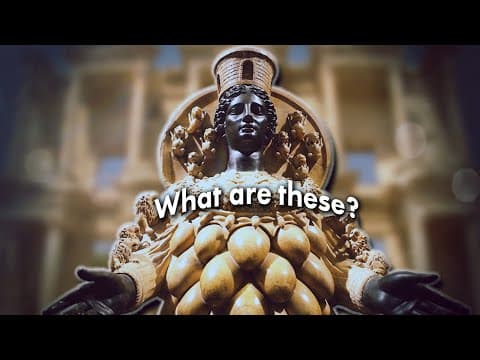
Artemis of Ephesus, often confused with the Greek goddess Artemis, represents a unique blend of local Anatolian traditions and Greek mythology. This blog explores her distinct characteristics, the significance of her temple in Ephesus, and the cultural impact of her worship over centuries.
Artemis, known as Diana in Roman mythology, is often depicted as an athletic huntress, ready to chase down her prey. The famous statue, the Diana of Versailles, captures this image perfectly, showcasing her in mid-stride, embodying the ideals of virginity and chastity. However, a different representation exists in the form of Artemis of Ephesus, a goddess worshiped in the ancient city of Ephesus, located in modern-day Turkey.
Unlike the athletic huntress of Greek mythology, the statue of Artemis of Ephesus presents a strikingly different figure. Standing upright with her legs tightly together, her arms are positioned in a formalized gesture, draped in an elaborate gown adorned with lions and bulls. Her towering headdress and rows of bulbous appendages around her torso raise questions about their meaning, often interpreted as breasts, though their true significance remains uncertain.
Ephesus was a prominent ancient Greek city on the Aegean Sea, with roots tracing back to the 10th century BCE. By 133 BCE, it became part of the Roman Republic and grew into one of the largest cities in the Roman Empire. The city was a commercial powerhouse, with trade routes converging in its bustling markets. The Roman geographer Strabo even declared Ephesus as the greatest trading city in Asia west of the Taurus Mountains.
Ephesus is perhaps most famous for the Temple of Artemis, one of the Seven Wonders of the Ancient World. Although little remains of the temple today, it was once a colossal structure measuring over 100 meters long and 20 meters tall, adorned with 127 pillars. The temple was central to the worship of Artemis and served as a hub for both religious and civic life in Ephesus.
The worship of Artemis in Ephesus likely began with the arrival of Greek settlers, although evidence of a sanctuary dedicated to her dates back to the 10th century. A proper temple was constructed in the 500s BCE under King Croesus, but it was destroyed by fire in 356 BCE. The Ephesians rebuilt it, and for nearly a millennium, it became a focal point of their religious life.
The Temple of Artemis was not just a place of worship; it was a symbol of Ephesus's identity. The goddess was depicted on coins, and her imagery was integrated into the city's political and social fabric. The temple complex included facilities for various civic activities, making it a central hub for the community.
Ritual processions honoring Artemis were integral to Ephesus's religious life. These events, often funded by wealthy citizens like the local official Caius Vibius Salutaris, involved elaborate parades through the city, reinforcing social cohesion and civic pride. The processions served not only to honor the goddess but also to display the wealth and influence of the city's leaders.
By the 1st and 2nd centuries CE, evidence suggests that the worship of Artemis in Ephesus involved elements of a mystery cult, characterized by initiation rituals and secret teachings. This aspect of her worship mirrored other mystery religions of the time, such as those dedicated to Isis and Mithras.
In Greek mythology, Artemis is the twin sister of Apollo and the daughter of Zeus and Leto. However, the Ephesians had their own version of her origin story, claiming she was born in a sacred grove near Ephesus. This local narrative highlights the goddess's significance to the city and its people.
The centrality of Artemis in Ephesus began to wane with the rise of Christianity. The New Testament recounts a conflict between the Apostle Paul and local artisans who feared that his teachings threatened their livelihoods tied to the worship of Artemis. The temple eventually fell into disrepair, suffering destruction from an earthquake and Gothic invasions in the 3rd century CE.
Despite the decline of her worship, the legacy of Artemis of Ephesus endures. Her story reflects the complex interplay of local traditions and Greek mythology, illustrating how religious practices evolved over time. The worship of Artemis lasted for centuries, shaping the identity of one of the most famous cities in the Roman Empire. As Dr. Guy Rogers aptly notes, the story of Artemis of Ephesus is one of remarkable success, demonstrating the enduring power of religious belief in shaping cultural identity.



















