
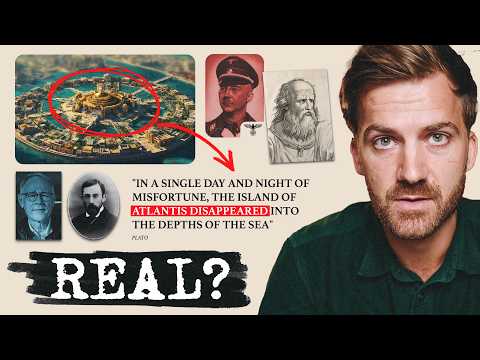
This blog post explores the intriguing history of Atlantis through the lens of ancient maps, tracing its origins from Plato's writings to 19th-century interpretations that blend science and mysticism, ultimately revealing the cultural and historical implications of the Atlantis legend.
The legend of Atlantis has captivated imaginations for centuries, and a recent discovery of a map claiming to pinpoint its location has reignited interest in this mythical civilization. This map, created in the late 1800s, not only asserts the existence of Atlantis but also aligns with the geographical features of the modern world. In this post, we will delve into the history of Atlantis, the maps that depict it, and the cultural significance of this enduring legend.
The story of Atlantis begins with the philosopher Plato, who lived in Athens around 2,400 years ago. In his writings, he described Atlantis as a utopian society located "past the pillars of Hercules," which is believed to refer to the Strait of Gibraltar. According to Plato, Atlantis was a marvel of engineering, featuring a series of concentric circles, canals, and walls made from exotic metals. It was a powerful civilization with a formidable navy and advanced technology.
However, most historians agree that Plato's account was not meant to be taken literally. Instead, it served as a parable about human hubris and the potential downfall of societies. Despite this, the idea of Atlantis persisted, especially during the Age of Exploration in the 1500s, when European explorers sought to uncover lost civilizations.
The 18th and 19th centuries marked a significant shift in how people approached the idea of Atlantis. The scientific revolution led to a greater understanding of the natural world, and explorers began to uncover ancient cities previously thought to be mere myths. This newfound scientific curiosity prompted many to wonder if Atlantis could also be real.
During this period, the concept of Atlantis was reexamined through a scientific lens. The understanding of plate tectonics and the discovery of similar structures across different cultures, such as the pyramids of Egypt and the Mayans, fueled speculation that a single advanced civilization might have existed in the past.
The maps that have drawn attention in recent years were created by William Scott-Elliot, a Scottish banker turned amateur cartographer and anthropologist. These maps, produced in the late 19th and early 20th centuries, claim to illustrate the location of Atlantis and its evolution over time. Scott-Elliot's work was influenced by both scientific theories and spiritual beliefs, reflecting the complex interplay of science and mysticism of that era.
Scott-Elliot's first map depicts what he believed Atlantis looked like at its height, overlaying modern geography with a representation of the ancient civilization. The map shows a circular city with sophisticated canals and a central palace, echoing Plato's descriptions but embellished with fantastical elements. Scott-Elliot's vision included advanced technology and a unique Atlantean race with extraordinary abilities.
Scott-Elliot produced several maps to illustrate the gradual sinking of Atlantis due to global catastrophes, including an ice age that reshaped the planet. He posited that the civilization eventually disappeared around 9,564 BC, coinciding with the biblical flood narrative. This narrative suggested that survivors of Atlantis spread their knowledge across the globe, explaining the similarities in ancient structures.
The allure of Atlantis extends beyond mere curiosity; it has been used to justify various ideologies throughout history. Scott-Elliot's theories, while pseudoscientific, contributed to a narrative that suggested a superior Aryan race descended from Atlanteans. This idea was later co-opted by figures like Heinrich Himmler, who sought to validate racist ideologies through a distorted interpretation of history.
Despite the lack of empirical evidence supporting the existence of Atlantis, the legend continues to thrive. The maps created by Scott-Elliot and others serve as a reminder of humanity's desire to find meaning in the unknown. They illustrate how scientific language can be misused to promote fantastical ideas, blurring the lines between fact and fiction.
The story of Atlantis is a cautionary tale about the power of narrative and the human inclination to seek out lost wonders. While the maps may be beautiful artifacts of a bygone era, they also represent the dangers of pseudoscience and the allure of myths. As we continue to explore our past, it is essential to approach such stories with a critical eye, recognizing the difference between empirical evidence and captivating tales.
In the end, the legend of Atlantis remains a fascinating chapter in the history of human thought, reflecting our enduring quest for knowledge and understanding of the world around us.



















