
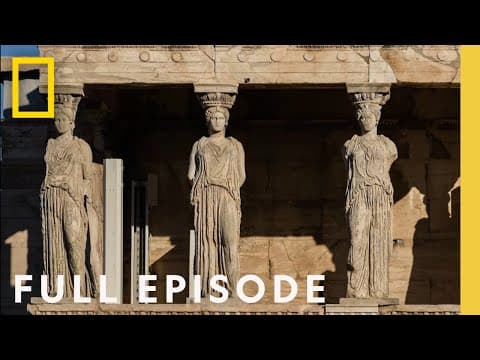
The Mediterranean Sea, a cradle of ancient civilizations, hides secrets of catastrophic events, trade, and warfare. Through advanced underwater scanning technology, we explore the Minoan civilization's collapse due to volcanic eruptions, the thriving trade of Ancient Greece, and the epic naval battles that shaped Rome's dominance.
Beneath the clear blue waters of the Mediterranean lie treasures of ancient empires, relics of their bloody wars, and secrets of the seismic forces that shaped them. Imagine if we could empty the oceans, revealing the secrets of the seafloor. With the latest underwater scanning technology, we can now explore these hidden worlds.
3,600 years ago, long before the Roman Empire, a mysterious civilization known as the Minoans dominated the Mediterranean. Their home was Crete, where they built magnificent temples and palaces adorned with stunning frescoes, celebrating their love of life and nature. However, much about the Minoan world remains a mystery, particularly their language, which we cannot decipher.
Historians know that the Minoans spread across the Mediterranean, trading olive oil and pottery for gold and ivory, growing ever richer and more powerful. Yet, by the 15th century BC, their civilization began to fade from history.
Scientists began to investigate the nearby island of Santorini, famous for its jagged cliffs and beautiful harbor. Marine geologist Evi Nomikou utilized multi-beam sonar technology to scan the depths of the bay, revealing Santorini's terrifying secret: a massive volcanic crater. The eruption around 1625 BC buried the thriving city of Akrotiri under ash, preserving it for 3,500 years.
Archaeologists discovered that the city was not destroyed solely by volcanic activity but also by a significant earthquake that preceded the eruption. As the Minoans faced this catastrophic event, they were struck by tsunamis triggered by the eruption, leading to the collapse of their civilization.
As the Mediterranean waters recede, archaeologists uncover a remarkable shipwreck off the coast of Cyprus, dating back almost 2,500 years. This discovery sheds light on the lives, power, and pleasures of the Ancient Greeks, who were known for their art, architecture, and maritime prowess.
The shipwreck, filled with amphorae—large earthenware jars—provides vital clues about ancient trade. These jars, once used to transport Chian wine, reveal the significance of wine in Greek culture and trade. The wreck illustrates the extensive trade networks that connected the Mediterranean, influencing Western civilization.
In the third century BC, Rome sought to expand its influence across the Mediterranean, leading to conflict with the powerful Carthaginian navy. The Battle of the Egadi Islands, described by the ancient historian Polybius, marked a turning point in this struggle.
Marine archaeologists, led by Bill Murray, discovered bronze battering rams on the seabed, confirming the site of this epic naval battle. The rams, used to attack enemy ships, provide evidence of the fierce confrontations that defined Roman naval warfare.
The Romans achieved a decisive victory, capturing thousands of Carthaginian soldiers and solidifying their dominance in the Mediterranean. This battle set Rome on a path to becoming a superpower, shaping the destiny of Europe for centuries to come.
As the Mediterranean continues to drain, the sunken city of Baiae, known for its decadence and excess, emerges. This Roman resort town was famous for its luxurious villas and extravagant parties, attracting the elite of Roman society.
Marine archaeologist Jon Henderson explores the ruins, revealing stunning mosaics and elaborate dining rooms. However, much of Baiae lies beneath the waves due to the volcanic activity in the region, which caused significant portions of the city to subside.
Baiae sits within a volcanic crater, and the underwater vents indicate the restless power of the volcano beneath. The area, known as Campi Flegri, is home to multiple volcanoes, and scientists warn that the pressures in the magma chambers are increasing, posing a potential threat to the millions living nearby.
The Mediterranean Sea, through advanced scanning technology, reveals its hidden treasures and catastrophic events that shaped ancient civilizations. From the collapse of the Minoans due to volcanic eruptions to the rise of Rome through naval battles, the secrets of the Mediterranean continue to captivate and educate us about our shared history. As we uncover these lost worlds, we gain invaluable insights into the forces that have shaped human civilization for millennia.



















