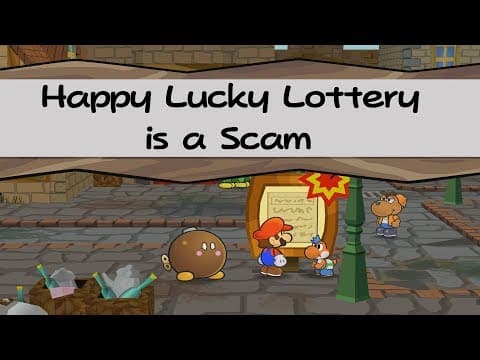
The Happy Lucky Lottery in Paper Mario: The Thousand-Year Door is not a game of chance but a predetermined system that guarantees when players will win, making it a deceptive mechanic that undermines the concept of luck in gaming.
In the world of video games, mini-games often serve as a fun diversion from the main storyline. One such mini-game is the Happy Lucky Lottery found in Paper Mario: The Thousand-Year Door. At first glance, it appears to be a simple lottery system where players can win prizes by purchasing tickets. However, a closer examination reveals that this lottery is anything but random. This article delves into the mechanics of the Happy Lucky Lottery, exposing its deceptive nature and the odds of winning.
The Happy Lucky Lottery requires players to spend 10 coins on a ticket each day. Players can check the lottery board to see if their ticket has won a prize. While it seems like a fun way to earn rewards, the reality is that most players will not win anything. For participating, players receive a daily mushroom, which adds a small incentive to keep trying.
The lottery's prize structure is based on matching numbers from right to left. The prizes are categorized as follows:
The prizes include various items, such as a live stream for fourth prize and an ultra shroom for third prize. However, if players win second or first prize again, they receive a low-value item instead of a significant reward. This raises questions about the overall value of participating in the lottery.
The odds of winning the grand prize are approximately 1 in 10,000. However, this figure is misleading. The lottery is designed in such a way that players are unlikely to win even once. For instance, if a player’s ticket is just one digit off from the winning number, they will not win any prize at all. The odds of being one digit off are about 1 in 9,000, which further illustrates the unlikelihood of winning.
Upon further investigation, it becomes clear that the Happy Lucky Lottery does not operate on luck. Instead, it is programmed to determine the day a player will win as soon as they purchase a ticket. Each prize has a corresponding memory address that indicates how many days until the player's number matches the winning number. The ranges for winning prizes are as follows:
This predetermined system means that players are guaranteed to win fourth prize starting from day 4 and ending on day 10, but they will not win any prizes during the first three days after purchasing a ticket.
If players decide to buy a new ticket for 100 coins, all progress towards winning the grand prize is reset. This means that players must wait another 335 days for a chance at the jackpot, effectively nullifying any previous attempts. The game’s design raises questions about the purpose of offering new tickets if they reset the day counter.
For those determined to win, there are ways to cheat the Happy Lucky Lottery. One method involves hacking the game to determine which day a player will win. Alternatively, players can manipulate the Nintendo GameCube system clock to skip ahead in time. By adjusting the clock, players can guarantee themselves all four prizes within 395 resets. However, if players set the clock back, they face a penalty of 500 coins.
The game tracks time using memory addresses that save the last time the lottery sign was read and the last ticket received. If the system clock is adjusted backwards, the game recognizes this and penalizes the player. This system is designed to hold players accountable for cheating, as it can differentiate between natural time progression and manual adjustments.
The Happy Lucky Lottery in Paper Mario: The Thousand-Year Door is a fascinating example of how game mechanics can create an illusion of chance while actually being predetermined. The odds of winning are heavily stacked against players, and the system is designed to ensure that winning is a rare occurrence. As players navigate this deceptive lottery, it becomes clear that the true nature of the Happy Lucky Lottery is far from lucky. Whether through hacking or clock manipulation, players may find ways to cheat the system, but the underlying mechanics reveal a game that does not play by the rules of chance.