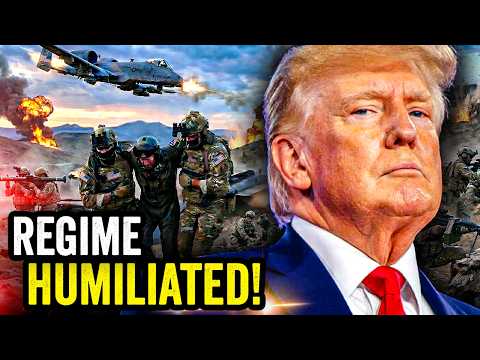
On Good Friday, an American F-15 was shot down over Iran, leading to a high-stakes rescue mission by U.S. special forces deep inside hostile territory. Despite overwhelming enemy forces and harsh terrain, the elite team successfully rescued the injured officer after 36 hours of evasion and intense combat, showcasing America's strategic dominance and refusal to leave any soldier behind.
In what has been described as an "Easter miracle," U.S. special forces carried out one of the most audacious rescue missions in modern warfare history. This operation took place deep inside Iranian territory, behind enemy lines, with thousands of Iranian Revolutionary Guard Corps (IRGC) troops closing in. The mission was a high-stakes effort to rescue two American airmen after their F-15 jet was shot down on Good Friday.
At 9:42 a.m. Eastern time on Good Friday, an F-15E Strike Eagle from the 48th Fighter Wing, based out of Lakenheath in the UK, was on a mission over southwestern Iran. Suddenly, the jet was hit by Iranian anti-aircraft fire, causing it to lose control. The pilot and the Weapon Systems Officer (WSO), a highly respected Air Force colonel, ejected from the burning aircraft and parachuted into hostile Iranian territory.
This scenario represented a military nightmare: two live American officers behind enemy lines in a nation at war with the U.S. Iran immediately broadcasted a bounty of $60,000 for whoever captured the Americans alive, prompting thousands of IRGC soldiers, militia, and tribal hunters to flood the mountainous region known as the Black Mountain area.
The pilot was found and rescued within hours. However, the colonel's parachute had drifted further into the rugged Zagros Mountains, and he was injured and alone in one of the most unforgiving terrains on Earth. Despite his injuries, the colonel employed the military survival technique known as SEIR: Survive, Evade, Resist, Escape.
He moved away from the crash site, climbing steep ridges to break line of sight from enemy search parties. After hours of movement, he found a narrow crevice nearly 7,000 feet above sea level where he took shelter armed only with a pistol and an emergency beacon. With minimal supplies and enemy forces closing in, he sent encrypted data bursts via satellite to keep U.S. command updated on his position without revealing it to the enemy.
President Trump personally oversaw the rescue operation from the White House situation room, emphasizing that no American would be left behind. Meanwhile, the CIA launched a deception campaign inside Iran, spreading false information that both crew members had already been rescued. This misinformation slowed the IRGC's search efforts and bought critical time for the colonel.
On Easter Eve, after confirming the colonel's exact location, the U.S. assembled an elite rescue team including Air Force Pararescue (PJs), Navy SEALs from SEAL Team Six, Delta Force operators, and support from the 160th Special Operations Aviation Regiment (Night Stalkers). They utilized MH-6 Little Birds for insertion, HH-60W Jolly Green helicopters for extraction, A-10 Thunderbolt IIs for close air support, and MQ-9 Reaper drones for overwatch.
The rescue team linked up with the colonel in his mountain crevice, stabilized his injuries, and began moving him out. However, the IRGC closed in, triggering a massive firefight described as one of the most intense close-quarters engagements in American rescue operation history. The U.S. forces unleashed suppressive fire, with aircraft providing devastating support, turning the mountain into a battlefield.
Despite the fierce combat, the U.S. forces held their ground, successfully extracted everyone with zero American casualties, and completed the mission. Shortly after midnight on Easter morning, President Trump posted the message: "We got him."
This rescue mission exemplified the core strategic logic of Operation Epic Fury, a broader U.S. campaign against Iran. Rather than engaging in symmetrical warfare, the U.S. imposed overwhelming asymmetry, fighting a different kind of war that Iran could not anticipate or counter effectively.
Examples of this strategy include:
The rescue operation mirrored this approach by countering Iran's manhunt with superior tactics, technology, and overwhelming force.
The successful rescue of the downed F-15 crew member was a testament to the skill, training, and determination of U.S. special forces and the strategic vision of the American leadership. It demonstrated total situational dominance, a refusal to accept defeat, and the commitment to never leave a soldier behind.
The colonel's final radio transmission, "God is good," echoed the sentiment of the entire mission. Secretary of Defense Pete Heggs echoed the phrase on social media, and military experts hailed the operation as superbly choreographed and executed beyond elite standards.
This mission will be remembered as a defining moment in modern warfare and a clear message of American resolve and capability.
Note: The transcript included an unrelated segment about Alzheimer's disease and kimchi, which has been excluded from this military-focused article to maintain coherence and relevance.