The recent US invasion of Venezuela led to the capture and removal of President Nicolas Maduro and his wife, sparking celebrations among Venezuelan expatriates in Spain. Maduro's controversial reign, marked by economic decline and suppression of opposition, caused many to flee Venezuela. However, international reactions vary, with some protests in the US opposing the intervention, highlighting a global divide on the issue.
The recent US invasion of Venezuela has resulted in significant developments, including attacks on multiple locations such as the capital city, Caracas, and most notably, the forcible removal and capture of President Nicolas Maduro and his wife by American forces. This event has triggered a wide range of reactions worldwide, with celebrations erupting among Venezuelan communities abroad, particularly in Spain.
Nicolas Maduro's tenure as president has been marked by controversy and hardship for Venezuela. Once an oil-rich nation, Venezuela has suffered severe economic decline under his leadership, leading to widespread poverty and instability. Maduro's administration has been characterized by the use of military force to suppress opposition, which has contributed to a mass exodus of Venezuelans seeking refuge in other countries.
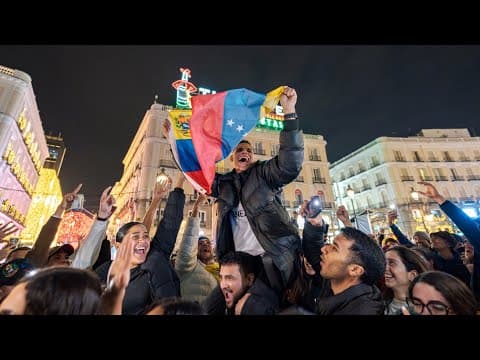
Spain has become a significant destination for many Venezuelans fleeing the turmoil at home. The Venezuelan diaspora in Spain has been closely following the developments in their homeland, and the news of Maduro's capture has sparked visible celebrations.
In Madrid, Venezuelans gathered to celebrate the capture of Maduro. The festivities included lively activities such as performing the limbo dance beneath a Venezuelan flag, symbolizing hope and relief among the expatriate community. These celebrations stand in stark contrast to the somber and tense atmosphere that has gripped Venezuela for years under Maduro's rule.
While Venezuelans in Spain celebrated, the reaction in the United States was more divided. Outside the White House in Washington, DC, a small group of protesters gathered, holding signs and using megaphones to voice their opposition to the US intervention. One prominent sign read "Hands off Venezuela," reflecting concerns about foreign interference and the sovereignty of Venezuela.
This division highlights the complex international response to the US's actions. President Donald Trump has stated his intention to oversee Venezuela until a "safe, proper and judicious transition" of power can be achieved. He emphasized the need to avoid repeating the prolonged instability that has plagued Venezuela in recent years.
President Trump articulated his position clearly, stating:
"We're going to run the country until such time as we can do a safe, proper and judicious transition. So we don't want to be involved with having somebody else get in and we have the same situation that we had for the last long period of years, and it has to be judicious, because that's what we're all about."
This statement underscores the US administration's approach to managing the situation in Venezuela, aiming for a transition that restores stability and governance.
The capture of Nicolas Maduro marks a pivotal moment in Venezuela's ongoing crisis. For many Venezuelans abroad, especially in Spain, it represents hope for change and an end to years of hardship. However, the international community remains divided on the legitimacy and consequences of the US intervention. As the situation unfolds, the world watches closely to see how Venezuela's future will be shaped in the aftermath of these dramatic events.