
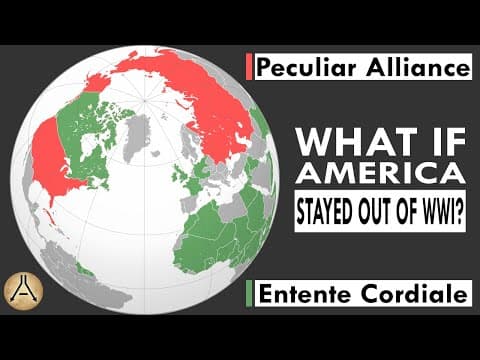
This blog post explores the hypothetical scenario of America remaining neutral during World War I, examining the potential outcomes of a Central Powers victory, the implications for global politics, and the societal changes that might have occurred in the United States and beyond.
The question of whether America should have entered World War I has been debated extensively, with many historians concluding that neutrality would have been a better choice. This perspective suggests that a Central Powers victory could have prevented the rise of the Nazis, World War II, and the Holocaust. But is this conclusion valid? What would have happened if America had indeed stayed out of the Great War?
When World War I erupted in 1914, America initially sought to remain neutral. However, American culture was heavily influenced by the Allies, particularly Britain, and there was a prevailing view of Germany as an autocratic and militaristic state. Atrocities committed by German soldiers in Belgium further fueled anti-German sentiment. Despite this, President Woodrow Wilson campaigned for re-election on a platform of neutrality.
Despite the desire for neutrality, American businesses profited from trading with Britain and France. The demand for American goods and loans contributed to the war effort, even as the U.S. government maintained a stance of non-involvement.
American neutrality was challenged by several factors, including the British blockade of Germany and Germany's unrestricted submarine warfare, which resulted in American casualties, notably the sinking of the RMS Lusitania in 1915. After a brief halt in submarine attacks, Germany resumed its campaign in 1917, leading to President Wilson's request for a declaration of war against Germany.
Once America entered the war, American soldiers, known as Doughboys, played a crucial role in breaking the stalemate on the Western Front. However, their involvement was limited to about six months of direct combat. The presence of American troops was significant, but many historians argue that the Allies could have eventually prevailed without them.
During this period, a diverse anti-war movement emerged in America, comprising various political factions, including Democrats, Republicans, socialists, and immigrant communities. If America had remained neutral, this movement might have gained traction, potentially preventing U.S. involvement in the war altogether.
If America had stayed out of the war, many historians, including Ross Kennedy and John Jay Tierney Jr., suggest that the Central Powers would have likely emerged victorious. The Allies were already struggling with financial and military challenges, and without American support, they might have faced defeat or been forced into a negotiated settlement.
In this alternate timeline, the Treaty of Versailles would likely have been harsher without American influence. The absence of U.S. participation could have led to a punitive peace that might have incited further conflict, potentially resulting in a German nationalist uprising similar to the Turkish War of Independence.
A neutral America could have fostered a stronger Socialist Party, as anti-war sentiments would not have been suppressed. This might have allowed socialists to maintain their influence and potentially rival the two major political parties.
American literature and art would also be significantly different. Works like "The Great Gatsby" might not exist without the experiences of authors during the war. Additionally, symbols of American identity, such as Uncle Sam, might not have gained the same prominence.
The war effort led to a significant increase in women's participation in the workforce. Without the war, the progress of the women's rights movement could have been delayed, affecting future generations.
The experiences of African American soldiers during the war contributed to the Civil Rights Movement. A neutral America might have altered the trajectory of racial relations, potentially reducing the discrimination faced by German Americans and other immigrant communities.
The geopolitical landscape would also shift dramatically. A neutral America might lead to strained relations with the UK and France, as they would still seek repayment for loans made during the war. This could foster resentment and alter alliances in the years following the conflict.
The question of whether America should have stayed out of World War I is complex. While some argue that neutrality could have prevented the rise of totalitarian regimes, the reality is that the dynamics of war and peace are unpredictable. The potential for a Central Powers victory raises questions about the future of Europe and the world, illustrating the intricate web of historical causation. Ultimately, this exploration of alternate history serves to deepen our understanding of the profound impacts of war on society and politics.



















