
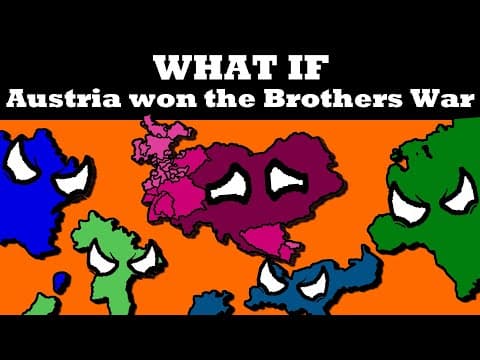
This blog post explores an alternate history scenario where Austria wins the Austro-Prussian War. It examines the military, diplomatic, and territorial implications of such a victory, including Austria's regained influence over Germany, the reshaping of alliances in Europe, and the potential for future conflicts. The analysis highlights the complexities of European politics and the long-term consequences of Austria's dominance.
The early 19th century was marked by fierce competition between Prussia and Austria for dominance over the German states. For much of this period, Austria held the upper hand, dominating the German Confederation and maintaining significant influence over the smaller German states. However, Prussia's ambitions and strategic maneuvers began to challenge this status quo, leading to a series of conflicts that would ultimately reshape the political landscape of Europe.
Austria's dominance was challenged by Prussia's establishment of the Zollverein, an economic union among German states that notably excluded Austria. This exclusion was a significant blow to Austrian influence, allowing Prussia to economically sway other German states. The revolutions of 1848 further destabilized Austria, leading to a temporary dismantling of the German Confederation and a wave of uprisings across Europe.
Despite these challenges, Austria managed to regain control with the help of Russia, which intervened to restore order in Hungary. Prussia, meanwhile, sought to capitalize on Austria's difficulties by attempting to establish a new German Confederation without Austrian involvement. However, this effort was thwarted, and the German Confederation was restored.
The conflict escalated when Austria and Prussia united against Denmark, but tensions soon flared between the two German powers. Prussia, with its superior military organization and technology, quickly defeated Austria in the Austro-Prussian War, leading to the establishment of the North German Confederation and solidifying Prussian dominance over Germany.
But what if Austria had managed to secure a victory in this conflict? While the military capabilities of the Prussian army were significantly advanced, a hypothetical scenario could involve Austria leveraging diplomatic strategies to alter the course of the war.
One key factor in this alternate scenario would be Austria's ability to neutralize Italy's involvement in the conflict. Historically, Italy was a significant adversary for Austria, but if Austria had successfully negotiated Italian neutrality through diplomatic pressure from France, the dynamics of the war could have shifted dramatically.
Assuming Austria could hold off the Prussian advance while maintaining a defensive posture, the entry of France into the conflict could have turned the tide. With French forces invading the Prussian Rhineland, Austria could have mounted a counteroffensive, forcing Prussia to defend on multiple fronts.
If Austria had emerged victorious, the implications for Europe would have been profound. Austria would likely regain control of Silesia, a territory rich in industrial resources that had been lost to Prussia. The German Confederation could be restored with Austria at its helm, potentially with the Austrian Emperor as the hereditary head of the Confederation, thereby strengthening Austrian influence over the German states.
In this new order, Austria would lead a united economic block in Germany, enhancing its power and influence. The restoration of the German Confederation would not only solidify Austria's dominance but also create a buffer against future conflicts with Prussia. Additionally, Austria might have expanded its influence in the Balkans and beyond, potentially acquiring territories that would have otherwise gone to Prussia.
The victory would not only reshape Austria's territorial holdings but also alter the diplomatic landscape of Europe. Austria's relationship with France could become more complex, as both nations would have competing interests in Germany. Meanwhile, Prussia, though defeated, would remain a significant power, likely fostering resentment and a desire for revenge.
Russia's position would also be affected. Historically, Russia had been a key ally of Austria, but in this alternate timeline, the dynamics could shift as Prussia seeks to align with Russia to counterbalance Austrian dominance. This could lead to a new era of competition between Austria and Russia, particularly in the Balkans, where both empires had vested interests.
The post-war world would be fraught with tension. Austria, while strengthened, would face challenges from Italy, which might feel isolated and resentful of Austrian influence. Prussia, now an aggrieved power, could seek alliances with Russia and Italy to challenge Austrian hegemony.
The peace established after an Austrian victory would likely be tenuous. Austria's policies of Germanization and repression of ethnic minorities within its empire could lead to unrest, particularly in Hungary and other regions with significant nationalist sentiments. Any major conflict could reignite these tensions, leading to uprisings and further instability.
In this alternate timeline, Austria might also pursue colonial ambitions more aggressively. With a stronger economic base from Silesia and a more unified German Confederation, Austria could seek to expand its influence in Africa and Asia, potentially acquiring territories that would have gone to Prussia in our timeline.
Austria's colonial pursuits could lead to competition with Italy and other European powers. While Austria might not have been as aggressive as Germany in its colonial ambitions, it could still secure significant territories, such as parts of East Africa or even influence in the Pacific.
The hypothetical scenario of an Austrian victory in the Austro-Prussian War presents a fascinating exploration of alternate history. The implications of such a victory would extend far beyond the battlefield, reshaping alliances, territorial boundaries, and the balance of power in Europe. While Austria might emerge as a dominant force in this alternate timeline, the underlying tensions and rivalries would likely set the stage for future conflicts, illustrating the complexities of European politics in the 19th century. The question remains: how would this altered landscape influence the course of history in the years to come?



















