
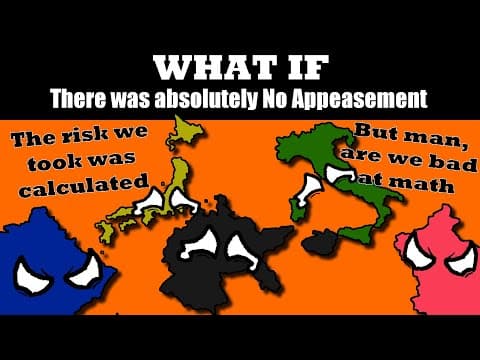
This blog explores an alternate history where the Axis powers face consistent setbacks during their rise to power. By examining key events from the remilitarization of Germany to Japan's failures in China, we analyze how different decisions could have led to disastrous outcomes for the Axis, ultimately reshaping the course of World War II.
In our timeline, the Axis powers experienced a series of fortunate events that allowed them to expand their influence and territory with minimal resistance. However, what if every move they made backfired? This blog post explores a counterfactual scenario where the Axis powers face consistent setbacks, leading to a dramatically different outcome in World War II.
In the early years, the Axis powers, particularly Germany, enjoyed significant luck. The Allies failed to intervene effectively at critical moments, allowing Germany to remilitarize and expand its territory without facing immediate consequences. For instance, when Germany sent forces into the Rhineland, the Allies turned a blind eye, which emboldened further aggression.
In this alternate timeline, Poland takes a bold step by invading Germany in 1934, contrary to the historical inaction of France and Britain. Poland's larger army overwhelms Germany's weakened forces, prompting a six-nation conference that includes the Soviet Union. This conference results in a new militarization pact that restricts Germany's military growth, significantly undermining its ambitions.
As Germany seeks to unify with Austria, tensions escalate. The new Austrian government, alarmed by German aggression, seeks protection from Italy and France, leading to the formation of an anti-German alliance. In 1935, when Germany attempts to annex the Saarland, France intervenes militarily, postponing the referendum and maintaining the territory's independence.
Meanwhile, Italy, feeling the pressure from the West, faces its own challenges. The League of Nations imposes economic sanctions following Italy's invasion of Ethiopia in 1935, which further weakens its economy. Unlike in our timeline, these sanctions are enforced, leading to a more prolonged and costly conflict for Italy.
As the Spanish Civil War unfolds, France and Britain recognize the Republican government, providing support that strengthens the anti-fascist side. The Republicans manage to keep the Communists out of power, leading to a more unified front against Franco's Nationalists. This prolonged conflict drains resources from both Italy and Germany, who are unable to provide adequate support to their allies.
In Asia, Japan's ambitions are thwarted as it engages in a disastrous war against the Soviet Union. Instead of focusing on China, Japan's military efforts are redirected towards the Soviets, leading to a protracted conflict that drains its resources. The Soviets, bolstered by their industrial capacity, eventually push Japan out of China, leading to significant territorial losses for Japan.
As the Axis powers face setbacks, their internal stability begins to crumble. Germany, having failed to expand its territory and facing economic strain, sees dissent within its ranks. Italy, burdened by its military failures and economic sanctions, contemplates a shift in governance.
By the late 1930s, the Axis powers are in disarray. Germany's military ambitions are curtailed, and its economy is on the brink of collapse. Italy, having lost its colonial ambitions, faces internal strife. Meanwhile, Japan's dreams of empire are shattered, leaving it vulnerable to internal and external pressures.
In this alternate history, the Axis powers' consistent failures lead to a dramatically different geopolitical landscape. The Allies, rather than facing a formidable Axis, find themselves in a position of strength, able to shape the future of Europe and Asia. This scenario highlights the fragility of power and the impact of strategic decisions in shaping historical outcomes.
As we reflect on this counterfactual analysis, it becomes clear that the course of history is often determined by a series of choices, some fortunate and others disastrous. The Axis powers, in this scenario, face the consequences of their overreach and miscalculations, leading to a world that diverges significantly from our own.



















