
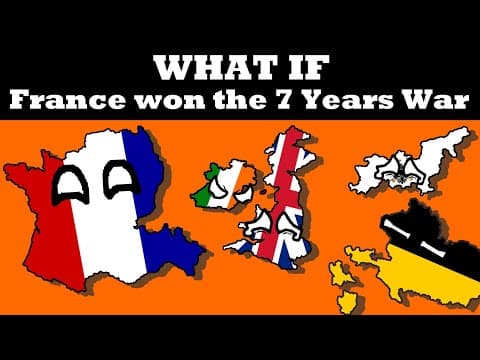
This blog post explores two alternate scenarios of the Seven Years War where France achieves either a moderate victory or a complete triumph. It discusses the implications of these outcomes on European power dynamics, colonial territories, and the potential for future conflicts, including the impact on the American colonies and the rise of revolutionary movements in France.
The Seven Years War, often considered the first global conflict, had profound implications for the balance of power in Europe and the colonial world. In this exploration, we delve into two alternate scenarios where France emerges victorious, either moderately or decisively, and examine the resulting shifts in history.
Initially, France recognized the British naval supremacy, which gave Britain a significant advantage in colonial engagements. To counter this, France aimed to form a coalition with Austria and Russia to achieve total European dominance. The strategy involved capturing British territories and defeating Prussia, while hoping that the colonies could withstand British pressure long enough to negotiate favorable terms.
At the outset, France's colonies held out against British forces for several years. However, the European front proved challenging. Despite some minor victories, the coalition struggled to pacify Hanover and Prussia. A significant French invasion of Hanover was repelled by British and Prussian forces, leading to increased pressure on France as the colonies began to falter.
As the war progressed, the British not only secured colonial victories but also gained naval supremacy, further complicating France's position. The situation worsened when Russia withdrew from the conflict following the death of Empress Elizabeth, leading to a resurgence of Prussian strength.
In this scenario, we envision a shorter war where France's initial plans succeed. The conflict begins with minor skirmishes in North America, similar to our timeline. However, Prussia preemptively invades Saxony, prompting a coalition against them. France successfully invades Hanover, putting Britain on the defensive.
The entry of Spain into the war, spurred by a change in leadership to Charles III, adds pressure on Britain. A successful Spanish invasion of Portugal further complicates British military efforts. While Britain achieves some victories, such as capturing Havana, the cumulative losses and the threat of a Franco-Spanish naval invasion lead to negotiations.
The resulting peace treaty sees Austria regain Silesia, while Prussia loses territory to Russia and Sweden. In North America, minor border adjustments occur, but the British Empire remains intact. In India, the British retain Bengal, but France maintains a strong position in the south, leading to a competitive colonial landscape.
This compromise peace allows France to secure its North American territories and maintain a foothold in India, setting the stage for future naval expansion.
In a more radical alternate history, we consider a scenario where France achieves complete dominance. This would require a significant naval victory, allowing a combined French-Spanish fleet to launch a successful invasion of Britain.
Assuming a large enough force lands on British soil, the French could potentially capture London. This would lead to a devastating blow to British power, with Ireland possibly breaking away and Scotland facing similar threats. In North America, France would resolve border disputes in its favor, seizing Canada and leaving Britain with only the 13 colonies.
With Britain crippled, France would invest heavily in its navy, outpacing British naval capabilities. The 1800s could become known as the French Century, with France dominating European politics and colonial affairs. The absence of a strong British presence would alter the course of revolutions, potentially preventing the American Revolution and reshaping global power dynamics.
Both scenarios present a drastically different world. In the moderate victory scenario, France retains its colonial holdings and avoids the crippling debt that led to the French Revolution. In the extreme victory scenario, France's dominance could lead to a significant shift in global power, with the potential for revolutionary movements emerging in Britain and beyond.
A crucial factor in these alternate histories is whether France embraces industrialization. If France modernizes its economy and military, it could maintain its status as a global power. Conversely, failure to adapt could lead to internal strife and vulnerability to British resurgence.
The outcomes of the Seven Years War had far-reaching consequences that shaped the modern world. By exploring these alternate scenarios, we gain insight into how different decisions and events could have led to a vastly different geopolitical landscape. The rivalry between France and Britain, along with the dynamics of colonialism and revolution, would have unfolded in unpredictable ways, forever altering the course of history.



















