
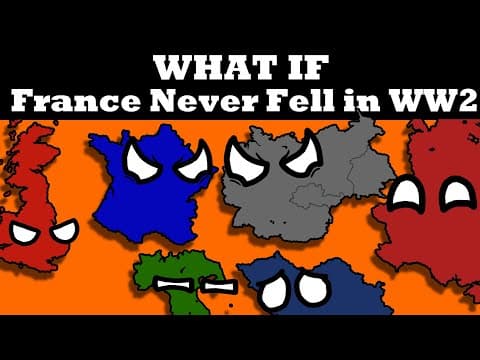
This article explores the hypothetical scenario where Germany fails to conquer France during World War II. It examines the Allied strategies, the implications of a prolonged conflict, and the potential shifts in global power dynamics, particularly regarding the Soviet Union and the United States.
World War II is often remembered for the rapid and decisive victories of the German military, particularly the swift fall of France in 1940. However, this outcome was not a foregone conclusion. In this article, we will explore the Allied strategies, the failures that led to France's defeat, and what might have happened if Germany had failed to conquer France.
The early years of World War II were marked by a series of missteps by the Western Allies. The Allies struggled to confront Germany effectively, failing to match its remilitarization and abandoning key allies like Czechoslovakia. When war broke out, their attempts to pressure Germany were largely ineffective, leading to a series of embarrassing defeats.
Today, the fall of France is often viewed as inevitable, but at the start of the conflict, few would have predicted such a rapid defeat. The French military, despite being one of the largest in the world, was poorly led and rigid in its command structure. The reliance on top-down orders and a lack of effective communication hampered their ability to respond to the German Blitzkrieg tactics.
Contrary to popular belief, the Maginot Line was not intended to be an impenetrable fortress. Instead, it was designed to redirect German attacks into the Low Countries, allowing French forces to engage the enemy away from their own territory. The French hoped to consolidate their forces and launch a counterattack in 1941 to cripple German industry.
However, the failure of the Franco-Belgian alliance, as Belgium reverted to neutrality in 1936, severely weakened France's strategic position. This left the French unable to effectively respond to the German invasion in 1940.
The British plan involved imposing a naval blockade on Germany, cutting off its access to resources. This strategy relied on the assumption that the Soviets would not supply Germany, which proved to be a critical miscalculation when the Molotov-Ribbentrop Pact was signed.
The British also underestimated the impact of the German invasion of Norway, which allowed Germany to secure vital resources. The failure of the British operation in Norway led to a significant setback for the Allies.
If the French had managed to hold off the German invasion, several key changes could have occurred:
With a prolonged conflict in the West, the Soviet Union's role would have become increasingly significant. Stalin, who had expected a long war in the West, would have leveraged his position to extract concessions from both the Germans and the Allies. This could have led to a more favorable outcome for the Soviets in Eastern Europe.
The fall of France had significant implications for the United States. Without this event, American military spending and preparations for war might have been less urgent. The political landscape in the U.S. could have shifted dramatically, potentially leading to different leadership and policies regarding intervention in Europe.
In Asia, Japan's ambitions would have been affected by the situation in Europe. Without the fall of France, Japan might have faced stronger opposition from the Western powers regarding its expansionist policies in Indochina. This could have led to a different trajectory for the Pacific War, with the U.S. potentially more focused on Japan rather than being drawn into a European conflict.
The hypothetical scenario of Germany failing to take France during World War II opens up a myriad of possibilities regarding military strategies, global power dynamics, and the eventual outcomes of the war. A successful defense by France could have led to a prolonged conflict, altering the course of history in ways that are difficult to predict. The implications for the Soviet Union, the United States, and even Japan would have been profound, reshaping the geopolitical landscape of the mid-20th century.



















