
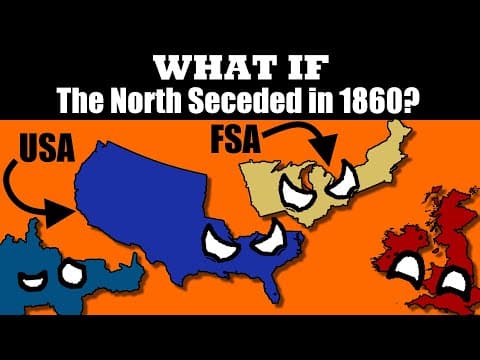
This article explores the hypothetical scenario of the Northern states seceding instead of the South in the 1860 U.S. election. It examines the political tensions, election dynamics, potential civil war outcomes, and long-term geopolitical consequences, including impacts on slavery, international relations, and world wars. The analysis reveals a complex alternate history with profound effects on America and the world.
In 1860, the United States faced a pivotal election that would determine the nation's fate. The political landscape was fractured, with the collapse of the Whig party, the rise of the Republican party, and deep divisions over slavery. This article explores the intriguing question: what if the Northern states had seceded instead of the South?
By the mid-19th century, the once-powerful Whig party had practically collapsed, leaving a political vacuum. Meanwhile, Supreme Court decisions increasingly favored the institution of slavery, intensifying national tensions. The Kansas-Nebraska Act led to violent conflict in Kansas, known as "Bleeding Kansas," as pro-slavery and anti-slavery forces clashed.
In response, the Republican party was formed, advocating against the expansion of slavery. Although they failed to win the 1856 election, their influence was growing.
The Democrats nominated James Buchanan, a moderate who avoided taking a strong stance on slavery in Kansas. The presence of a third party, the Know Nothing party led by former Whig President Millard Fillmore, split the vote, allowing Democrats to carry some Northern free states.
By 1860, the Republican party had become the favorite in the North, while the South faced a crisis over slavery. The Democratic party split between Northern Democrats supporting Stephen Douglas and Southern Democrats backing John Breckinridge, who favored radical pro-slavery policies. A fourth party, the Constitutional Union party led by John Bell, opposed secession.
The Southern states were considering secession if the Democrats lost, hoping to justify it through an electoral defeat. Ultimately, Abraham Lincoln won the 1860 presidential election, leading to the Civil War in our timeline.
Northern states dominated the population and electoral votes, making a Republican victory likely. Even if Democrats unified behind a moderate candidate, Lincoln would probably still win. For the North to consider secession, significant changes would have been necessary in the 1850s, including more aggressive pro-slavery federal policies and Supreme Court rulings.
Controversial cases like Dred Scott declared that African Americans could not claim citizenship, and other rulings suggested that slavery was constitutionally protected nationwide. These decisions heightened tensions and fears on both sides.
A historical plan to prevent Lincoln's victory involved splitting the vote in New York, a key Northern state. If Southern parties had united earlier and focused on New York, they could have prevented any candidate from winning a majority, sending the election to the House of Representatives.
In the House, each state had one vote, and the Republicans lacked the 18 states needed to win. The Southern states could have voted together for Breckinridge, but this was uncertain. If the House failed to elect a president, the Senate would choose between the top two vice-presidential candidates.
With a Democratic majority in the Senate, Joseph Lane, Breckinridge's running mate, could have become president. Lane supported pro-slavery constitutional interpretations, enforcing the Fugitive Slave Act and expanding slavery.
Northern outrage over the election being "stolen" and the enforcement of pro-slavery policies could have sparked secessionist movements. Unlike the South, Northern secession would likely have been gradual and less coordinated, with resistance strongest in New England.
Riots and clashes could have escalated, leading to a civil war with different dynamics than the one in our timeline. The North, as the industrial and population center, would have had significant advantages but faced political marginalization.
The South, controlling the federal government and military, would have had the upper hand initially. However, the North's industrial strength and population could have led to a prolonged conflict.
Britain, opposed to slavery, might have supported the North economically and diplomatically, unlike in our timeline where direct intervention was unlikely.
The South would be on the defensive, trying to reclaim Northern territory, while the North would be the aggressor seeking to force Southern acceptance of independence. Northern morale would likely be higher, fueled by abolitionist ideals.
The scenario of Northern secession in 1860 presents a complex alternate history with profound implications. Political fragmentation, prolonged conflict, and shifting alliances would reshape America and the world. While speculative, this exploration highlights the fragile balance of historical events and the enduring impact of slavery and sectionalism on the United States.
Understanding these possibilities enriches our grasp of history and the forces that shaped the nation.
Thank you for reading this comprehensive analysis of what might have been if the North had seceded in 1860. The alternate paths of history remind us of the delicate interplay of politics, society, and human choices.



















