
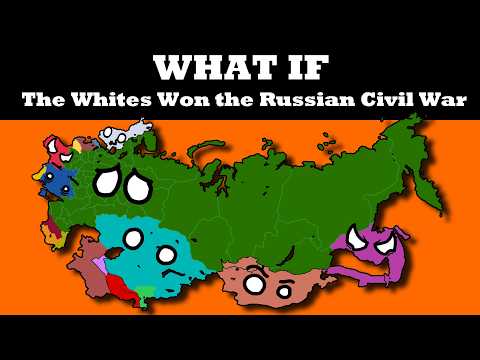
This article explores the hypothetical scenario of a White victory in the Russian Civil War, analyzing the potential political, social, and economic ramifications for Russia and the world. It discusses the challenges the Whites would face in unifying the country, the impact on neighboring nations, and the long-term consequences of such a victory on global geopolitics, including the rise of nationalism and the potential for future conflicts.
In 1917, the Russian Civil War erupted, pitting the Bolsheviks against the Whites, a coalition of anti-Bolshevik forces. If we were to imagine a scenario where the Whites emerged victorious, what would that mean for Russia and the world? This article delves into the potential outcomes of a White victory, examining the political, social, and economic ramifications.
At the onset of the Civil War, the Whites had several advantages:
However, as the war progressed, the Bolsheviks consolidated control over key industrial and population centers, which shifted the balance of power.
Despite their initial advantages, the Whites faced significant challenges:
While the odds were against them, a path to victory for the Whites could have been forged through several key events:
The Czechoslovak Legion, formed during World War I, could have played a crucial role in supporting the Whites. Their initial goal was to fight for the Russian Empire, but after the Bolsheviks signed a peace treaty with Germany, their situation became precarious. If they had successfully traversed Russia to reach Vladivostok, they could have provided significant military support to the Whites.
An early assassination attempt on Lenin could have destabilized the Bolshevik leadership. If Lenin had been killed, the resulting power vacuum might have led to infighting among Bolshevik leaders, weakening their resolve and effectiveness.
The Whites could have capitalized on key battles, such as the fight for Tsaritsyn (now Volgograd), where Joseph Stalin was present. A White victory in this battle could have resulted in the capture or death of Stalin, further destabilizing the Bolshevik regime.
If the Whites had managed to secure victory, the immediate aftermath would not have been a straightforward path to stability.
Despite defeating the Bolsheviks, the Whites would likely struggle to unify Russia. Various factions, including the former Tsarists, nationalists, and regional independence movements, would vie for power. The Alash Orda in Kazakhstan and other groups seeking autonomy would complicate governance.
Russia's economy was already in disarray by 1916, with a debt-to-GDP ratio of around 200%. A White victory would not alleviate these economic burdens. The West might initially support the new regime, but as debts mounted, pressure for repayment would increase, potentially leading to economic instability.
The Bolsheviks had implemented reforms that appealed to the peasantry, such as land redistribution. The return of the Whites could provoke resentment among those who feared losing these gains, leading to social unrest and potential uprisings.
A White victory would have significant implications for global geopolitics:
The Polish and Ukrainian independence movements would likely gain momentum, as the Whites would be seen as a continuation of imperial rule rather than liberators. This could lead to increased tensions and conflicts in the region.
The Whites might adopt a more aggressive stance towards Japan and Turkey, potentially reigniting conflicts over territories like Manchuria and Armenia. The lack of Bolshevik support for Turkish independence movements could alter the dynamics of the Turkish War of Independence.
Without the Bolsheviks, nationalist movements across Europe might gain strength. The absence of a Soviet Union could lead to a different trajectory for fascism and nationalism in Germany and Italy, potentially altering the course of World War II.
While a White victory in the Russian Civil War might initially seem like a favorable outcome, the complexities of governance, economic challenges, and social unrest would likely lead to a tumultuous and fragmented Russia. The geopolitical landscape of Europe and Asia would also be significantly altered, with potential conflicts arising from nationalist movements and shifting alliances. Ultimately, the legacy of a White victory would be one of instability and uncertainty, rather than the promised restoration of a glorious Russian Empire.



















