
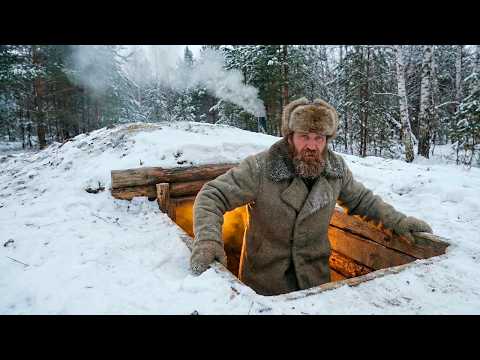
The Zemlyanka, an ancient earth-sheltered home used by Slavic peoples for over 6,000 years, provided exceptional thermal insulation and protection against harsh winters. Unlike shallow Western pit houses, Zemlyankas were deep, multi-roomed, and ingeniously built with earth, logs, and clay. They saved thousands, including Jewish refugees during WWII, yet were forgotten due to modernization and stigma.
Imagine a brutal Russian winter with temperatures plunging to 35° below zero, fierce winds slicing through the steppe, and snow blanketing the landscape as far as the eye can see. There are no visible houses or cabins, yet thin wisps of smoke rise directly from the snow-covered ground. Upon closer inspection, you discover a family living warm and alive beneath the earth itself. This underground shelter is called a Zemlyanka.
For more than 6,000 years, the Zemlyanka was one of the most effective survival shelters ever built. It kept medieval Slavic peasants alive through winters that would kill a modern person in hours, sheltered colonists on the Russian frontier, and hid 1,200 Jewish refugees from the Nazis in the forests of Belarus during World War II. Remarkably, it achieved all this using only dirt, logs, and an intuitive understanding of the earth's thermal properties—a knowledge largely forgotten today.
The word "Zemlyanka" derives from the Russian word "zemlya," meaning earth. It literally means a house made from the earth itself. These homes were dug 1 to 1.5 meters into the ground, with floors ranging up to 25 square meters. They featured clay ovens or hearths, sometimes multiple rooms including living areas and cellars for storage. Walls were reinforced with logs sealed with a mixture of clay, straw, and animal dung, and roofs were heavy timber frames covered with branches, earth, and turf, making them nearly invisible from above.
Unlike the shallow Gruben House of early medieval England, which was typically only half a meter deep and often lacked heating, the Zemlyanka was a true home. It was deeper, larger, and equipped with heating systems. The Gruben House was often a workshop or weaving shed, while the Zemlyanka was a place where people were born, raised families, and lived for generations.
The earliest ancestors of the Zemlyanka appeared in the Neolithic Ucutani Tripilia culture in modern Ukraine, dating back to at least 4,000 BCE. By the early medieval period (5th to 10th century), the Zemlyanka became the dominant form of housing across the Slavic world. Historical accounts from Byzantine, Arab, and Persian sources describe Slavic peoples living in earth-dug homes with stone stoves and pointed wooden roofs.
Archaeological excavations across Central and Eastern Europe have confirmed these descriptions, revealing settlements with sloped ramps for entry, hearths, and walls built using traditional log construction techniques.
The key to the Zemlyanka's effectiveness lies in the principle of thermal mass. Below the frost line—typically 60 to 150 cm underground—the earth maintains a nearly constant temperature between 10 and 15°C year-round. This stable temperature buffers the interior from extreme outside temperature swings.
With walls, floors, and roofs surrounded by earth, the interior starts at this baseline temperature. A small clay oven, body heat from inhabitants, and heat from any livestock could raise the temperature to a comfortable level with minimal fuel. Ethnographic studies confirm that Zemlyankas maintained interior temperatures above freezing during harsh winters without mechanical heating or modern insulation.
In contrast, modern above-ground homes must generate a large temperature differential to stay warm, requiring significant energy. Earth-sheltered homes require 25 to 80% less energy for heating and cooling, with passive solar designs achieving up to 90% lower energy bills.
Additional benefits include inherent fire resistance, wind resistance due to low profile, quieter interiors, and greater structural stability during earthquakes.
Building a Zemlyanka was a skilled but efficient process, taking approximately 3 to 4 weeks with experienced workers. Materials included local timber, clay, straw, animal dung, and earth.
The process involved:
The Zemlyanka was a recurring solution during existential crises in Eastern Europe:
One of the most extraordinary chapters in Zemlyanka history occurred during World War II. The Bielski brothers, Jewish partisans in the forests of Belarus, used Zemlyankas to shelter 1,236 refugees from Nazi persecution. They built underground dugouts reinforced with young trees and covered with stolen barn doors and earth to remain hidden.
These underground camps included kitchens, mills, bakeries, bathhouses, medical clinics, schools, workshops, synagogues, courts, and even jails—an entire underground civilization invisible from above. Despite brutal conditions, the Zemlyankas kept them alive through winters with temperatures as low as 35° below zero.
Despite its proven effectiveness, the Zemlyanka disappeared from collective knowledge in the 20th century. The shelter became associated with poverty and backwardness, stigmatized as a symbol of desperate peasant life. As urbanization and industrial housing expanded, the skills and knowledge to build Zemlyankas were lost within a generation.
Ironically, modern earth-sheltered homes, though initially more expensive to build, save 50 to 80% on heating and cooling costs over their lifetime. The United States Department of Energy recommends earth-sheltered construction for climates with significant temperature extremes—the very conditions where Zemlyankas thrived.
For 6,000 years, humans used the earth itself as a primary defense against the cold. From Neolithic pit houses to medieval Slavic villages, Cossack settlements, and partisan camps, the Zemlyanka was a resilient, energy-efficient shelter that saved countless lives.
Today, as we face rising energy costs and environmental challenges, revisiting the principles behind the Zemlyanka could inspire sustainable, low-energy housing solutions. The earth beneath our feet remains at a stable temperature year-round, offering a natural, forgotten resource for shelter and survival.
The next time you face a high heating bill, remember the Zemlyanka—a shelter that required no electricity, gas, or modern insulation, only earth, logs, clay, and an understanding of nature that we have traded for convenience.



















