
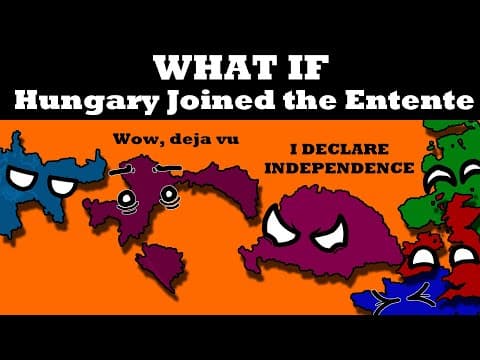
This article explores the hypothetical scenario of Hungary breaking away from the Austro-Hungarian Empire during World War I to join the Entente powers. It examines the internal political divisions within Hungary, the diplomatic negotiations with the Entente, potential military outcomes, and the broader implications for the war and post-war Europe. The analysis also considers alternate post-war borders and the long-term effects on Central and Eastern Europe.
While it is common to think of Austria-Hungary as a unified nation, in reality, since 1867, Austria and Hungary functioned almost as separate states united primarily by the Habsburg monarchy, military matters, and foreign policy. By 1914, both sides of the empire faced significant internal issues.
The Austrian part of the empire grappled with religious tensions and nationalism, particularly between the Orthodox populations and the German elements. Most of the Austrian Empire was composed of Slavic peoples, leading to discontent among the German-speaking population, some of whom even advocated for integration into Germany.
Hungary's challenges centered on minority rights. Political loyalties were split, with minorities generally supporting the Liberal Party, which favored the Austro-Hungarian compromise, while ethnic Hungarians tended to support the Party of Independence, which sought greater Hungarian autonomy or independence.
This internal conflict within Hungary, especially the desire among some factions to break free from Vienna's control, forms the basis of the hypothetical scenario explored here.
At the start of the war, Hungary was deeply divided:
Given these divisions, the question arises: what if Hungary had attempted to break away from the Habsburg Empire during World War I, effectively cutting Germany's main ally in half?
In January 1915, the Hungarian opposition reached out to London to gauge the Entente's position on Hungarian independence. Hungary offered to leave the war and declare independence if the Entente respected its territorial integrity, while still recognizing Franz Joseph as their king. They even expressed support for Romanian claims on Austria as a distraction from Transylvania.
The Entente's response was cautious. They had already made vague promises to Romania regarding Transylvania and were aware of Russian and Serbian claims on Hungarian territory. Negotiations were limited, and the Entente stated they would only discuss specifics after Hungary achieved independence.
In May 1915, after Italy joined the war on the Entente side, the Hungarian opposition contacted Rome, reiterating their willingness to leave the war in exchange for territorial integrity. These negotiations were not secret from the Austrian court, which did little to stop them, viewing them as minor threats.
The Hungarian government quickly rallied behind the war effort after Italy's entry, and the opposition's momentum faded. By the time Hungary reconsidered independence, it was too late, and the Entente was calling for the dissolution of the kingdom.
If the Party of Independence had won the 1914 elections (historically, they lost in 1910), they would have held key institutions and been the official government rather than a fringe opposition. This would have made the Entente more receptive to Hungarian independence, seeing it as a real possibility to weaken the Central Powers.
Hungary had a small professional army but relied heavily on the common army, which was ethnically diverse and could fracture along ethnic lines. Minorities within Hungary might remain loyal to the Habsburg crown, complicating any independence movement.
Austria would likely respond with an invasion, promising autonomy to minorities loyal to the Kaiser and attempting to isolate Hungarian forces.
A Hungarian declaration of independence would have forced Austria-Hungary to divert resources to suppress the rebellion, weakening their position on other fronts. Serbia might have had a respite, and Italy could have made gains against a weakened Austria.
Germany would have had to reinforce Austria-Hungary, delaying their offensives against Russia. Bulgaria might have remained neutral or joined the Entente, and Romania could have sided with the Entente as well.
While the war might have continued for years, the Central Powers would have faced significant strategic challenges.
If Hungary had declared independence during the war, it would likely have been treated more like Czechoslovakia at the Paris Peace Conference, with better negotiating power and less partitioning than in our timeline.
Hungary would retain a larger territory and more minorities than in our timeline.
Post-war restrictions on Hungary's military capabilities would likely be less severe, allowing Hungary to maintain a stronger defense.
Hungary might have joined alliances of Eastern European states against communism and central power revival, increasing its regional influence.
Despite initial independence, Hungary's economic ties to Germany would likely draw it into Germany's sphere of influence, especially during the Great Depression and World War II.
Hungary's role in World War II might not differ significantly, eventually aligning with Germany or facing conquest.
Post-World War II, Hungary would have a different territorial shape, retaining more minorities and possibly avoiding some of the harsher consequences it faced historically.
The fate of Russia after World War I would heavily influence Hungary's future. A victorious Russia might annex Galicia and influence Eastern Europe, while a collapsed Russia could lead to a power vacuum benefiting Hungary.
If Austria-Hungary swiftly suppressed the independence movement, Hungary would be reduced in size and power, with territories like Croatia, Banat, Transylvania, and Slovakia partitioned or granted autonomy.
A successful declaration would destabilize the Central Powers, potentially leading to an earlier defeat for Germany and Austria-Hungary, and a radically different post-war Europe with a stronger Hungary and a surviving Russian Empire.
The hypothetical scenario of Hungary joining the Entente during World War I presents a fascinating alternate history with significant implications for the war's progression and the post-war order in Central and Eastern Europe. While the complexities of ethnic divisions, military loyalties, and international diplomacy make any definitive outcome uncertain, it is clear that such a move would have profoundly altered the balance of power and the shape of Europe in the 20th century.
Understanding these possibilities helps illuminate the fragile nature of empires and alliances during one of history's most tumultuous periods.



















