
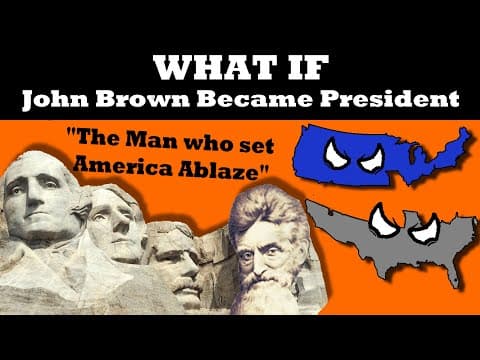
John Brown, a radical abolitionist, never realistically had a path to the presidency, but imagining his election in 1861 reveals a deeply divided nation. His uncompromising stance on slavery would have alienated border states, likely causing them to join the Confederacy, leading to an early Union defeat and a fractured country. Alternatively, if he led competently, his harsh policies might have prolonged the war and intensified Reconstruction, leaving a lasting impact on American history.
John Brown was a radical abolitionist known for his extreme actions against slavery, including leading a raid on an armory to arm slaves for a rebellion across the South. Though his raid failed and he was executed for treason, his actions further polarized the nation and contributed to the tensions leading up to the Civil War.
This article explores an alternate history scenario: what if John Brown had become President of the United States in 1861, as the Civil War began? While this is an unrealistic scenario, it offers a fascinating lens to examine the potential consequences of his uncompromising abolitionist stance on the nation.
In reality, John Brown had no viable path to political power. However, for the sake of this scenario, imagine Brown as a successful businessman who transitioned into politics, becoming a radical abolitionist voice in the North. His prominence rose during the violent conflicts in "Bleeding Kansas," where his sons died fighting for the anti-slavery cause, making the Brown family heroes among many Northerners.
Brown's charisma and personal discipline made him a popular figure within the Republican Party. At the 1860 National Republican Convention, four major candidates vied for the nomination: William Seward, Abraham Lincoln, Salmon Chase, and John Brown. In this alternate scenario, a deadlock between Seward and Lincoln leads to both endorsing Brown, who then secures the nomination.
Despite this, Brown loses the popular vote in the general election due to his radicalism. However, no candidate wins a majority, and the election is decided by the House of Representatives, which, due to a split Democratic Party, elects Brown as President.
Brown's election shocks the nation. He is seen as an illegitimate president, having won neither the popular nor electoral vote outright. Many Southern states secede immediately, and even border states consider leaving the Union.
In his inaugural address, Brown declares his divine mission to destroy slavery, condemns Southern elites, and asserts that secession is unconstitutional and will be met with force. This uncompromising stance sets the tone for his presidency.
Unlike Lincoln, who sought to keep border states loyal by delaying abolition and using political caution, Brown's immediate war on slavery alienates key border states such as Maryland, Delaware, and Kentucky. These states likely join the Confederacy, placing Washington D.C. in a precarious position, potentially surrounded and vulnerable to capture.
The Union capital may be occupied or forced to relocate, a major blow to the Union cause.
Brown struggles to rally the Northern population. Seen as illegitimate and responsible for the national split, he faces widespread draft dodging and low enthusiasm for the war. Northern state militias may refuse to cooperate with his government, focusing instead on local defense.
The Confederacy, aware of its advantage, might adopt a defensive strategy after capturing Washington, avoiding risky offensives.
Brown's hope lies in the Emancipation Proclamation-like measures, recruiting freed slaves as soldiers and encouraging slave rebellions in the South. However, these efforts do not immediately turn the tide.
Within a month of taking office, Brown's administration faces near defeat. His vice president likely impeaches him, taking over and negotiating a peace deal with the South. The Confederacy, in a strong position, might refuse to return Washington D.C. and seize additional territories such as Kansas and the Southwest.
The Union is left defeated and fractured, with the South stronger than in many Confederate victory scenarios and the North weakened and divided.
Brown's presidency would be remembered as disastrous, responsible for the most American deaths due to his uncompromising and brash policies. The creation of a Confederate nation dedicated to preserving slavery becomes a grim reality.
A future war to reclaim the South would be costly and difficult, with a weaker Northern government and less unity.
Brown might spend his remaining years in despair or attempt a final slave rebellion, possibly dying at the hands of Confederate forces.
Suppose Brown manages to keep the nation together initially and leads the war competently. He takes control of border state governments, delaying extreme policies just enough to maintain their loyalty.
Brown immediately employs freedmen as soldiers and encourages slave revolts, conducting a harsh war against slavery by burning plantations and punishing slave owners.
The South's only hope becomes the 1864 election, hoping Brown is voted out.
The Republican Party moderates Brown during his term but supports him overall. However, Northern enthusiasm wanes due to the war's brutality.
By 1864, Republicans replace Brown with Lincoln as the presidential candidate. Lincoln's platform of unity and reconciliation resonates with the war-weary nation.
Assuming Lincoln wins in 1864, he faces a difficult post-war situation. Brown's orders to try Confederate leaders as traitors and the harsh treatment of Southern landowners complicate reconciliation.
Reconstruction is more thorough, with seized lands redistributed to freed slaves, especially along the Mississippi. This centralizes the freed slave population and strengthens their position.
Lincoln likely avoids assassination, possibly serving until 1872, overseeing a more rigorous Reconstruction.
While the South is treated more harshly, and some racial tensions persist, freed slaves gain a stronger foothold in society, making rollback of their rights more difficult.
Brown would be remembered as a deeply controversial figure. Even supporters might view his methods as too extreme. His belief that the ends justify the means sets a dangerous precedent in American politics.
He would likely be the president responsible for the highest American casualties due to his aggressive policies.
Meanwhile, Lincoln's subsequent presidency would be seen as a period of healing and reconciliation, albeit under more challenging circumstances.
While John Brown's presidency is an unrealistic historical scenario, exploring it reveals the delicate balance of political, social, and military factors that shaped the Civil War era. Brown's radicalism, while morally driven, might have fractured the Union irreparably or prolonged the conflict with devastating consequences.
This thought experiment underscores the complexity of leadership during times of national crisis and the profound impact of political decisions on the course of history.



















