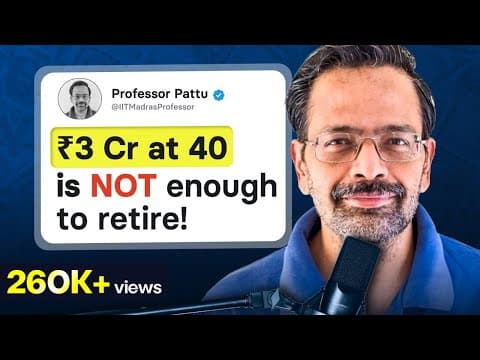
Dr. Pattu discusses the unrealistic expectations surrounding early retirement and the importance of realistic financial planning, emphasizing that a ₹3 crore corpus may not suffice for a comfortable retirement. He advocates for a balanced approach to spending and investing, starting retirement planning early, and understanding the complexities of asset allocation.
Retirement planning is a topic that often evokes dreams of financial freedom and leisure. However, many aspiring retirees, particularly those looking to retire early, may not fully grasp the financial realities involved. Dr. Pattu, a prominent financial educator from IIT Madras, sheds light on this issue, particularly the misconception that a corpus of ₹3 crore is sufficient for retirement.
Many individuals today aspire to retire by the age of 30 or 40. While this may seem appealing, Dr. Pattu argues that such goals are often unrealistic. He emphasizes the need for a balance between enjoying life and saving for the future.
"When you're young, it's always better to have some fun because once you get older, there are certain things you can't do," he states. This perspective encourages young individuals to invest in experiences while also planning for their financial future.
Dr. Pattu discusses common calculations found online that suggest a ₹3 crore corpus can sustain a comfortable retirement. He explains that many of these calculations are overly simplistic and do not account for real-life complexities. For instance, he highlights that wealth is built through income, not merely through returns on investments.
One of the tools Dr. Pattu mentions is the delay calculator, which helps individuals understand the impact of postponing retirement planning. By inputting variables such as current expenses, expected retirement age, and inflation rates, users can see how delaying their investment can significantly affect their retirement corpus.
A popular notion circulating online is the idea of creating an infinite corpus through strategic investments. Dr. Pattu likens this to the concept of perpetual motion, stating that just as perpetual motion is impossible due to energy loss, a retirement corpus cannot last indefinitely without careful management. He asserts that a ₹3 crore corpus is insufficient for someone with monthly expenses of ₹1 lakh, emphasizing the need for realistic financial planning.
Dr. Pattu stresses that the ideal time to start planning for retirement is the moment one receives their first paycheck. He encourages individuals to set aside a portion of their income for retirement from the outset, regardless of their current financial situation.
"Wealth is built with income, not just returns," he reiterates, highlighting the importance of consistent saving and investing.
When discussing asset allocation, Dr. Pattu suggests a balanced approach, recommending that individuals maintain a mix of equity and fixed income investments. He shares his own experience, noting that his equity exposure for retirement is around 63-65%.
Dr. Pattu also addresses common investment choices like real estate and gold. He describes real estate as a "black box" due to its unpredictable market value and emphasizes that it should not be considered a primary investment for retirement. Similarly, he points out that gold can be just as volatile as stocks, making it a risky asset class.
For those nearing retirement, Dr. Pattu recommends seeking the guidance of a certified financial advisor. He compares the process of organizing investments to decluttering a wardrobe, suggesting that a professional can help streamline and optimize one's financial portfolio.
In conclusion, Dr. Pattu's insights serve as a crucial reminder that retirement planning requires careful consideration and realistic expectations. A ₹3 crore corpus may not be sufficient for a comfortable retirement, especially for those with high monthly expenses. By starting early, maintaining a balanced investment strategy, and seeking professional advice, individuals can better prepare for their financial future.
Ultimately, the key takeaway is to prioritize both enjoyment of life and prudent financial planning, ensuring that the dream of retirement does not become a financial burden.