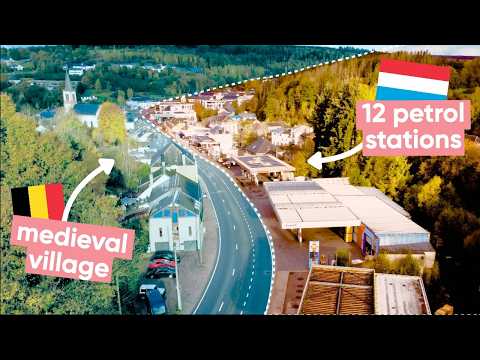
Martalange, a small village split between Belgium and Luxembourg, has a unique border history dating back to the 19th century. Due to Luxembourg's significantly lower excise duties on fuel and alcohol, the Luxembourg side of Martalange hosts numerous petrol stations attracting cross-border customers, creating a phenomenon known as fuel tourism. This situation stems from complex historical treaties and differing taxation laws between the two countries.
Martalange is a small village located on the border between Belgium and Luxembourg. Despite its tiny population, it is famous for having an unusually high number of petrol stations. This phenomenon is deeply rooted in the village's complex historical border and the differing taxation laws of the two countries.
Martalange straddles the border between the Belgian province of Luxembourg and the Grand Duchy of Luxembourg. Interestingly, the Belgian province of Luxembourg is twice the size of the country Luxembourg itself.
The history of this border region dates back about 500 years to the Holy Roman Empire. Over centuries, the territory changed hands multiple times, especially during the Napoleonic era and the Congress of Vienna in 1815.
After Napoleon's defeat, the Congress of Vienna reinstated Luxembourg as a Grand Duchy, placing it in a personal union with the Kingdom of the Netherlands. However, Luxembourg was also made a member of the German Confederation, creating a complex political situation.
In 1830, Belgium declared independence from the Netherlands, and most of Luxembourg's territory was annexed by Belgium, except for Luxembourg City. This led to confusion and disputes over the border.
The Great Powers convened the London Conference in 1831 to resolve the issue, resulting in the Treaty of the 18 Articles, which proposed a border splitting Luxembourg between Belgium and the Grand Duchy. However, the treaty was initially rejected by the Netherlands.
After years of negotiation, the Treaty of London in 1839 (also known as the Treaty of the 24 Articles) finalized the border, splitting Luxembourg into two parts: the Belgian province of Luxembourg and the Grand Duchy of Luxembourg.
A key issue was the village of Martalange and the Arlon-Bastogne road running through it. The treaty assigned Martalange to Luxembourg but the road to Belgium, creating a contradiction.
Surveyors in 1843 resolved this by making the road itself the border: everything west of the road became Belgian Martalange, and everything east became Rombach Martalange in Luxembourg.
Although the European Union and the Schengen Area have removed hard border controls, the laws and taxation policies of Belgium and Luxembourg remain different.
Luxembourg has relatively low excise duties on fuel and alcohol compared to Belgium. Excise duties are taxes levied on producers, often to discourage harmful products like petrol and alcohol.
Luxembourg's excise duty on fuel is among the lowest in the EU, making petrol approximately 19 cents per liter cheaper than in Belgium. This translates to savings of around 7 to 8 euros per full tank for a typical 40-liter car.
Due to these tax differences, many people from Belgium and other neighboring countries cross into Luxembourg to buy cheaper fuel. This has led to the phenomenon known as "fuel tourism."
Martalange's Luxembourg side has capitalized on this by hosting a remarkable number of petrol stations—12 in total for a population of just 218. Some companies operate multiple stations, such as Shell, BP, Esso, and Q8.
Luxembourg also has significantly lower excise duties on alcohol, including spirits, beer, and wine. This has turned petrol stations into outlets for alcohol sales, contributing to Luxembourg having one of the highest per capita alcohol consumption rates in the EU.
Belgium loses substantial revenue due to cross-border shopping and workers moving to Luxembourg for better salaries. The border situation in Martalange exemplifies this economic tension.
The Luxembourg government encourages this commercial activity, leading to the replacement of historical village structures with petrol stations and commercial outlets.
Martalange's unique situation is a product of centuries-old treaties and modern economic policies. The village's split border and Luxembourg's favorable tax regime have created a hotspot for fuel tourism, resulting in an unusually high density of petrol stations in a tiny community.
This case highlights how historical borders and differing national policies can shape local economies and landscapes in unexpected ways.