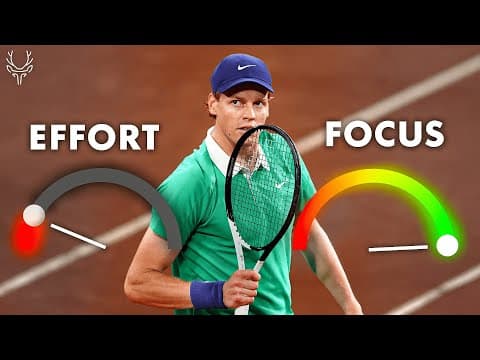
This blog explores how overexertion in sports can hinder performance, highlighting the psychological issues of overthinking, hypervigilance, and overarousal. It offers practical tips for athletes to find the right balance in their efforts, ensuring they perform at their best without succumbing to pressure.
The harder you try, the worse you play. This paradox is a common struggle for many athletes, and understanding it can be the key to unlocking better performance. In this blog, we will explore the psychological challenges that come with trying too hard and provide actionable strategies to help athletes perform at their best.
Meet Cole, a promising young tennis player on the Challenger Tour. Despite his talent and skills, Cole finds himself repeatedly knocked out of tournaments by lower-ranked players. This is not due to a lack of ability; rather, it stems from a common pitfall among athletes: overtrying.
Cole's desperation to succeed creates psychological tension that manifests physically. His grip tightens, footwork stiffens, and he begins to make uncharacteristic mistakes, such as spraying forehands long and committing double faults. As his peers advance in their careers, Cole remains stuck, traveling to small towns for tournaments only to exit in the first round. This cycle continues for years, leaving him frustrated and questioning his efforts.
Cole's experience is not unique. Many talented athletes across various sports struggle to achieve their potential due to the paradox of trying too hard. Let's delve into three main psychological issues that arise from this phenomenon:
When athletes overtry, they shift from trusting their instincts to fixating on every movement. This is explained by the explicit monitoring theory in sports psychology, where well-learned movements become awkward as athletes attempt to consciously control each step. As a result, their technique deteriorates, timing falters, and the effortless execution that typically characterizes their performance disappears. Muscles tighten, reactions slow, and simple skills become challenging to execute.
Hypervigilance occurs when athletes tie their self-worth to every outcome, leading to obsessive monitoring of their performance. This phenomenon, known as ego involvement, distracts athletes from focusing on the moment. Instead, they constantly evaluate their performance, asking themselves questions like, "Am I doing this right?" or "What if I mess up?" This self-monitoring not only creates mistakes but also drains confidence, causing hesitation and missed opportunities.
Overarousal happens when the effort to succeed ramps up an athlete's body and mind beyond the optimal level of stress and energy, as described by the Yerkes-Dodson law. This state manifests physically and mentally, resulting in a racing heart, tightened muscles, and rapid energy depletion. Athletes may act impulsively, force plays, and experience a crash in stamina. Unlike overthinking, overarousal is more about physical response than cognitive processes.
These three issues often occur simultaneously, creating a vicious cycle. Overthinking leads to second-guessing, hypervigilance traps athletes in self-monitoring, and overarousal pushes the body into overdrive. The outcome is a performance spiral where every mistake feels magnified, and every decision becomes increasingly difficult.
To help athletes find the right balance between effort and performance, here are three effective strategies:
Visualize your effort as a dial in your mind. When overtrying, this dial is turned up to 100%, causing tension and high alertness. To combat this, mentally adjust the dial to a slightly lower setting, perhaps 85 or 90%. This adjustment allows movements to flow naturally without completely disengaging. Finding your personal sweet spot is crucial, as different sports may require varying levels of intensity.
Deliberately put the moment into perspective by minimizing the importance of a single point or play. Injecting humor into the situation can help reduce tension and stress. This approach does not promote carelessness; instead, it fosters a sense of freedom, allowing athletes to compete hard while regaining their natural rhythm. Mistakes become less daunting, and the game feels lighter.
When athletes overtry, they often rush or force outcomes. To counteract this instinct, intentionally slow down and focus on executing one play at a time. By doing the opposite of what your overtrying instincts dictate, you grant your mind and body permission to relax and trust your skills. This approach does not mean abandoning the desire to win; rather, it paves a smoother path to success without the obstacles of overthinking and self-doubt.
Understanding the psychological barriers that come with trying too hard is essential for athletes aiming to reach their full potential. By recognizing the issues of overthinking, hypervigilance, and overarousal, and implementing strategies like adjusting the intensity dial, minimizing self-talk, and playing for the opposite, athletes can enhance their performance. Remember, it's not about trying less; it's about trying smarter. With the right mindset and techniques, athletes can navigate the pressures of competition and achieve the results they deserve.