Editorial Team
5 min read
Two independent amateur searches used OpenAI tools to build software for public telescope data. One flagged 49 possible planets; professional scrutiny has begun, but neither search has confirmed a new planet.
Two amateur astronomers used OpenAI’s tools to build searches of public telescope observations, producing possible planets for professional researchers to investigate, the AI developer said in its November 24 account of the work. One search flagged 49 candidates. The unresolved question is whether any of the new signals comes from a planet.
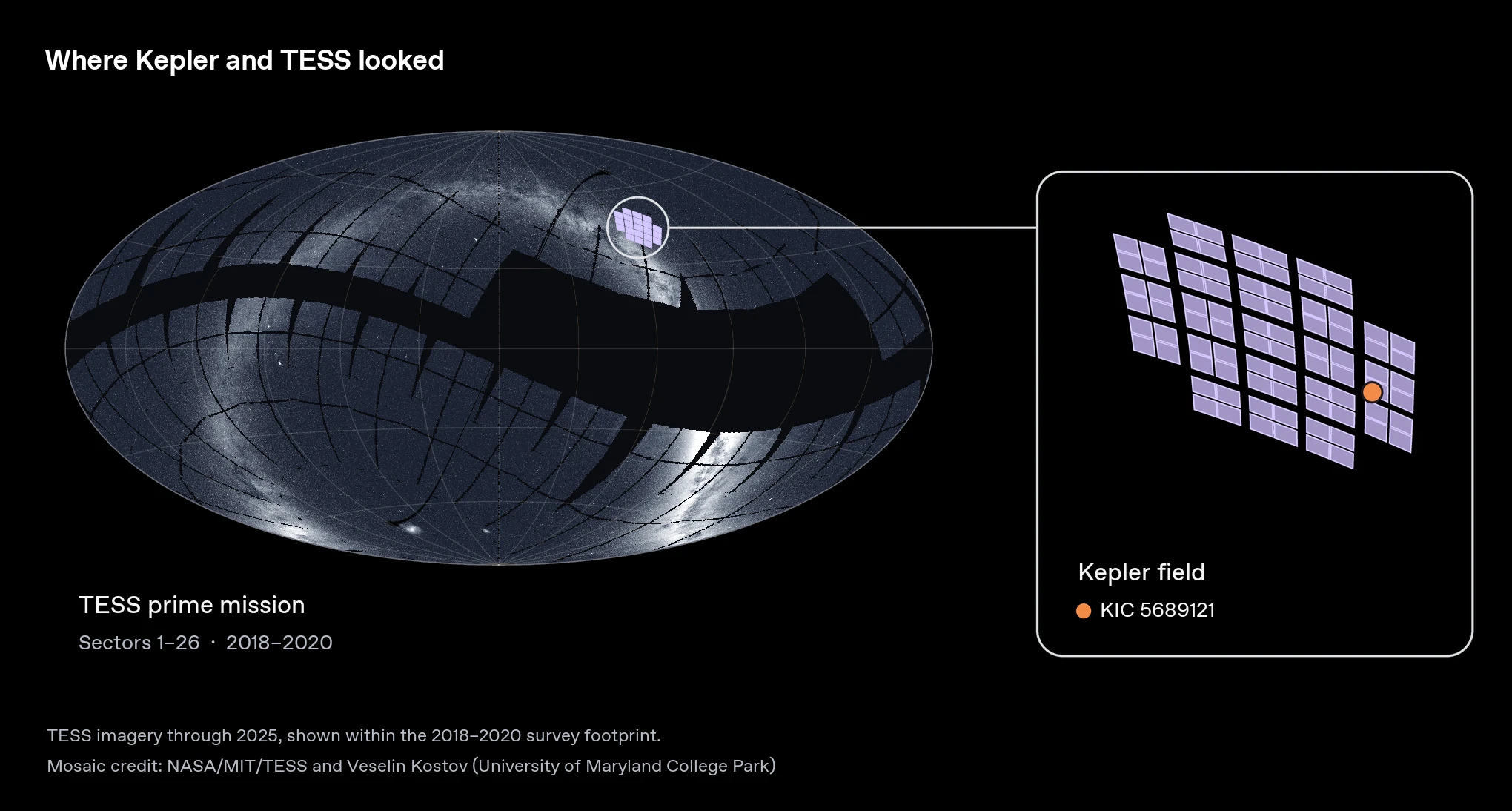
OpenAI’s graphic shows the Kepler field and TESS’s 2018–2020 survey footprint using imagery through September 2025. Mosaic: NASA/MIT/TESS and Veselin Kostov, University of Maryland College Park. Source: OpenAI.
Ethan Byrd, founder of the email infrastructure startup Primitive and a longtime astronomy enthusiast, used OpenAI’s Astra AI model to help search observations of about 19 million stars. OpenAI says his first pass produced 49 possible exoplanets—planets beyond our solar system.
Working independently, Kevin Bond, an OpenAI engineer whose interest in astronomy grew from photographing the night sky, used the company’s Codex coding assistant to search observations of about 100,000 stars from the US space agency NASA’s Kepler telescope. That planet-hunting mission operated from 2009 to 2018. The 49 candidates belong to Byrd’s search, rather than a combined tally from both men.
Byrd tried several AI models before selecting Astra. OpenAI does not explain the comparative results behind that choice. He used it to review published methods, build software and run initial checks on signals, drawing on NASA’s Transiting Exoplanet Survey Satellite, or TESS, and other public telescope archives. TESS launched in 2018.
One of Byrd’s searches looked broadly for planet candidates; another targeted habitable zones—the distances from a star where a planet with a suitable atmosphere could sustain liquid surface water. That search criterion does not establish that any candidate is habitable.
Bond used Codex to compare existing astronomical methods, combine them into a program and test code changes. One AI agent searched light curves, which plot a star’s brightness over time, while another checked promising candidates in more detail.
OpenAI says proteins based on GPT-6.2 designs bound to five targets in laboratory tests. The results suggest general-purpose models can take on parts of protein design, while specialist screening and evidence beyond binding remain essential.
His program flagged more than 200 signals, including 10 associated with already confirmed planets, according to OpenAI’s account of the work. Recovering known planets checks that the program can recognize relevant patterns; it does not establish overall accuracy without accounting for missed planets and false positives.
AI-assisted planet detection predates these efforts. A 2017 research paper by Christopher J. Shallue and Andrew Vanderburg described a deep convolutional neural network that classified potential planet signals. The researchers statistically validated two new planets, including an eighth planet around Kepler-90.
In the current work, the reported role of Astra and Codex includes helping amateurs review methods, write software and check signals. The 2017 system instead learned to classify signals as possible planets or false positives. These are different uses of AI, and the earlier result makes clear that AI-assisted planet hunting itself is not new.
OpenAI, which developed both tools and employs Bond, presents the searches as examples of wider access to scientific work. Its account gives no project costs, computing budgets, elapsed search times or controlled comparison with conventional software. The two star counts describe different search populations, not a like-for-like test of Astra against Codex or established astronomical software.
Nor does participation require these particular products. The same account points readers to NASA’s Exoplanet Watch, which lets volunteers request observations and learn to plot light curves without owning a telescope. Public archives and established citizen-science programs are part of the infrastructure behind the opportunity.
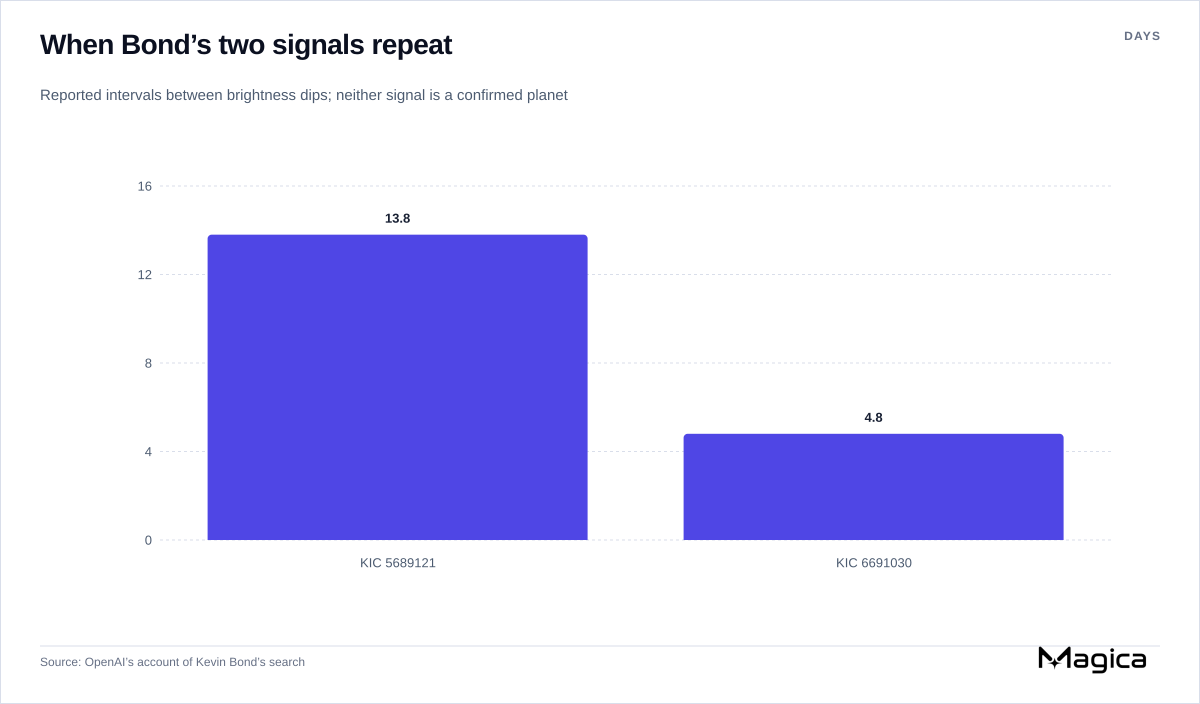
Company-reported recurrence intervals for two signals in Bond’s Kepler search. Repeated dips help schedule follow-up observations; they do not confirm planets. Source: OpenAI.
Both searches look for recurring dips in starlight that could occur when a planet crosses in front of its star. Eclipsing stars can produce similar patterns, and temperature changes aboard a telescope can affect its measurements.
Two signals from Bond’s search stood out, according to OpenAI. Around KIC 5689121, a relatively cool star about half the Sun’s size in Lyra, the dips repeat about every 13.8 days. If a planet causes them, the blocked light suggests a diameter about 2.4 times Earth’s. Around the faint northern star KIC 6691030, a dip every 4.8 days is consistent with a planet smaller than Neptune. Those sizes remain interpretations of the signals, not measurements of confirmed planets.
Vishal Gajjar, an astronomer and associate director for international SETI programs at the SETI Institute, independently found both signals in the Kepler data, OpenAI says. In the company’s account, he places Bond’s work in the Kepler Bonus Catalog, a collection of stars beyond Kepler’s original targets, and says conventional searches may have missed promising candidates there. That is a qualified assessment, not evidence of a measured advantage over other searches.
As a report relaying OpenAI’s findings emphasizes, recovering signals independently from the same observations does not establish that planets caused them. Gajjar describes the initial checks as encouraging in OpenAI’s account and says follow-up observations will reveal more.
Byrd has sent one of his strongest candidates to researchers working on TESS for further analysis; two more await submission. His search is still running. Bond’s two candidates could take months or years to resolve, according to OpenAI.
Astronomers can watch for predicted transits, statistically test alternative explanations or measure the star’s motion under an orbiting planet’s gravitational pull. Those checks, followed by publication of the evidence for scientific scrutiny, are what would move the candidates toward established discoveries. For now, the searches have supplied places to investigate.
Attorney General Todd Blanche defended an interagency security judgment backing Jensen Huang’s return to Nvidia, but withheld details as chip-diversion allegations and demands for congressional testimony remained unresolved.
Anthropic is rolling out a beta that installs Claude artifacts as Mac and Windows apps. They gain desktop permissions and their own windows, but still depend on a Claude account, connectivity and plan limits.
South Korea has increased rewards for reporting college entrance exam cheating amid concerns about AI-assisted misconduct. Cheaters who confess and identify accomplices can receive the full reward and reduced penalties, while the extent of AI use remains unproven.
Jensen Huang disputes that Trump alone secured his reinstatement, while acknowledging government security assurances. Nvidia's independent investigation is continuing despite his return.
New York has enacted a five-year moratorium on toys containing AI companions, with penalties up to $15,000 per day for each violation. The ban starts after this holiday season, and its scope depends on a statutory definition of simulated relationships.

Meta is putting Muse in Instagram messages and prompting users to organize saved posts. The integration widens access to an existing agent as Meta pursues transaction revenue, with compute costs and permission controls still consequential.
Anthropic's Skills over MCP beta lets service providers deliver and update workflow instructions through their connections to Claude. Skills and server instructions already existed; the change ties their delivery to the service, with deployment restrictions and approval controls that matter for business use.
Dell lifted its fiscal 2027 revenue outlook by $10 billion after a record quarter. AI servers led the expansion, but traditional servers and higher infrastructure margins also drove a sharp shift in its earnings mix.
Jensen Huang reportedly admitted a conduct violation and promised employee feedback sessions after returning as Nvidia CEO. The board has pledged to continue its investigation and expand compliance oversight.
Kadoa tallies 28 purchases and 15 sales through September, highlighting President Donald Trump’s financial exposure to Nvidia while leaving his holdings during November’s turmoil unknown. The White House says independent managers control the accounts.
Walmart says Meta’s Muse can find products and complete purchases through its invitation-only Agent Gateway beta. The connection gives the outside AI agent a supported shopping route while Walmart handles product matching, accounts and checkout.
Britain’s cyber security authority says AI-assisted attacks have increased markedly since September, causing outages and compromises across multiple sectors. The agency attributes the change to faster, persistent automation of familiar attacks, while established security controls remain effective.
Epochal, founded by former xAI founding members Guodong Zhang, Zihang Dai and Manuel Kroiss, is launching a historical web environment for forecasting agents. Zhang is reportedly investing $100 million personally; the product’s replay results leave future prediction gains unproven.
Tidal is moving from labeling and demonetizing fully AI-generated recordings to banning them, citing a surge in deliveries and little listening. AI-assisted music will remain eligible, leaving detection and appeals central to enforcement.
MiniMax says its security systems logged and later accessed URLs from forwarded AI requests, including requests marked private. It has disabled the mechanism, while Novita has confirmed unexpected forwarding and OpenRouter is testing the chain behind its privacy labels.
Five directors reportedly lead all-stock talks between Elon Musk’s two public companies. Ownership, voting rights and the economics of SpaceX’s heavy AI spending remain central to assessing a potential combination.
The Document Foundation now requires contributors to seek permission before using large language models in LibreOffice development. Even approved users face disclosure requirements, human-written communications and restrictions on compatibility-sensitive code.
Donald Trump's intervention in Jensen Huang's return as Nvidia CEO coincided with a rally that may have added up to $15 million to his holdings. Disclosure ranges and missing recent trades leave the actual gain uncertain.
Britain’s financial regulator says AI providers must assess whether their agents perform regulated activities, while banks and other regulated firms retain responsibility for systems supplied by outsiders.