Editorial Team
6 min read
Anthropic is rolling out a beta that installs Claude artifacts as Mac and Windows apps. They gain desktop permissions and their own windows, but still depend on a Claude account, connectivity and plan limits.
Anthropic, the maker of the Claude AI assistant, began rolling out “Install as app” on November 24. The beta turns artifacts—outputs and interactive tools created in Claude conversations—into Mac and Windows apps with their own icons and windows. Users gain desktop capabilities without having to package or sign software, but opening these installed artifacts still requires an online Claude account.
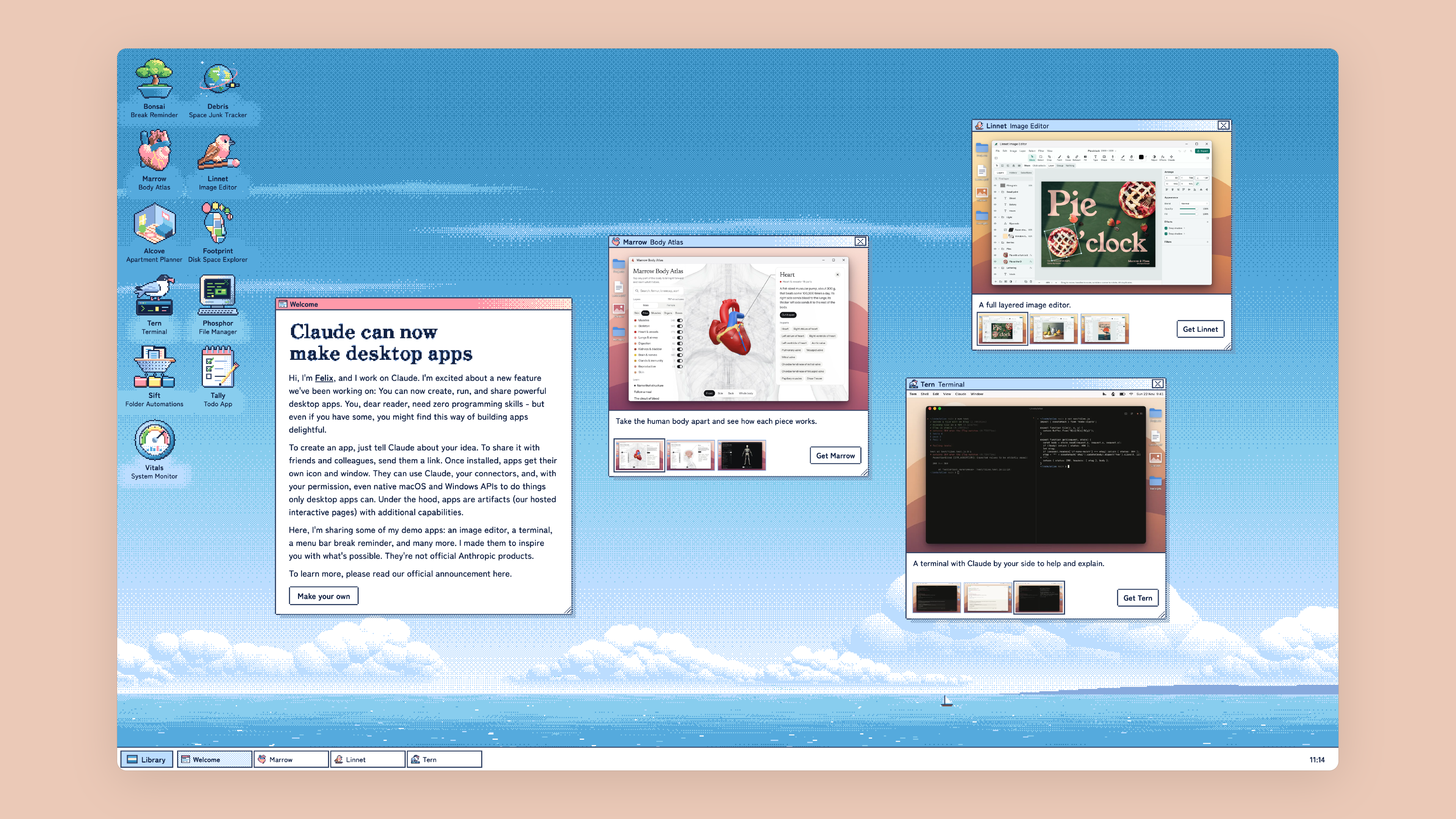
Anthropic’s launch gallery shows demonstration apps made with artifacts, including the Linnet image editor and Tern terminal. Source: Anthropic.
Users describe a tool to Claude, try the resulting artifact and select “Install as app.” Anthropic says there is no packaging or signing step, API key or separate login. Apps can use Claude and its connectors to other services, send notifications, and add a macOS menu bar item or Windows system tray icon, according to the announcement.
The change is aimed at tools people return to: Anthropic describes meeting-preparation pages that pull from calendars and email, and trackers for orders awaiting shipment. Its employees have built demonstrations including an image editor, file managers and a computer-performance monitor. Those examples show the intended uses; they do not establish reliability across users’ machines.
The installed app remains the underlying artifact. Edits by its creator or another editor automatically change the app, and a tool with a menu bar or tray item can keep running after its window closes. The support documentation distinguishes this from adding a browser shortcut, which does not confer the desktop capabilities.
Building AI-powered apps inside Claude is older than this release. In a 2025 announcement, Anthropic described artifacts that could call Claude, be shared through links and charge each recipient’s AI usage against that recipient’s subscription. Desktop installation extends that existing system with a new place to run and new permissions.
OpenAI says proteins based on GPT-6.2 designs bound to five targets in laboratory tests. The results suggest general-purpose models can take on parts of protein design, while specialist screening and evidence beyond binding remain essential.
AI-assisted app development also has routes outside installed artifacts. Apple announced agentic coding in Xcode 26.3 in February 2026, giving coding agents including Anthropic’s Claude Agent and OpenAI’s Codex access to its app-development environment. Apple said those agents could explore projects, change settings and iterate through builds and fixes. That developer workflow is a different comparison from the beta’s direct installation of a conversational artifact.
An Anthropic employee, Felix Rieseberg, also said on X that Apple Developer account holders could have Claude build a standalone app, according to a launch report summarizing his post. That is a separate route from “Install as app”; the beta’s account requirement should not be read as a limit on every app Claude can help someone build.
Separate windows do not confer independence from Anthropic’s service. The support guide says users must be online and signed in to Claude Desktop to open an installed artifact. Building it and any requests it makes to Claude count toward plan usage limits. A free account can use the beta, but availability on a free plan does not mean unlimited AI consumption. Neither the announcement nor the guide provides an app-level cost estimate or a benchmark for how many tasks a given allowance will cover.
The online requirement is especially consequential for tools intended to replace utilities that users expect to open without connectivity. An independent assessment argues that users would be better served by existing apps or Xcode. The documented limitation supports a narrower conclusion: suitability depends on the task. A meeting-preparation tool that retrieves email already needs connectivity; a local file utility may not.
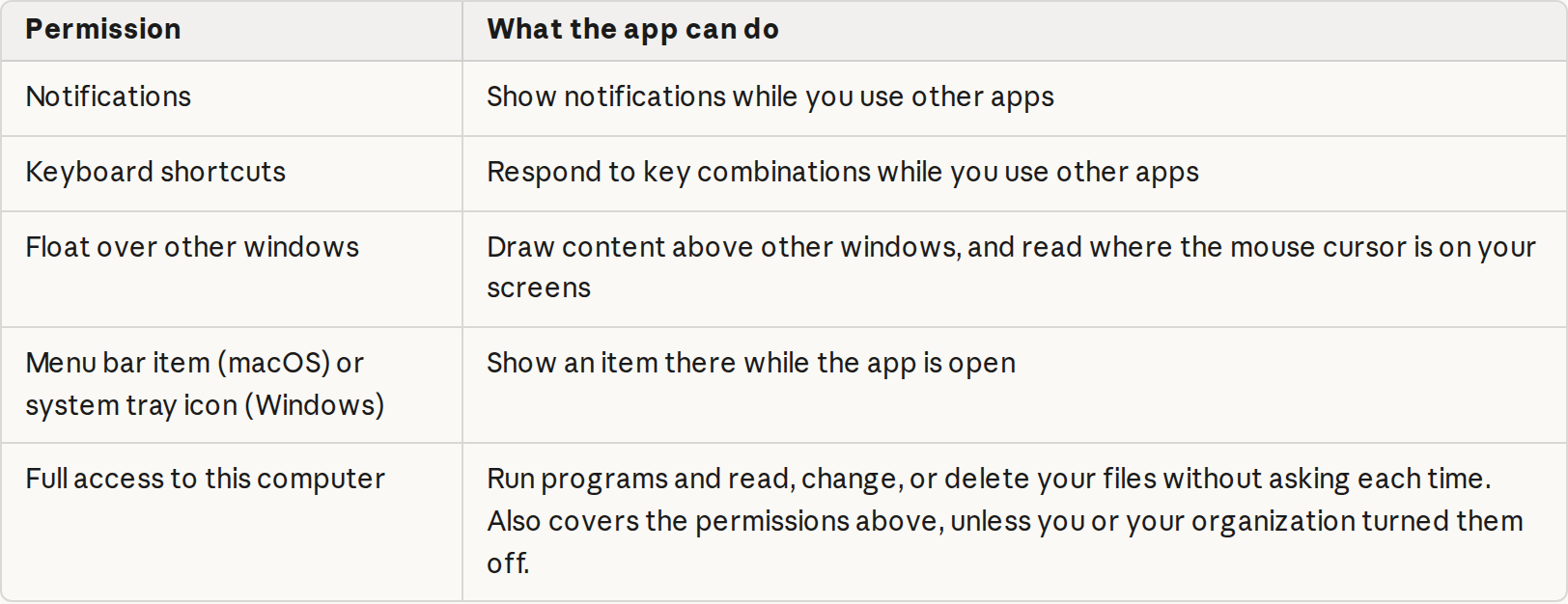
Anthropic’s permissions table shows what installed apps can request, including permission to run programs and read, change or delete files. Source: Claude Help Center.
Permissions have three levels. By default, an app is restricted to browser-like capabilities. Individual app permissions can enable notifications, global keyboard shortcuts, menu bar or tray items, and windows that float above other windows. The floating-window permission also permits reading the cursor’s position on screen. Full computer access permits running programs and reading, changing or deleting files without asking for each action.
Anthropic says it does not review apps before installation. Full access is restricted to apps users made themselves or, for Team and Enterprise customers, apps made within their organization. Allowing a permission covers one version; Claude asks again after updates, including the user’s own edits. A denial remains in place until the user changes it. Code loaded from another website can change without a fresh permission request, an important qualification to that version-based safeguard.
Revocation also has limits. Turning off full access stops programs the app started, except those that have detached themselves from it, and does not undo previous changes. If sharing access is withdrawn, the guide says programs the app started can take up to about 20 minutes to stop, or longer when Claude cannot check access. Uninstalling removes granted permissions but leaves the underlying artifact in place. These distinctions matter when a personal convenience tool becomes software trusted with work files.
The beta spans Free, Pro, Max, Ultra, Team and Enterprise plans and requires Claude Desktop version 6.28899.0 or later. Team customers have installation enabled by default, with full access disabled until an administrator enables it. Enterprise owners must enable the feature itself.
Availability has further boundaries. Linux, web and mobile installation are unsupported. Template-based Docs, Slides and Sheets, legacy artifacts and live artifacts from Claude Cowork cannot be installed. Anthropic excludes HIPAA-ready organizations and hybrid deployments. Full access is unavailable in Claude for Teachers and K–12 organizations; installation may also be disabled or unavailable. For organizations using zero data retention for Claude Code, the support guide says installed apps are not covered by that protection. On macOS, Claude’s computer-use feature can see an installed app but cannot click or type in it.
For individuals, the next decision is which recurring tasks benefit enough from notifications, a persistent tray item or file access to justify the account dependency and permissions. For organizations, it is whether to enable installation alone or also authorize full computer access. The beta supplies a simpler installation path; evidence of reliability, task-level usage and the effectiveness of permission revocation will determine how broadly these tools can be trusted with daily work.
Attorney General Todd Blanche defended an interagency security judgment backing Jensen Huang’s return to Nvidia, but withheld details as chip-diversion allegations and demands for congressional testimony remained unresolved.
South Korea has increased rewards for reporting college entrance exam cheating amid concerns about AI-assisted misconduct. Cheaters who confess and identify accomplices can receive the full reward and reduced penalties, while the extent of AI use remains unproven.
Jensen Huang disputes that Trump alone secured his reinstatement, while acknowledging government security assurances. Nvidia's independent investigation is continuing despite his return.
New York has enacted a five-year moratorium on toys containing AI companions, with penalties up to $15,000 per day for each violation. The ban starts after this holiday season, and its scope depends on a statutory definition of simulated relationships.

Meta is putting Muse in Instagram messages and prompting users to organize saved posts. The integration widens access to an existing agent as Meta pursues transaction revenue, with compute costs and permission controls still consequential.
Anthropic's Skills over MCP beta lets service providers deliver and update workflow instructions through their connections to Claude. Skills and server instructions already existed; the change ties their delivery to the service, with deployment restrictions and approval controls that matter for business use.
Dell lifted its fiscal 2027 revenue outlook by $10 billion after a record quarter. AI servers led the expansion, but traditional servers and higher infrastructure margins also drove a sharp shift in its earnings mix.
Two independent amateur searches used OpenAI tools to build software for public telescope data. One flagged 49 possible planets; professional scrutiny has begun, but neither search has confirmed a new planet.
Jensen Huang reportedly admitted a conduct violation and promised employee feedback sessions after returning as Nvidia CEO. The board has pledged to continue its investigation and expand compliance oversight.
Kadoa tallies 28 purchases and 15 sales through September, highlighting President Donald Trump’s financial exposure to Nvidia while leaving his holdings during November’s turmoil unknown. The White House says independent managers control the accounts.
Walmart says Meta’s Muse can find products and complete purchases through its invitation-only Agent Gateway beta. The connection gives the outside AI agent a supported shopping route while Walmart handles product matching, accounts and checkout.
Britain’s cyber security authority says AI-assisted attacks have increased markedly since September, causing outages and compromises across multiple sectors. The agency attributes the change to faster, persistent automation of familiar attacks, while established security controls remain effective.
Epochal, founded by former xAI founding members Guodong Zhang, Zihang Dai and Manuel Kroiss, is launching a historical web environment for forecasting agents. Zhang is reportedly investing $100 million personally; the product’s replay results leave future prediction gains unproven.
Tidal is moving from labeling and demonetizing fully AI-generated recordings to banning them, citing a surge in deliveries and little listening. AI-assisted music will remain eligible, leaving detection and appeals central to enforcement.
MiniMax says its security systems logged and later accessed URLs from forwarded AI requests, including requests marked private. It has disabled the mechanism, while Novita has confirmed unexpected forwarding and OpenRouter is testing the chain behind its privacy labels.
Five directors reportedly lead all-stock talks between Elon Musk’s two public companies. Ownership, voting rights and the economics of SpaceX’s heavy AI spending remain central to assessing a potential combination.
The Document Foundation now requires contributors to seek permission before using large language models in LibreOffice development. Even approved users face disclosure requirements, human-written communications and restrictions on compatibility-sensitive code.
Donald Trump's intervention in Jensen Huang's return as Nvidia CEO coincided with a rally that may have added up to $15 million to his holdings. Disclosure ranges and missing recent trades leave the actual gain uncertain.
Britain’s financial regulator says AI providers must assess whether their agents perform regulated activities, while banks and other regulated firms retain responsibility for systems supplied by outsiders.