Editorial Team
7 min read
Anthropic's Skills over MCP beta lets service providers deliver and update workflow instructions through their connections to Claude. Skills and server instructions already existed; the change ties their delivery to the service, with deployment restrictions and approval controls that matter for business use.
Anthropic, the developer of the Claude AI assistant and the Claude Code coding agent, has opened a public beta that lets connected services deliver workflow skills alongside their tools. The November 24 announcement ties instructions for multi-step jobs to the service supplying the connection, so providers can update both together.
That gives software providers a way to maintain the playbooks Claude uses for their services. For customers, the decision combines convenience with control: accepting a connection can also mean accepting an ongoing source of instructions capable of directing code execution.
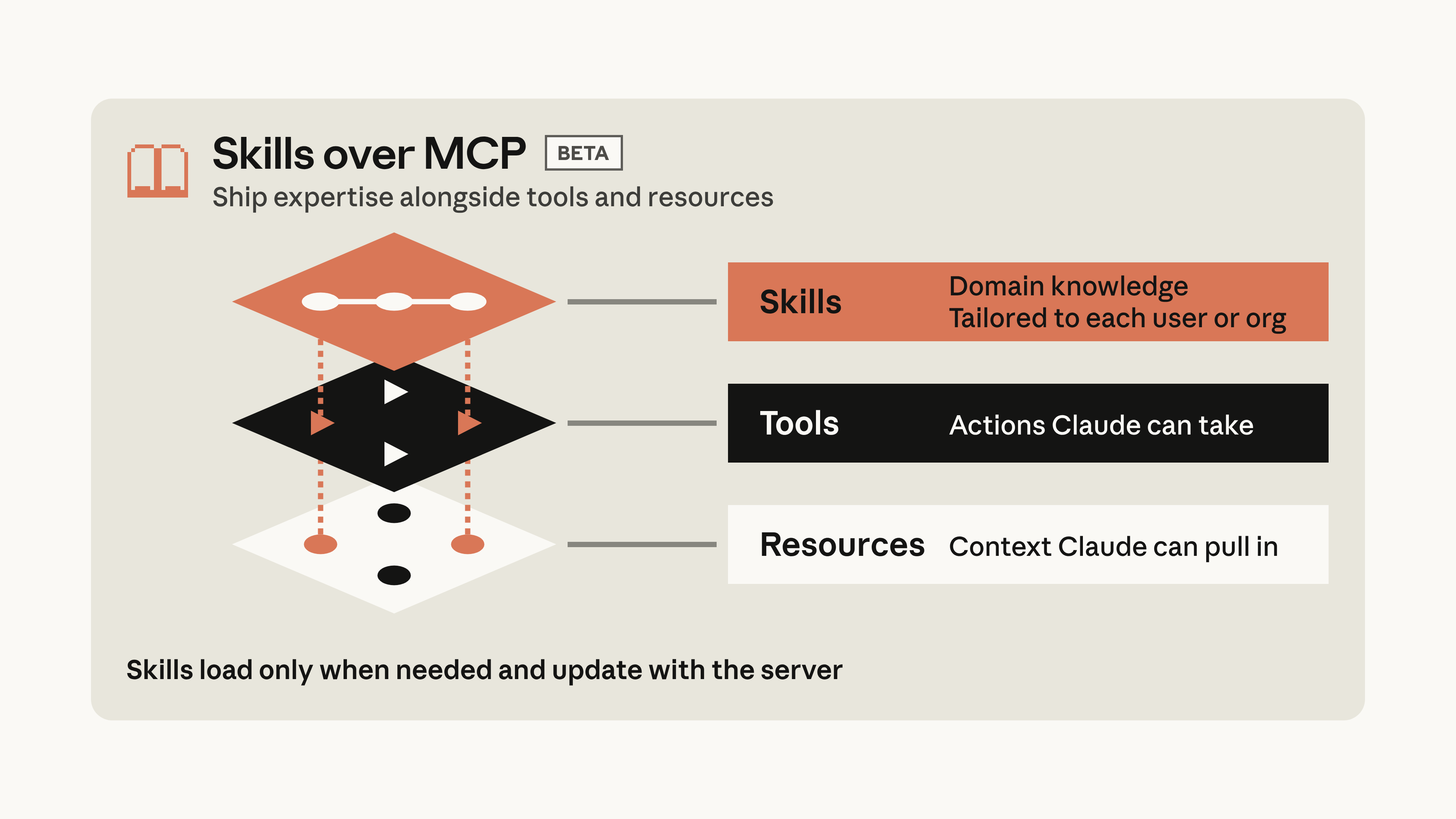
Anthropic’s Skills over MCP diagram shows workflow guidance alongside tools and resources. Skills load when needed and update with the server. Source: Anthropic. Source: Anthropic.
The Model Context Protocol, or MCP, is the open standard Anthropic introduced in November 2024 to connect AI systems to external tools and data. An MCP server exposes a service's capabilities to a client such as Claude; a connector makes that service accessible through the relationship. Skills over MCP adds a defined way to deliver skills containing workflows, references and account- or organization-specific practices.
Skills themselves predate this release. Anthropic's earlier Agent Skills announcement described folders of instructions, scripts and resources loaded when relevant, with support across Claude apps, Claude Code and the API. Users could already install skills through plugins or local folders and share them through version control.
MCP also already carried server instructions and reusable prompts. The Claude Code reference describes prompts exposed as commands and instructions that help Claude find a server's tools. The beta therefore extends an existing system for supplying guidance; it does not introduce instructions to otherwise instruction-free connections. Its practical change is to make skills discoverable through the server, loaded when needed and maintained with that server's tools.
Anthropic's examples span Shopify store design and updates, HubSpot customer onboarding, and Atlassian analysis using organizational context. These are examples of supported workflows, not evidence that every connector now supplies skills. The reference documentation says Anthropic keeps skills disabled for some connectors during the beta, with no user setting to override that restriction.
Carta's connector illustrates another availability distinction. Its launch post says Claude can issue equity and retrieve fund data as soon as users connect Carta. Anthropic separately lists drafting and issuing equity from an uploaded document as coming soon. Carta's broader connector claim does not establish that this document-based workflow has shipped.
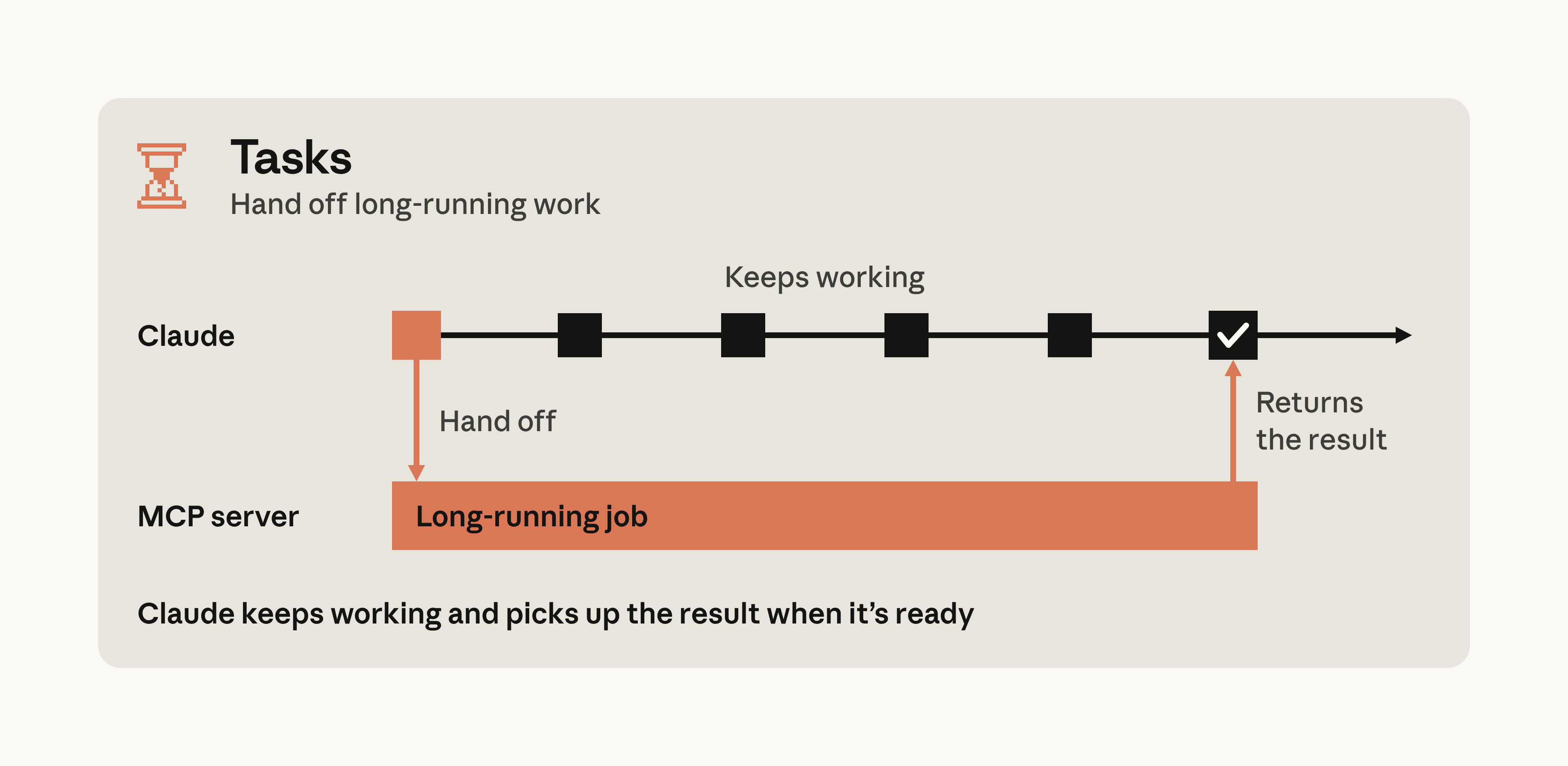
Tasks lets an MCP server run a longer job while Claude continues working and retrieves the result when ready. Source: Anthropic. Source: Anthropic.
Alongside the beta, Anthropic says Tasks and Elicitation are generally available in Claude and Claude Code for Pro, Max and Ultra plans, and rolling out to Team and Enterprise organizations.
Tasks lets an MCP server perform a longer operation, including an agent loop, while Claude continues working and later retrieves the result. Anthropic cites ZoomInfo's deeper account and contact research as an example of work that previously required several prompts.
The operational distinction is consequential: the Claude Code documentation says a task on a remote server keeps running after the user exits. Using the stop command requests cancellation, but the server may still finish the job. Customers need to distinguish leaving a conversation, requesting cancellation and confirming that work actually stopped.
Elicitation lets a server pause an operation to request input through a form or link, then resume. Anthropic says Supabase confirms costs before creating a paid project and seeks confirmation before destructive SQL; Railway asks before potentially destructive changes such as removing a service; and GitHub requires a repository's name before deletion. These are service-implemented checkpoints. Claude Code also supports hooks that can answer elicitation requests automatically, so the mechanism alone does not guarantee a human approves every consequential action.
File Uploads is a separate, forthcoming extension. Anthropic says it will let Claude pass PDFs, spreadsheets and images to servers without routing the files through the model's context window. The announcement lists rollout as coming soon for Claude and Claude Code on Pro, Max, Ultra and eligible Team and Enterprise plans.
Anthropic originated MCP, but the standard now sits in the Agentic AI Foundation, established by the Linux Foundation, the nonprofit steward of open-source projects including Linux and Kubernetes. Its December 2025 formation announcement named MCP as a founding contribution alongside Block's goose agent framework and OpenAI's AGENTS.md convention for repository instructions.
That announcement already listed MCP adoption by Cursor, Microsoft Copilot, Gemini, VS Code and ChatGPT as well as Claude. A report tracing the protocol's expansion also describes OpenAI's addition of remote MCP servers to its Responses API in May 2025. Anthropic says the latest features belong to the open specification and its extensions and work in compatible clients. Existing MCP adoption does not establish that those clients have implemented every new extension.
Anthropic reports more than 700 million monthly downloads of MCP software development kits and more than 10,000 MCP connectors for Claude. These measure downloads and connector availability, not distinct users, paid customers or completed workflows. They also provide no like-for-like measure of adoption of the new beta.
The release builds on earlier infrastructure work: Anthropic says the latest MCP specification is stateless, reducing server scaling burdens; Enterprise Managed Auth lets administrators authorize supported servers once; and MCP Apps embeds service interfaces in Claude. These are foundations for the launch, not new capabilities of the Skills beta itself.
Anthropic also says existing tool search can reduce the context occupied by tool definitions by more than 85% in multi-server setups. That is neither an equivalent reduction in total inference costs nor a measured result for Skills over MCP. The launch supplies no per-workflow cost comparison or comparative task-completion benchmark for the beta.
Skills over MCP is on by default for Pro, Max and Ultra plans in Claude and Claude Code, and requires administrator enablement for Team. The launch announcement lists Enterprise support as forthcoming, while the Claude Code reference already describes Enterprise enablement and scanning controls. Those descriptions should not be read as confirmation of a completed Enterprise rollout.
Claude Code requires version 2.1.331 or later, a supported model and a direct Anthropic connection with feature-flag fetching enabled. Its reference excludes cloud sessions, non-interactive runs and the Agent SDK from MCP skills support, as well as cloud-provider connections and some compliance configurations, including zero data retention. These are restrictions on MCP-delivered skills, not on MCP tools or all locally installed skills.
The permission model also matters. In Claude Code's default auto mode, a classifier decides whether an MCP skill loads without displaying a user prompt or reading the skill. Manual mode prompts; users can approve the current version until its files change. Explicit ask rules can require approval each time, including in auto mode, and deny rules can block skills. Approving all future versions through an allow rule is limited to specified server and settings scopes; it is not a blanket option for connectors or plugin servers.
Anthropic scans skills from third-party Directory connectors added through claude.ai, and from custom connectors when an Enterprise organization's scanning setting is enabled. It does not scan every server: even a Directory server added through the command line falls outside that coverage. The documentation warns that servers can change skills at any time and that skills can direct Claude to run code. Trust in the provider therefore remains part of the deployment decision after the initial connection.
For organizations considering the beta, the immediate decision is which providers may supply changing instructions and which loads require approval. Supported execution environments and cancellation behavior need checking alongside the workflow itself.
The unanswered performance question is whether a provider-maintained skill completes the same job more reliably, with fewer interventions and lower total cost than tools combined with existing prompts or separately installed skills. Comparable task results—including failures, required approvals and server-side charges—would establish the value of the new delivery mechanism. The launch's examples and SDK download totals do not yet answer that question.
OpenAI says proteins based on GPT-6.2 designs bound to five targets in laboratory tests. The results suggest general-purpose models can take on parts of protein design, while specialist screening and evidence beyond binding remain essential.
Attorney General Todd Blanche defended an interagency security judgment backing Jensen Huang’s return to Nvidia, but withheld details as chip-diversion allegations and demands for congressional testimony remained unresolved.
Anthropic is rolling out a beta that installs Claude artifacts as Mac and Windows apps. They gain desktop permissions and their own windows, but still depend on a Claude account, connectivity and plan limits.
South Korea has increased rewards for reporting college entrance exam cheating amid concerns about AI-assisted misconduct. Cheaters who confess and identify accomplices can receive the full reward and reduced penalties, while the extent of AI use remains unproven.
Jensen Huang disputes that Trump alone secured his reinstatement, while acknowledging government security assurances. Nvidia's independent investigation is continuing despite his return.
New York has enacted a five-year moratorium on toys containing AI companions, with penalties up to $15,000 per day for each violation. The ban starts after this holiday season, and its scope depends on a statutory definition of simulated relationships.

Meta is putting Muse in Instagram messages and prompting users to organize saved posts. The integration widens access to an existing agent as Meta pursues transaction revenue, with compute costs and permission controls still consequential.
Dell lifted its fiscal 2027 revenue outlook by $10 billion after a record quarter. AI servers led the expansion, but traditional servers and higher infrastructure margins also drove a sharp shift in its earnings mix.
Two independent amateur searches used OpenAI tools to build software for public telescope data. One flagged 49 possible planets; professional scrutiny has begun, but neither search has confirmed a new planet.
Jensen Huang reportedly admitted a conduct violation and promised employee feedback sessions after returning as Nvidia CEO. The board has pledged to continue its investigation and expand compliance oversight.
Kadoa tallies 28 purchases and 15 sales through September, highlighting President Donald Trump’s financial exposure to Nvidia while leaving his holdings during November’s turmoil unknown. The White House says independent managers control the accounts.
Walmart says Meta’s Muse can find products and complete purchases through its invitation-only Agent Gateway beta. The connection gives the outside AI agent a supported shopping route while Walmart handles product matching, accounts and checkout.
Britain’s cyber security authority says AI-assisted attacks have increased markedly since September, causing outages and compromises across multiple sectors. The agency attributes the change to faster, persistent automation of familiar attacks, while established security controls remain effective.
Epochal, founded by former xAI founding members Guodong Zhang, Zihang Dai and Manuel Kroiss, is launching a historical web environment for forecasting agents. Zhang is reportedly investing $100 million personally; the product’s replay results leave future prediction gains unproven.
Tidal is moving from labeling and demonetizing fully AI-generated recordings to banning them, citing a surge in deliveries and little listening. AI-assisted music will remain eligible, leaving detection and appeals central to enforcement.
MiniMax says its security systems logged and later accessed URLs from forwarded AI requests, including requests marked private. It has disabled the mechanism, while Novita has confirmed unexpected forwarding and OpenRouter is testing the chain behind its privacy labels.
Five directors reportedly lead all-stock talks between Elon Musk’s two public companies. Ownership, voting rights and the economics of SpaceX’s heavy AI spending remain central to assessing a potential combination.
The Document Foundation now requires contributors to seek permission before using large language models in LibreOffice development. Even approved users face disclosure requirements, human-written communications and restrictions on compatibility-sensitive code.
Donald Trump's intervention in Jensen Huang's return as Nvidia CEO coincided with a rally that may have added up to $15 million to his holdings. Disclosure ranges and missing recent trades leave the actual gain uncertain.
Britain’s financial regulator says AI providers must assess whether their agents perform regulated activities, while banks and other regulated firms retain responsibility for systems supplied by outsiders.