Editorial Team
5 min read
The Nasdaq 100 fell 4.32% in morning trading on November 25 as AI shares slid alongside tariff and inflation concerns. Its retreat approached 20% from October levels, but the comparison depends on intraday versus closing prices, and the session was unfinished.
The Nasdaq 100 fell more than 4% on November 25 as semiconductor shares led technology stocks lower and Nvidia, the AI chip supplier, lost about 8%. A morning market report put the benchmark on course for a bear market. Trading was still underway, leaving the closing-price test unsettled.
The stakes extend beyond individual chipmakers. Launched in January 1985, the Nasdaq 100 tracks 100 large Nasdaq-listed nonfinancial companies. Technology has the largest weight, but consumer and healthcare businesses also feature. Its modified market-capitalization method gives larger companies more influence, subject to weight limits. Exchange-traded and mutual funds provide ways to track it. The operator said more than $1.7 trillion of exposure was linked to the benchmark globally as of June 30, 2026, in its index guide. That figure measures linked exposure, not losses or withdrawals during this selloff.
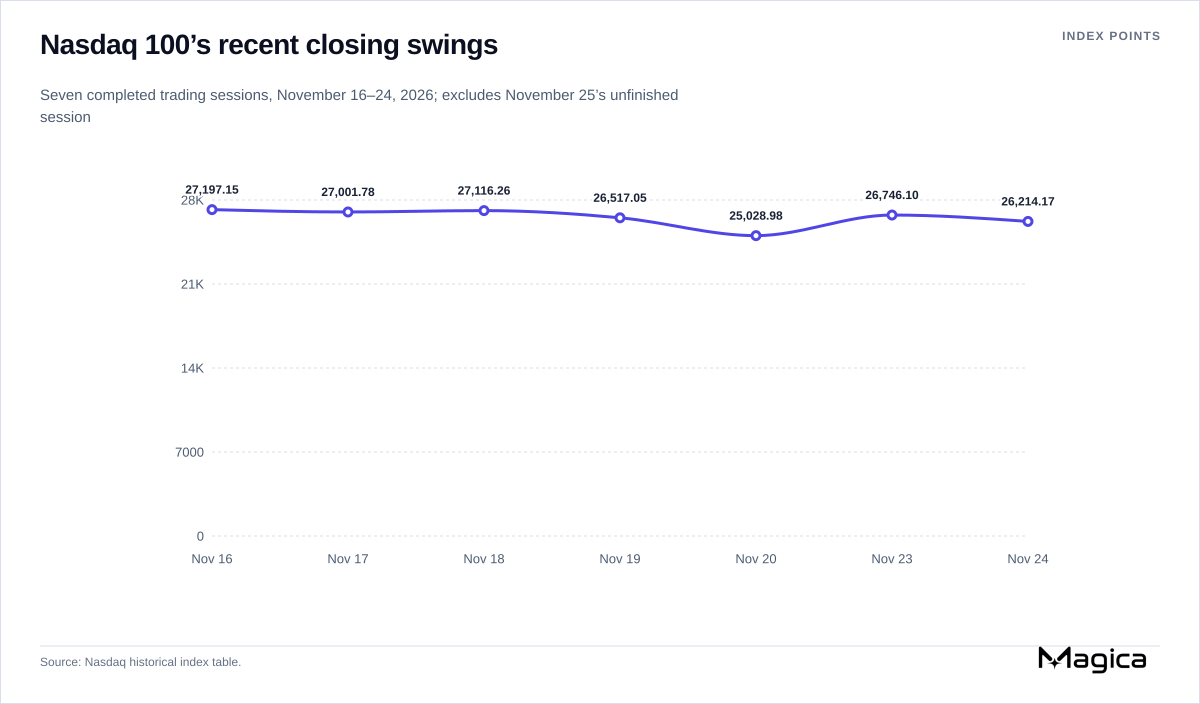
Nasdaq 100 closes across seven completed sessions. November 25’s unfinished session is excluded. Chart: Magica; data: Nasdaq. Source: Nasdaq.
The morning index snapshot showed the Nasdaq 100 at 25,082.21, down 1,131.95 points, or 4.32%, from the previous close of 26,214.17. Its November 25 historical closing-value field was still blank.
The morning report described the index as more than 20% below its peak. A separate market update put the retreat from its October record at about 19%. These snapshots should not be treated as identical measurements. Nasdaq's visible history shows how the reference price changes the calculation:
Sellers are seeking buyers for thousands of Nvidia B300 chips, while Asian data centers try to replace Chinese customers affected by U.S. controls. Rental prices have fallen, but short contracts remain scarce and operators face demanding financing terms.
| October 6 reference | Index level | Decline to 25,082.21 | Level 20% below reference |
|---|---|---|---|
| Closing value | 31,224.69 | 19.67% | 24,979.75 |
| Intraday high | 31,361.37 | 20.02% | 25,089.10 |
The declines equal one minus the November 25 quote divided by each reference; the threshold levels equal 80% of those references. October 6 has the highest closing value and intraday high in the 50 displayed rows, which run back to September 17. That limited table does not independently establish an all-time record.
The displayed quote was above the closing-reference boundary, although the day's low of 24,970.66 had dipped beneath it. Neither observation establishes where the session would finish. The history also shows that the retreat was interrupted by sharp rebounds: after closing at 25,028.98 on November 20, the index rose to 26,746.10 on November 23, a calculated gain of 6.9%, before falling again.
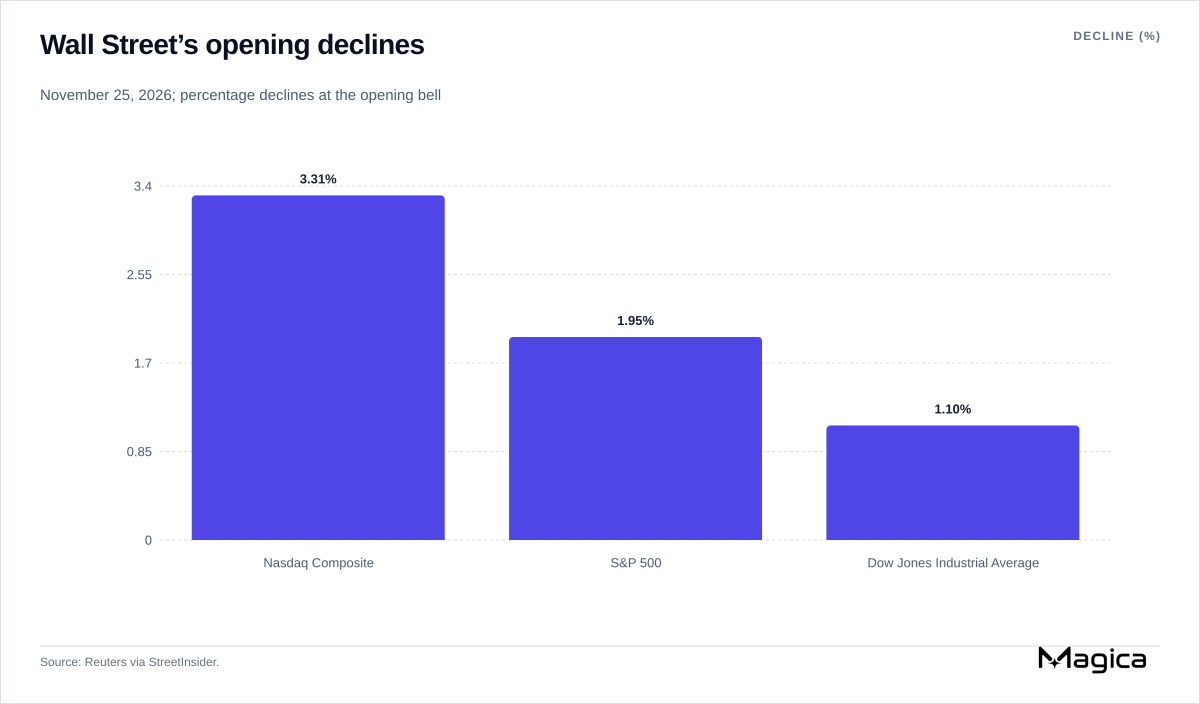
Opening declines on November 25, distinct from the later Nasdaq 100 snapshot. Chart: Magica; data: Reuters via StreetInsider. Source: Reuters via StreetInsider.
The weakness spread beyond the Nasdaq 100. At the opening bell, the broader Nasdaq Composite fell 3.31% to 22,948.482, while the S&P 500 lost 1.95% and the Dow Jones Industrial Average declined 1.10%, according to the opening market report. Those opening moves and the later Nasdaq 100 quote concern different benchmarks and observation times.
The morning account linked pressure on growth stocks to a new tariff announcement and hotter-than-expected inflation data, which raised expectations of a Federal Reserve rate increase in December. Those were expectations about a future policy decision, not an announced increase.
The tariff plans concerned goods from China, the European Union and a dozen other economies. The market update placed them within US President Donald Trump's effort to restore sweeping global import taxes after the Supreme Court found those taxes unconstitutional. The opening report described proposals, rather than tariffs already in effect.
Yet inflation concerns did not prevent a move into government debt. The market update put the 10-year Treasury yield at 4.82%, down 11 basis points, and described its eighth consecutive daily decline. It also identified AI spending and borrowing costs as continuing concerns. Expectations for a policy-rate increase and falling longer-term Treasury yields were occurring together.
The selloff followed a brief improvement in sentiment around Nvidia's leadership. Jensen Huang, its returning president and chief executive, was reinstated to those roles and the board on November 23, the company said in its board announcement filed with the SEC. Nvidia said the vote was unanimous, but an independent directors' investigation into reports that Huang had been targeted by a foreign intelligence effort would continue, alongside government investigations and inquiries.
The market update described fading enthusiasm following Huang's return as spending and financing concerns persisted. The leadership decision therefore provides relevant context for the week's reversal; it does not establish the cause of Wednesday's losses.
Nor did falling shares uniformly signal weaker company forecasts. Dell Technologies joined the technology retreat despite raising its revenue outlook for the third time, the same update said. That outlook was Dell's forecast, not realized revenue. Together, these accounts limit what stock prices alone establish about AI demand or business performance.
The immediate test is the closing index level against a verified prior closing peak. Relative to the October 6 close shown in Nasdaq's table, the 20% boundary is 24,979.75. The morning snapshot cannot supply a closing confirmation, and a full peak history is needed to verify the record reference.
Beyond that label, the unresolved question is whether spending and financing concerns translate into weaker orders, revenue or investment plans. These market reports do not establish those changes or separate the effect of AI reassessment from tariff and interest-rate pressures. Subsequent company results and spending disclosures would be needed to make that judgment.
Lenders are delaying or reassessing financing for Asian data centers serving Chinese technology firms as new US licensing rules put chip purchases and customers’ access to computing capacity in doubt.
Meta employees describe cuts to moderation teams and difficulty correcting mistakes as AI enforcement expands. Meta claims better accuracy, while account restrictions and an EU investigation put the effectiveness of appeals under scrutiny.
Dario Amodei rejects handing political authority to AI while defending task automation. An independent assessment finds faster progress at Anthropic, largely through AI assistance, but leaves important evidence outside public view.
OpenAI is piloting Private Inference with selected business customers. The feature targets provider access during processing, but model coverage, costs and evidence of its protections remain key questions.
Executives at rival AI developers are challenging a view reported among some Anthropic employees that people should delegate authority to superior machines. Anthropic defends human oversight, while the dispute exposes a harder question about who retains power when AI makes better decisions.
Officials told congressional staff there was no evidence China directed Alice Huang’s affair with Nvidia founder Jensen Huang. Reports of later information sharing, excluded intelligence and scrutiny of her former company complicate the security assessment.
Updates incorporating Sam Corcos’s requests appeared in his AI-built strategy game during a FinCEN cyber disruption. The Treasury CIO says computers develop it autonomously; the record does not establish time diverted from official duties or who pays the project’s costs.
SpaceX won conditional authorization for its Starmind orbital data centers, with deployment deadlines through 2040. The FCC left higher-altitude debris plans unresolved and did not judge whether the computing business will work.
NVIDIA has released Nemotron-Labs-Image-30B-A3B for non-commercial research and evaluation. The broader creation framework awaits legal clearance, and its best GenEval and GenEval2 results use GPT-6 assistance rather than the downloadable generator alone.
SpaceX reportedly lowered small-cluster Blackwell quotes to $10–$12 per GPU-hour, matching rates already offered to large customers. A possible Anthropic nonrenewal puts roughly 50,000 older H200 GPUs in focus, but does not establish an exit from the broader compute relationship.
CoreWeave’s debt sold off despite a brief stock-market rally around Nvidia’s leadership reversal. Recent fundraising and expected customer prepayments offer support, but infrastructure purchases far exceed operating cash flow and debt has more than doubled since year-end.
A public supply page advertises B300 systems at up to 18.6 million yuan apiece, alongside trader reports of nearly $3 million prices. Its verification warnings leave inventory, sellers and delivery unproven.
ARK bought a reported 751,710 Anthropic shares across six ETFs before the stock opened lower Wednesday. The purchase follows an IPO and private placement totaling $119.5 billion in gross proceeds, but the Claude developer faces slowing sequential revenue growth and heavy compute obligations.
Google Research’s AI framework claims an unconditional factoring algorithm that improves on a 1992 theoretical bound. The six-paper release awaits independent scrutiny and promised machine-checkable proofs, and does not establish a practical encryption-breaking advance.
New US chip controls put Malaysian data center projects serving Chinese AI customers under scrutiny. Workloads and ownership determine exposure, while existing US tenants and private equity funding complicate predictions of a broad financing retreat.
Fujitsu is combining OpenAI Daybreak with its own assessment system and security specialists to find exploitable vulnerabilities, propose fixes and retest them. Pricing is undisclosed, and its internal results do not establish comparative performance.
EA will add an optional John Motson commentary track to FC 27 on November 26, mixing archive recordings with AI-generated speech. His family has licensed the recreation, raising a different consent question from EA’s existing work with living commentators.
Authors allege NVIDIA distributed pirated books through BitTorrent and to business partners including Adobe. The court allowed the amended pleading, but transfers of the authors’ own works remain unproven.
Malaysia will advise data centres against hosting or serving seven US-blacklisted entities. The move targets access to local computing infrastructure while Malaysian reexport checks and the terms of the advisory remain unresolved.