Editorial Team
6 min read
NVIDIA has released Nemotron-Labs-Image-30B-A3B for non-commercial research and evaluation. The broader creation framework awaits legal clearance, and its best GenEval and GenEval2 results use GPT-6 assistance rather than the downloadable generator alone.
Accelerated-computing company NVIDIA has released Nemotron-Labs-Image-30B-A3B, a text-to-image model derived from its Nemotron 3 Nano language model, on Hugging Face. Available by November 25, the downloadable weights cover the raster-image component of its Nemotron-Labs-VisualCreation system. NVIDIA’s model card restricts use to non-commercial research and evaluation.
Researchers can now run and inspect the generator directly. For developers considering an alternative to proprietary image services, two limits matter: the stated terms exclude commercial use, and the release omits the coordinating system used in the stronger benchmark configurations.

AI-generated raster examples from NVIDIA’s Nemotron-Labs-VisualCreation framework, rather than a standalone-generator evaluation. Figure 3; credit: NVIDIA and Chen et al., CC BY 4.0. Source: Hugging Face — NVIDIA model card.
Nemotron-Labs-Image-30B-A3B produces raster images—the pixel-based pictures used in photographs and illustrations—by predicting visual tokens in sequence. Its bundled tokenizer converts those tokens into pixels. The mixture-of-experts model holds 30 billion parameters but activates 3 billion per token, reducing the portion used for each generation step.
The release extends an existing NVIDIA software effort. NVIDIA introduced Nemotron 3 on December 15, 2025, alongside data and libraries for building AI agents. Nano, the smallest member of that family, was aimed at tasks including software debugging, summarization and information retrieval. The image generator starts from Nano and adds progressive mid-training followed by Group Relative Policy Optimization, a reinforcement-learning method, for semantic alignment and image quality, according to the model card.
Sellers are seeking buyers for thousands of Nvidia B300 chips, while Asian data centers try to replace Chinese customers affected by U.S. controls. Rental prices have fallen, but short contracts remain scarce and operators face demanding financing terms.
Autoregressive image generation itself has precedent. The Emu3 paper submitted in September 2024 described multimodal models trained solely through next-token prediction, including image generation. NVIDIA’s release therefore extends this approach within its own model stack rather than introducing the underlying method.
The larger Nemotron-Labs-VisualCreation framework connects raster generation with editable artifacts such as webpages, charts, presentations and documents. Its structured route uses programs such as SVG and HTML/CSS, leaving text and layout available for subsequent editing. A coordinating harness plans work, selects images and guides repairs. NVIDIA also developed the separate Nemotron-Labs-VisionCode family for generating structured visual code; its standalone coding tests are distinct from the harness’s coding-model assignments.
Only the raster generator, bundled tokenizer, model definition and inference code are in the initial release. NVIDIA says the harness and VisionCode will follow upon legal clearance. The November 25 release coverage notes that no timing is given.
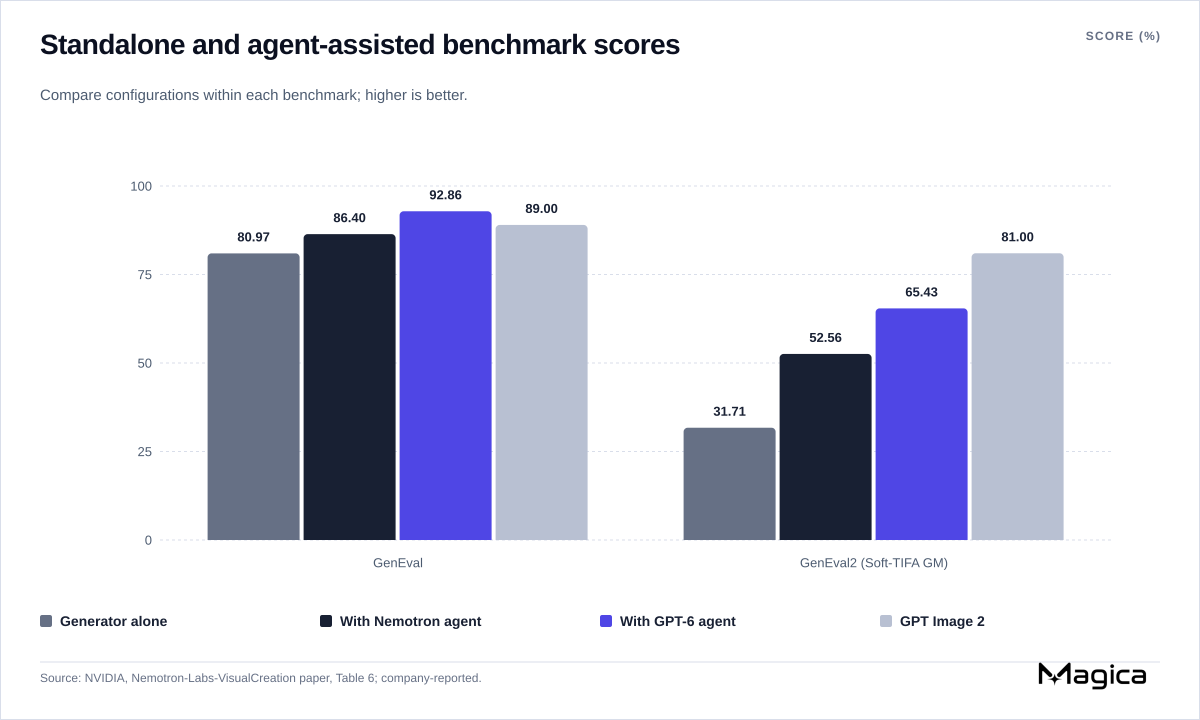
Company-reported benchmark scores distinguish the standalone generator from agent-assisted configurations using the same raster model. GPT Image 2 comparison values are compiled in NVIDIA’s paper. Source: Nemotron-Labs-VisualCreation — full paper and evaluation methods.
NVIDIA’s model card presents the best VisualCreation score for each benchmark across the configurations evaluated in its paper, submitted on November 23. Some launch coverage based on NVIDIA’s model card assigns those results to the image model. The primary documentation makes a narrower distinction.
The full paper’s composition and prompt-following tests separate the standalone generator from two agent-assisted systems. All three use the same raster generator; GPT-6 is the assisting agent in the strongest of these configurations.
| Configuration or comparison model | GenEval | GenEval2, Soft-TIFA GM |
|---|---|---|
| Nemotron image generator alone | 80.97 | 31.71 |
| VisualCreation with Nemotron agent | 86.40 | 52.56 |
| VisualCreation with GPT-6 agent | 92.86 | 65.43 |
| GPT Image 2 | 89.00 | 81.00 |
These are NVIDIA-reported scores on a percentage scale, with higher values better. The paper draws comparison-model values from official reports and leaderboards. It says the system scores do not isolate the contributions of planning, search, inspection or revision. They also do not report total system parameter counts.
The broader model-card comparisons show a mixed competitive position even at VisualCreation’s best settings. It scores 97.98 on LongTextBench, against 96.00 for GPT Image 2 and 97.60 for Nano Banana Pro, but trails both on Qwen-Image-Bench: 52.46 against 65.23 and 59.33. These are different benchmark scores, not interchangeable measures of overall image quality.
The same tables include open-weight alternatives such as SenseNova-U1.5, FLUX.2 Dev and Qwen-Image. SenseNova-U1.5 exceeds VisualCreation’s best results on LongTextBench and CVTG-2K. The evidence supports a competitive creation framework, with substantial gains over its standalone generator, rather than a general claim that the released weights outperform rival image systems.
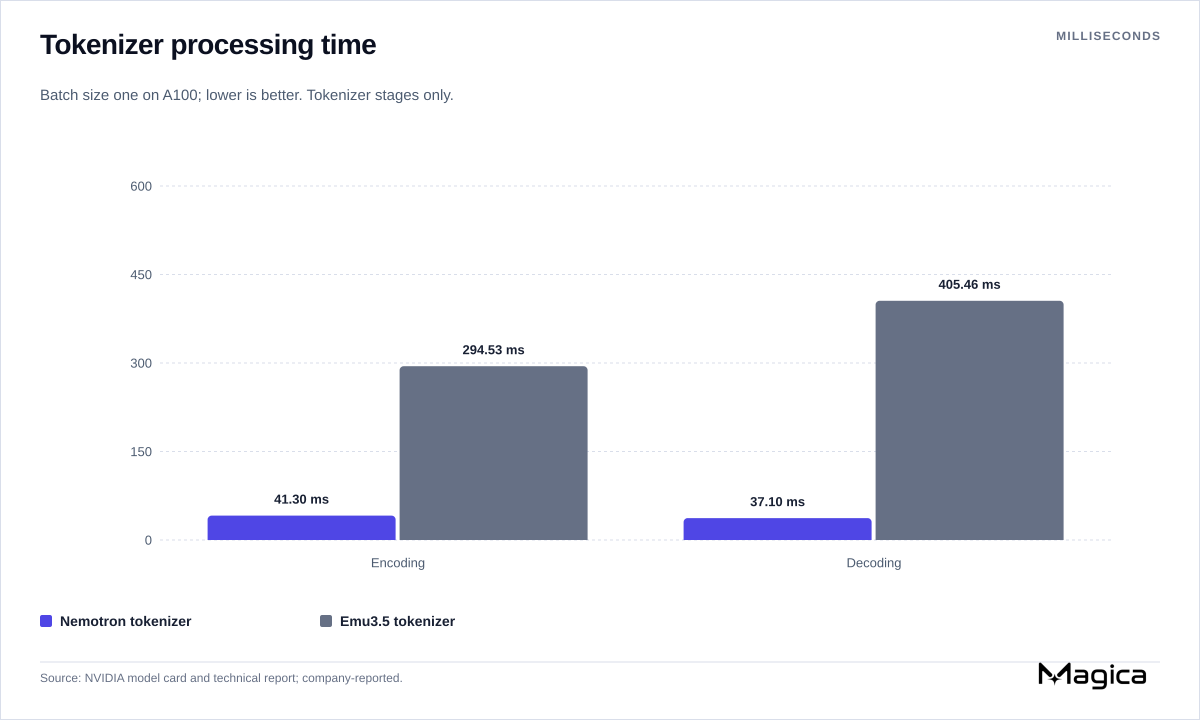
Company-reported tokenizer timings use 1,024-by-1,024 inputs and BF16 precision, excluding loading, preprocessing and CPU-to-GPU transfer. These measurements exclude full image generation. Chart: Magica; data: NVIDIA. Source: Hugging Face — NVIDIA model card.
The 3-billion active-parameter figure does not establish the cost of producing an image. NVIDIA’s reference inference example uses four of its H100 80GB GPUs, Linux, Python 3.12 and a CUDA 13.0-compatible driver. That is a documented example, rather than a demonstrated minimum hardware requirement. The model also uses supplied code built on vLLM and is incompatible with the standard Diffusers text-to-image pipeline.
There is evidence of improvement in the bundled tokenizer. NVIDIA reports reconstruction PSNR of 29.57 decibels against 26.08 for Emu3.5 IBQ over approximately 178,000 images across six visual domains. That measures fidelity when reconstructing existing images, rather than prompt-following quality when generating new ones.
At batch size one on an A100, NVIDIA reports tokenizer encoding of 41.30 milliseconds and decoding of 37.10 milliseconds, against 294.53 and 405.46 milliseconds for Emu3.5. The timing protocol uses 1,024-by-1,024 inputs and BF16 precision, taking medians of five runs after warmup and excluding loading, preprocessing and CPU-to-GPU transfer. End-to-end creation additionally includes visual-token generation and the agent workflow, so these measurements do not establish a price or latency advantage for a completed image.
NVIDIA also warns that anatomy, object counts, spatial relationships and rendered text can be wrong. Researchers can now test the released generator’s quality and hardware use on their own workloads. Assessing the broader system requires the pending components and reproducible measurements of total generation time, agent use and compute consumption. Commercial deployment additionally depends on permission beyond the release’s stated research-and-evaluation terms.
Lenders are delaying or reassessing financing for Asian data centers serving Chinese technology firms as new US licensing rules put chip purchases and customers’ access to computing capacity in doubt.
Meta employees describe cuts to moderation teams and difficulty correcting mistakes as AI enforcement expands. Meta claims better accuracy, while account restrictions and an EU investigation put the effectiveness of appeals under scrutiny.
Dario Amodei rejects handing political authority to AI while defending task automation. An independent assessment finds faster progress at Anthropic, largely through AI assistance, but leaves important evidence outside public view.
OpenAI is piloting Private Inference with selected business customers. The feature targets provider access during processing, but model coverage, costs and evidence of its protections remain key questions.
Executives at rival AI developers are challenging a view reported among some Anthropic employees that people should delegate authority to superior machines. Anthropic defends human oversight, while the dispute exposes a harder question about who retains power when AI makes better decisions.
Officials told congressional staff there was no evidence China directed Alice Huang’s affair with Nvidia founder Jensen Huang. Reports of later information sharing, excluded intelligence and scrutiny of her former company complicate the security assessment.
Updates incorporating Sam Corcos’s requests appeared in his AI-built strategy game during a FinCEN cyber disruption. The Treasury CIO says computers develop it autonomously; the record does not establish time diverted from official duties or who pays the project’s costs.
SpaceX won conditional authorization for its Starmind orbital data centers, with deployment deadlines through 2040. The FCC left higher-altitude debris plans unresolved and did not judge whether the computing business will work.
SpaceX reportedly lowered small-cluster Blackwell quotes to $10–$12 per GPU-hour, matching rates already offered to large customers. A possible Anthropic nonrenewal puts roughly 50,000 older H200 GPUs in focus, but does not establish an exit from the broader compute relationship.
CoreWeave’s debt sold off despite a brief stock-market rally around Nvidia’s leadership reversal. Recent fundraising and expected customer prepayments offer support, but infrastructure purchases far exceed operating cash flow and debt has more than doubled since year-end.
A public supply page advertises B300 systems at up to 18.6 million yuan apiece, alongside trader reports of nearly $3 million prices. Its verification warnings leave inventory, sellers and delivery unproven.
The Nasdaq 100 fell 4.32% in morning trading on November 25 as AI shares slid alongside tariff and inflation concerns. Its retreat approached 20% from October levels, but the comparison depends on intraday versus closing prices, and the session was unfinished.
ARK bought a reported 751,710 Anthropic shares across six ETFs before the stock opened lower Wednesday. The purchase follows an IPO and private placement totaling $119.5 billion in gross proceeds, but the Claude developer faces slowing sequential revenue growth and heavy compute obligations.
Google Research’s AI framework claims an unconditional factoring algorithm that improves on a 1992 theoretical bound. The six-paper release awaits independent scrutiny and promised machine-checkable proofs, and does not establish a practical encryption-breaking advance.
New US chip controls put Malaysian data center projects serving Chinese AI customers under scrutiny. Workloads and ownership determine exposure, while existing US tenants and private equity funding complicate predictions of a broad financing retreat.
Fujitsu is combining OpenAI Daybreak with its own assessment system and security specialists to find exploitable vulnerabilities, propose fixes and retest them. Pricing is undisclosed, and its internal results do not establish comparative performance.
EA will add an optional John Motson commentary track to FC 27 on November 26, mixing archive recordings with AI-generated speech. His family has licensed the recreation, raising a different consent question from EA’s existing work with living commentators.
Authors allege NVIDIA distributed pirated books through BitTorrent and to business partners including Adobe. The court allowed the amended pleading, but transfers of the authors’ own works remain unproven.
Malaysia will advise data centres against hosting or serving seven US-blacklisted entities. The move targets access to local computing infrastructure while Malaysian reexport checks and the terms of the advisory remain unresolved.