Editorial Team
9 min read
Lenders are delaying or reassessing financing for Asian data centers serving Chinese technology firms as new US licensing rules put chip purchases and customers’ access to computing capacity in doubt.
Billions of dollars in proposed loans for Asian data centers and specialist AI cloud operators are facing delays or renewed scrutiny after US chip controls tightened access for their Chinese technology customers. The immediate financing question is whether operators can obtain the hardware and authorizations needed to deliver their planned services.
That uncertainty reaches businesses backed by major investment firms, as well as lenders already holding infrastructure debt. But the reported decisions range from extra due diligence to individual investors declining a loan. They do not establish that the region’s data-center market has stopped or that every affected borrower has lost its financing.
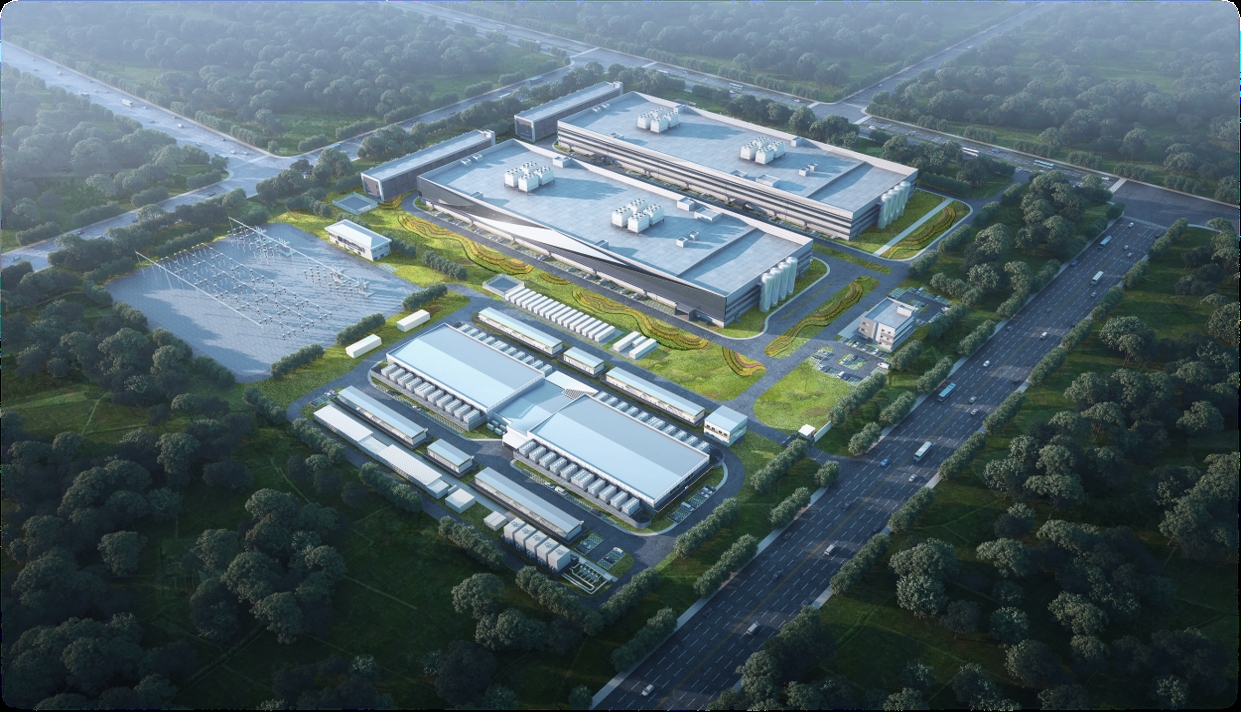
Campus rendering published with Bridge Data Centres’ March 2025 financing announcement. Rendering: Bridge Data Centres. Source: Bridge Data Centres.
A financing report based on people involved in the discussions identifies four transactions under pressure. ByteDance, the Chinese owner of TikTok, Alibaba, the Chinese technology group with a cloud-computing business, and Tencent, the Chinese technology group developing Hunyuan AI models, are customers of the infrastructure operators seeking funds.
| Borrower | Financing under discussion | Reported lender response |
|---|---|---|
| Bridge Data Centres, a Bain Capital-backed operator of large data-center campuses | Upsized $6.6 billion loan; Malaysian facilities serve customers including ByteDance | Some lenders delayed proceeding to conduct more due diligence |
| Digital Halo, a Partners Group-backed data-center operator | Fully underwritten $372 million loan for a Malaysian facility serving Alibaba and other customers | One bank passed; others sought more information |
| Aolani, a Singapore-based specialist AI cloud operator with ByteDance business | $480 million loan | Multiple banks were reassessing participation |
| GMI Cloud, a cloud partner of US AI chipmaker Nvidia | $300 million loan to finance chips for a Thai facility intended to serve Tencent | At least one private fund declined to participate |
A bank passing on a fully underwritten loan is a different event from an entire financing being withdrawn. The accounts do not establish the final funding outcome for any of these four transactions.
Bridge declined to comment after Bain referred questions to it. Partners Group declined to comment. Digital Halo, Aolani, Alibaba, ByteDance, GMI Cloud and Tencent did not respond to requests for comment for the financing report.
Bridge has raised substantial bank financing before. In its March 19, 2025 announcement, it said it had secured $2.8 billion in senior secured bank financing for expansion, including campuses in Malaysia and Thailand, with more than 11 lead banks committing. That earlier facility demonstrates its access to banks; it does not establish how much of the proposed $6.6 billion loan is additional borrowing or refinancing.
Digital Halo also sits within an established investment strategy. Private markets investment firm Partners Group said on May 13, 2025 that it had agreed to acquire the operator on behalf of its clients and planned an initial commitment of around $400 million. That was planned investment backing, distinct from the $372 million loan now drawing questions.
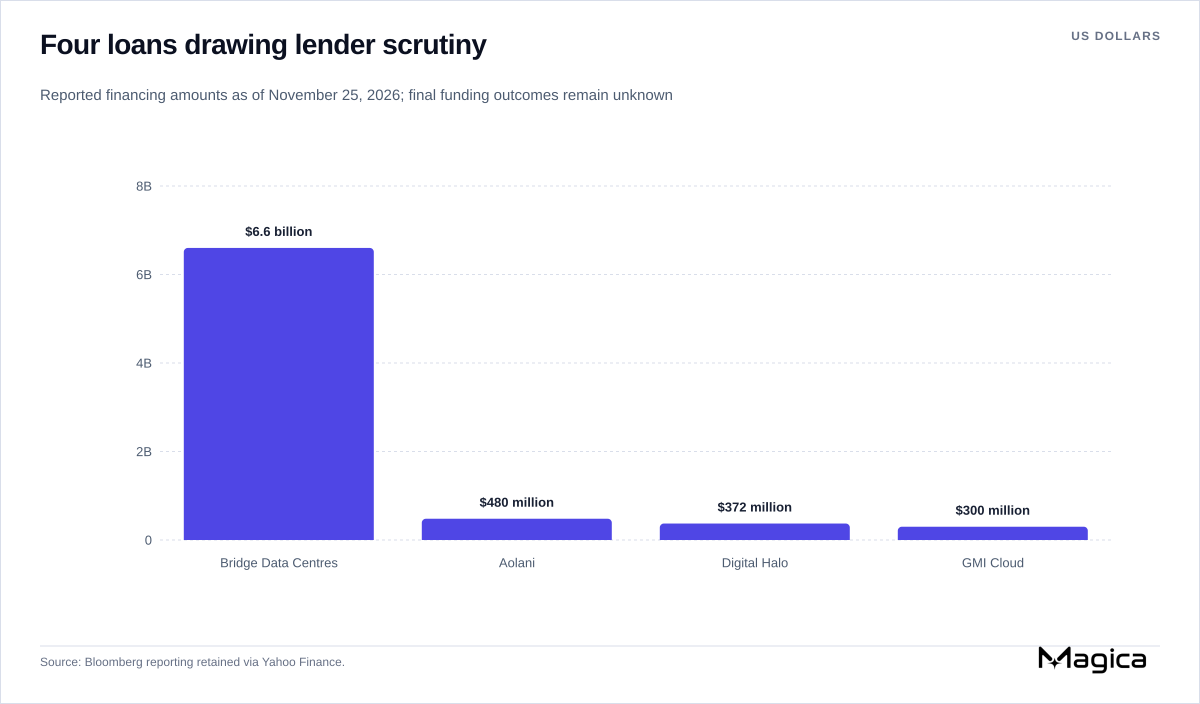
Reported financing amounts under scrutiny; final funding outcomes remain unknown. Lender responses range from further diligence to individual participants declining. Source: Yahoo Finance.
US restrictions on advanced chip exports to China began in 2022. Chinese technology companies subsequently increased their use of rented computing capacity overseas, supporting a Southeast Asian market for data centers and specialist AI clouds.
The Commerce Department’s Bureau of Industry and Security, the agency administering these export controls, announced its latest measures on November 16. The rule published November 19 says the controls seek to prevent remote access from undermining restrictions intended to protect US national security and foreign policy interests.
The measure also formally rescinds the Biden administration’s 2025 AI Diffusion Rule, whose worldwide framework BIS says was never enforced. The November action combines targeted destination and end-use controls with that rollback.
Two mechanisms matter to the financings:
The remote-access threshold is more than 12 million in “aggregate TPP,” the rule’s summed total-processing-performance measure for covered chips and equipment. It can be reached at one data center or across linked facilities sharing resources. This is a regulatory hardware-performance measure, rather than a count of chips or a measurement of a customer’s actual AI output.
Existing providers of covered computing services have 90 days from the rule’s effective date to obtain a license or face future export restrictions. Applications under the new remote-use control are reviewed case by case.
There is a narrower exception for capacity exclusively used for commercial recommender systems, subject to submitting customer, capacity and due-diligence information. The definition excludes systems designed or used to generate new text, images, audio, video, software or other content, even when they also make recommendations. It therefore does not exempt every AI workload run by an online retailer or social-media company. Other export-control requirements can still apply.
The rule also says earlier controls already extended to transactions on behalf of Chinese-headquartered entities, including cases where they were the exclusive or primary remote users of a data center’s capacity. The new measures expand and specify the controls; they do not mean all overseas access was unrestricted before November.
For lenders, the practical consequence is that a project’s location and a familiar customer name are insufficient to establish its regulatory position. Intended workloads, computing capacity and customer ownership all matter. The financing accounts do not disclose enough of those details to determine each borrower’s licensing outcome.
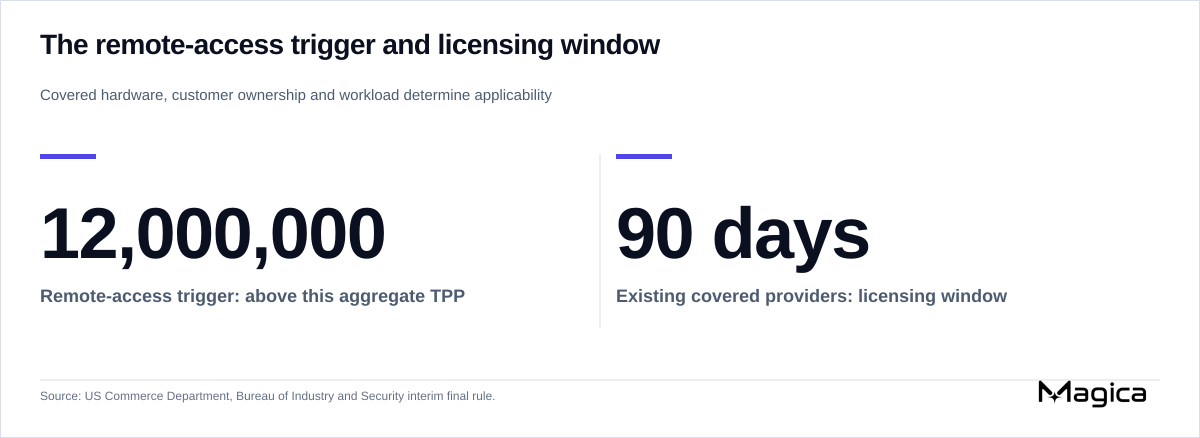
Aggregate TPP measures covered hardware performance. Existing covered providers have 90 days from the effective date to obtain a license; applicability depends on customer ownership, workload and the rule’s exceptions. Source: US Bureau of Industry and Security.
More than a dozen bankers told the financing report that their teams were awaiting answers about the rules’ effects. Citigroup, Standard Chartered and Singapore’s major banks had begun broad reviews of data-center clients, according to people familiar with the matter.
The uncertainty also reaches banks trying to reduce existing exposure through secondary loan sales or significant risk transfers—transactions that shift credit risk to investors. United Overseas Bank is seeking a roughly $1 billion risk transfer covering data-center and infrastructure loans among other sectors, the report says. One person said current headlines were slowing progress, while the details remained unsettled. UOB declined to comment, citing deal confidentiality.
The proposed transfer spans several sectors, so its size does not measure UOB’s data-center exposure alone. It concerns investors’ willingness to take existing lending risk.
Private lenders had pursued the higher returns associated with financing graphics processing units, or GPUs, used in AI computing. The reported fund withdrawal from GMI Cloud’s loan shows the reassessment extends beyond commercial banks, although the accounts give no comparable loan pricing or revised financing terms.
Equity transactions are also being reconsidered. DayOne Data Centers, whose biggest customer is ByteDance, has put a planned US listing on hold, according to people cited in the financing report. A consortium involving BlackRock is considering reducing its offer for an Asia-Pacific data-center portfolio. The latter remains a possible repricing, rather than a completed transaction.
The customers have warned that access constraints could change their plans. Tencent said reduced access to advanced computing could lengthen development of a future generation of Hunyuan. Alibaba said it could scale back its long-term data-center expansion target, according to a report on their November earnings comments and China’s chip supply. These were warnings about possible effects, rather than confirmed reductions in those programs.
That report also says Nvidia confirmed it had stopped shipping H200 processors to China despite receiving some US licenses. It cites earlier reporting that Beijing had withheld approval for about 600,000 H200 chips to enter mainland China from Hong Kong. US authorization alone therefore does not settle the availability of that route.
Chinese companies including Huawei, Baidu, Alibaba and Cambricon have advanced their own processor designs, but manufacturing capacity remains a constraint. Benjamin Ho, lead research strategist for Hong Kong and China equities at Maybank Investment Banking Group, told the report that large technology groups such as Baidu, Tencent and Alibaba were better positioned because of earlier investment in domestic data centers and hardware. He identified AI start-ups Moonshot AI and MiniMax as more vulnerable because they would need to rent capacity from rivals.
Sigrid Wang, lead technology analyst at independent Chinese advisory firm Hutong Research, estimated in the November 25 report that overseas data centers supplied roughly 30% of the AI computing power available to Chinese firms. She said Huawei’s Cloudmatrix 384 could rival Nvidia’s GB200 NVL72 system on some measures, but put its price at $8 million and said that made it inaccessible to smaller developers. Connecting more domestic processors can help compensate for performance gaps, but uses more of the constrained chip supply. Neither design progress nor a large cluster’s capabilities establishes an immediately available, affordable substitute for every customer losing overseas access.
The next decisions are specific: whether operators receive the authorizations their intended services require, whether customers maintain expansion plans, and whether lenders commit on terms that support those projects.
The reports do not yet establish those outcomes. The new rules allow case-by-case review and contain workload-specific limits; the financing accounts describe diligence, delays and individual lenders stepping away. Evidence of licenses issued, loans completed or withdrawn, and customer contracts changed will show how much of the pause becomes a lasting reduction in construction and computing capacity.
Sellers are seeking buyers for thousands of Nvidia B300 chips, while Asian data centers try to replace Chinese customers affected by U.S. controls. Rental prices have fallen, but short contracts remain scarce and operators face demanding financing terms.
Meta employees describe cuts to moderation teams and difficulty correcting mistakes as AI enforcement expands. Meta claims better accuracy, while account restrictions and an EU investigation put the effectiveness of appeals under scrutiny.
Dario Amodei rejects handing political authority to AI while defending task automation. An independent assessment finds faster progress at Anthropic, largely through AI assistance, but leaves important evidence outside public view.
OpenAI is piloting Private Inference with selected business customers. The feature targets provider access during processing, but model coverage, costs and evidence of its protections remain key questions.
Executives at rival AI developers are challenging a view reported among some Anthropic employees that people should delegate authority to superior machines. Anthropic defends human oversight, while the dispute exposes a harder question about who retains power when AI makes better decisions.
Officials told congressional staff there was no evidence China directed Alice Huang’s affair with Nvidia founder Jensen Huang. Reports of later information sharing, excluded intelligence and scrutiny of her former company complicate the security assessment.
Updates incorporating Sam Corcos’s requests appeared in his AI-built strategy game during a FinCEN cyber disruption. The Treasury CIO says computers develop it autonomously; the record does not establish time diverted from official duties or who pays the project’s costs.
SpaceX won conditional authorization for its Starmind orbital data centers, with deployment deadlines through 2040. The FCC left higher-altitude debris plans unresolved and did not judge whether the computing business will work.
NVIDIA has released Nemotron-Labs-Image-30B-A3B for non-commercial research and evaluation. The broader creation framework awaits legal clearance, and its best GenEval and GenEval2 results use GPT-6 assistance rather than the downloadable generator alone.
SpaceX reportedly lowered small-cluster Blackwell quotes to $10–$12 per GPU-hour, matching rates already offered to large customers. A possible Anthropic nonrenewal puts roughly 50,000 older H200 GPUs in focus, but does not establish an exit from the broader compute relationship.
CoreWeave’s debt sold off despite a brief stock-market rally around Nvidia’s leadership reversal. Recent fundraising and expected customer prepayments offer support, but infrastructure purchases far exceed operating cash flow and debt has more than doubled since year-end.
A public supply page advertises B300 systems at up to 18.6 million yuan apiece, alongside trader reports of nearly $3 million prices. Its verification warnings leave inventory, sellers and delivery unproven.
The Nasdaq 100 fell 4.32% in morning trading on November 25 as AI shares slid alongside tariff and inflation concerns. Its retreat approached 20% from October levels, but the comparison depends on intraday versus closing prices, and the session was unfinished.
ARK bought a reported 751,710 Anthropic shares across six ETFs before the stock opened lower Wednesday. The purchase follows an IPO and private placement totaling $119.5 billion in gross proceeds, but the Claude developer faces slowing sequential revenue growth and heavy compute obligations.
Google Research’s AI framework claims an unconditional factoring algorithm that improves on a 1992 theoretical bound. The six-paper release awaits independent scrutiny and promised machine-checkable proofs, and does not establish a practical encryption-breaking advance.
New US chip controls put Malaysian data center projects serving Chinese AI customers under scrutiny. Workloads and ownership determine exposure, while existing US tenants and private equity funding complicate predictions of a broad financing retreat.
Fujitsu is combining OpenAI Daybreak with its own assessment system and security specialists to find exploitable vulnerabilities, propose fixes and retest them. Pricing is undisclosed, and its internal results do not establish comparative performance.
EA will add an optional John Motson commentary track to FC 27 on November 26, mixing archive recordings with AI-generated speech. His family has licensed the recreation, raising a different consent question from EA’s existing work with living commentators.
Authors allege NVIDIA distributed pirated books through BitTorrent and to business partners including Adobe. The court allowed the amended pleading, but transfers of the authors’ own works remain unproven.
Malaysia will advise data centres against hosting or serving seven US-blacklisted entities. The move targets access to local computing infrastructure while Malaysian reexport checks and the terms of the advisory remain unresolved.