Editorial Team
5 min read
OpenAI is piloting Private Inference with selected business customers. The feature targets provider access during processing, but model coverage, costs and evidence of its protections remain key questions.
OpenAI, the developer of ChatGPT and the models businesses access through its application programming interface (API), says it is testing Private Inference with its first enterprise customers, according to company statements described in a report on the pilot. OpenAI says the alpha uses confidential computing and verifiable controls to protect sensitive information while its models process requests.
For banks, hospitals and legal practices handling sensitive information, the processing boundary matters. A company can accept that its documents will not become model training material and still be unwilling to let an AI provider inspect them when answering a request. The pilot tests an additional protection for that work, but its practical reach depends on model availability, verification and cost.
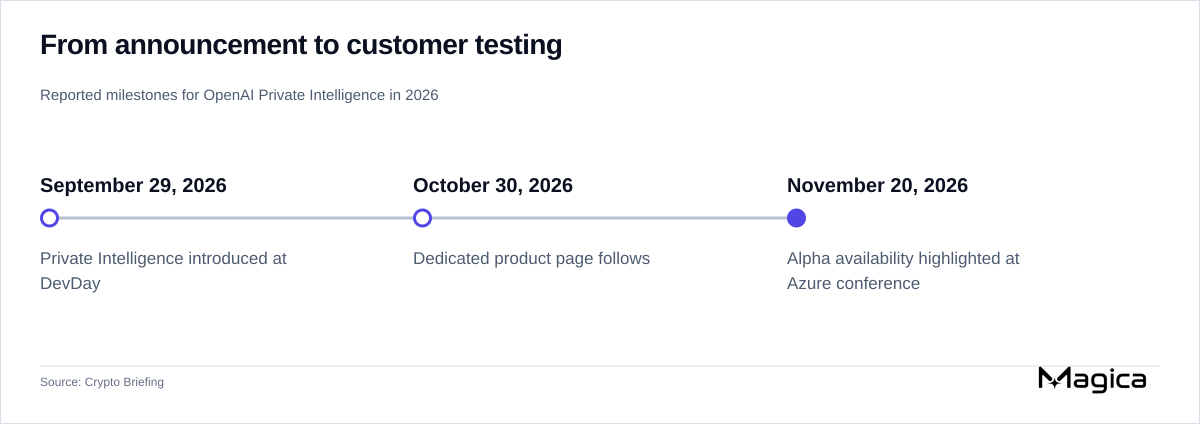
Reported milestones distinguish the Private Intelligence announcement from the later highlighting of limited Private Inference availability. Graphic: Magica; source: Crypto Briefing. Source: Crypto Briefing.
A report on the alpha says availability was highlighted at an Azure conference technical session on November 20, 2026. It places the introduction of the broader Private Intelligence offering at OpenAI’s September 29 DevDay, followed by a dedicated product page on October 30. The development is customer testing of a previously announced capability.
OpenAI’s own product page labels Private Inference an alpha and limits access protections to eligible workflows. Private Intelligence is the broader offering that brings together data ownership, access restrictions, security and controls over agents’ actions. Its describes Private Inference as a preview and asks organizations about their privacy needs and AI use cases. Neither description establishes broad availability.
Sellers are seeking buyers for thousands of Nvidia B300 chips, while Asian data centers try to replace Chinese customers affected by U.S. controls. Rental prices have fallen, but short contracts remain scarce and operators face demanding financing terms.
Inference is the stage when a model processes a prompt and generates an answer. OpenAI says Private Inference combines confidential computing with verifiable controls to protect prompts and responses during that stage. The alpha report describes what OpenAI calls attested confidential environments: isolated computing spaces whose running configuration can be checked before sensitive information is submitted. The pilot report similarly attributes the independently verifiable hardware protection to OpenAI; neither account supplies an independent test of this alpha.
That is distinct from Zero Data Retention, which OpenAI says means eligible API prompts and responses are not retained after processing. It is also distinct from a promise not to use business content to improve models. OpenAI had already made that training commitment when it launched ChatGPT Enterprise on August 28, 2023, its workplace version of ChatGPT. That announcement also offered encryption in transit and at rest. Private Inference addresses a further question: who can access content while the computation happens?
Safety checks add another layer. OpenAI’s registration form says Zero Data Retention with Private Safety Processing enables automated safety reviews without exposing the underlying content to its personnel. The alpha report dates a phased rollout of that combination to around September 22, 2026, before the broader Private Intelligence announcement.
The pilot report describes encrypted flagged content stored in the customer’s cloud and readable only by a secured review system. The alpha report names AWS and Azure as examples of customer-controlled infrastructure for safety records. That storage arrangement concerns safety processing; it does not establish that the model itself runs in a customer’s cloud. Zero Data Retention also should not be read as a claim that this separate encrypted safety record cannot exist.
OpenAI says customers own their inputs and outputs and decide what agents can access, which tools and actions they can use, and when approval is required. It lists SOC 2 Type 2 audits, ISO certifications and support for US healthcare privacy requirements through business associate agreements for eligible services. Those qualifications matter: the page does not establish that every workflow receives every protection or assurance.
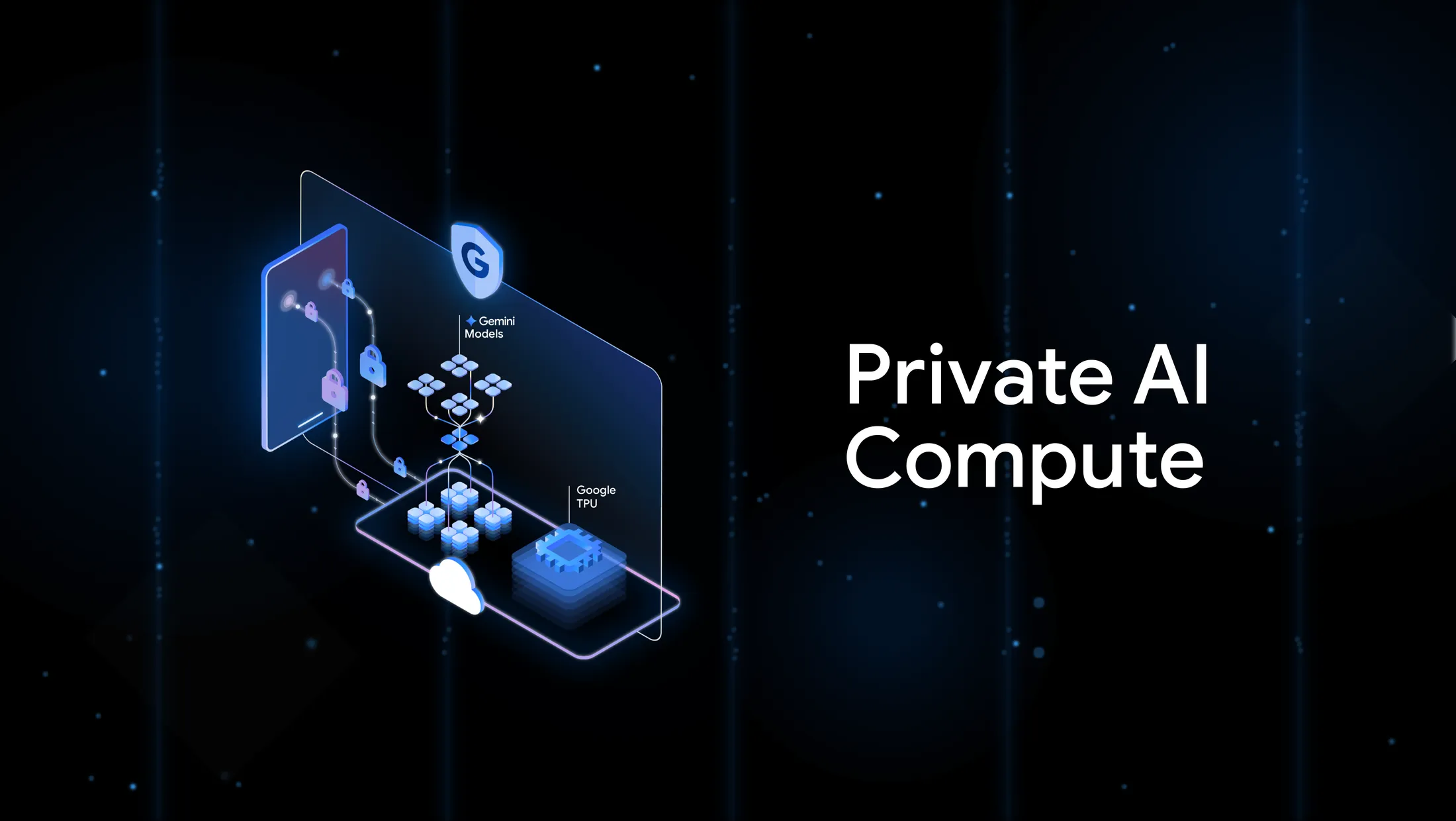
Google’s illustration of its company-reported Private AI Compute architecture, introduced in November 2025. Equivalent protections across Google’s and OpenAI’s offerings have not been established. Source: Google Private AI Compute announcement.
OpenAI is entering an existing field. Apple’s Private Cloud Compute technical overview describes a system for Apple Intelligence, its personal AI system for iPhone, iPad and Mac. Apple describes cloud processing for larger models with protections intended to prevent even Apple staff from accessing personal data sent to the service.
Apple’s design provides a concrete verification benchmark. Its overview commits to publishing production software images for inspection and describes devices sending requests only to servers whose cryptographic measurements match software listed in a public transparency log. These are Apple’s architectural commitments, not proof that OpenAI’s implementation has equivalent safeguards.
Google introduced Private AI Compute on November 11, 2025, pitching private cloud AI experiences powered by its Gemini models. These precedents limit any claim that provider-inaccessible AI processing is unique to OpenAI. They do not establish that the products offer equivalent protections, support the same workloads or serve the same enterprise customers.
The alpha report says OpenAI has not publicly disclosed supported models, pricing or performance overhead. Without those details, customers cannot make a like-for-like assessment of the cost and responsiveness of protected inference against their existing deployment.
Infrastructure is another open constraint. The pilot report says OpenAI is expanding the compute capacity needed to extend the offering. It supplies no capacity figure or broad availability date, leaving the scale and timing of access uncertain.
The next meaningful evidence is therefore a supported-model list, measured performance, commercial terms and a clearer explanation of how customers independently verify the protections. Until then, the pilot marks a move toward deploying the privacy architecture; it does not settle how widely or economically businesses can use it.
Lenders are delaying or reassessing financing for Asian data centers serving Chinese technology firms as new US licensing rules put chip purchases and customers’ access to computing capacity in doubt.
Meta employees describe cuts to moderation teams and difficulty correcting mistakes as AI enforcement expands. Meta claims better accuracy, while account restrictions and an EU investigation put the effectiveness of appeals under scrutiny.
Dario Amodei rejects handing political authority to AI while defending task automation. An independent assessment finds faster progress at Anthropic, largely through AI assistance, but leaves important evidence outside public view.
Executives at rival AI developers are challenging a view reported among some Anthropic employees that people should delegate authority to superior machines. Anthropic defends human oversight, while the dispute exposes a harder question about who retains power when AI makes better decisions.
Officials told congressional staff there was no evidence China directed Alice Huang’s affair with Nvidia founder Jensen Huang. Reports of later information sharing, excluded intelligence and scrutiny of her former company complicate the security assessment.
Updates incorporating Sam Corcos’s requests appeared in his AI-built strategy game during a FinCEN cyber disruption. The Treasury CIO says computers develop it autonomously; the record does not establish time diverted from official duties or who pays the project’s costs.
SpaceX won conditional authorization for its Starmind orbital data centers, with deployment deadlines through 2040. The FCC left higher-altitude debris plans unresolved and did not judge whether the computing business will work.
NVIDIA has released Nemotron-Labs-Image-30B-A3B for non-commercial research and evaluation. The broader creation framework awaits legal clearance, and its best GenEval and GenEval2 results use GPT-6 assistance rather than the downloadable generator alone.
SpaceX reportedly lowered small-cluster Blackwell quotes to $10–$12 per GPU-hour, matching rates already offered to large customers. A possible Anthropic nonrenewal puts roughly 50,000 older H200 GPUs in focus, but does not establish an exit from the broader compute relationship.
CoreWeave’s debt sold off despite a brief stock-market rally around Nvidia’s leadership reversal. Recent fundraising and expected customer prepayments offer support, but infrastructure purchases far exceed operating cash flow and debt has more than doubled since year-end.
A public supply page advertises B300 systems at up to 18.6 million yuan apiece, alongside trader reports of nearly $3 million prices. Its verification warnings leave inventory, sellers and delivery unproven.
The Nasdaq 100 fell 4.32% in morning trading on November 25 as AI shares slid alongside tariff and inflation concerns. Its retreat approached 20% from October levels, but the comparison depends on intraday versus closing prices, and the session was unfinished.
ARK bought a reported 751,710 Anthropic shares across six ETFs before the stock opened lower Wednesday. The purchase follows an IPO and private placement totaling $119.5 billion in gross proceeds, but the Claude developer faces slowing sequential revenue growth and heavy compute obligations.
Google Research’s AI framework claims an unconditional factoring algorithm that improves on a 1992 theoretical bound. The six-paper release awaits independent scrutiny and promised machine-checkable proofs, and does not establish a practical encryption-breaking advance.
New US chip controls put Malaysian data center projects serving Chinese AI customers under scrutiny. Workloads and ownership determine exposure, while existing US tenants and private equity funding complicate predictions of a broad financing retreat.
Fujitsu is combining OpenAI Daybreak with its own assessment system and security specialists to find exploitable vulnerabilities, propose fixes and retest them. Pricing is undisclosed, and its internal results do not establish comparative performance.
EA will add an optional John Motson commentary track to FC 27 on November 26, mixing archive recordings with AI-generated speech. His family has licensed the recreation, raising a different consent question from EA’s existing work with living commentators.
Authors allege NVIDIA distributed pirated books through BitTorrent and to business partners including Adobe. The court allowed the amended pleading, but transfers of the authors’ own works remain unproven.
Malaysia will advise data centres against hosting or serving seven US-blacklisted entities. The move targets access to local computing infrastructure while Malaysian reexport checks and the terms of the advisory remain unresolved.