Editorial Team
7 min read
Knit Health’s NEA-led Series A funds deployment of Med-BEAM for care navigation and hospital operations. Its early company benchmark beats three Claude models at predicting clinical actions, while better patient outcomes remain unproven by that test.
Knit Health, a healthcare AI startup founded in 2025 by University of California, Berkeley scientists, has raised $35 million to deploy Med-BEAM, its model for predicting patients’ next steps in care. The Series A is led by investment firm New Enterprise Associates, or NEA, according to the company’s financing announcement.
Knit is starting with patient navigation, specialist routing, scheduling and hospital operations. Its larger ambition is to supply predictive intelligence to other healthcare applications and AI agents. That puts the financing behind a consequential proposition: using patterns in past care to help decide how patients reach scarce clinical resources.
The startup announced the NEA-led Series A on November 16. Its announcement names Frist Cressey Ventures, Town Hall Ventures and SignalFire as participants, alongside continued support from Uncork, Moxxie, the Aligned Fund and Coalition Operators. The financing will support scientific and engineering hiring and expansion into more clinical settings.
Knit has raised $46.6 million in total, according to the funding report. Co-founder and CEO Jonathan Kolstad, a Berkeley Haas healthcare economist who has spent decades studying healthcare systems, initially disclosed the round in a report focused on patient referrals.
A July Berkeley account of Knit’s origins describes its incubation in the university’s Center for Healthcare Marketplace Innovation and a foundational data partnership with UC San Francisco. Kolstad had worked with audit logs recording the actions of doctors, nurses and care teams. That background helps explain Knit’s focus on clinical behavior and the organization of care.
The economic premise is that better matching can make existing clinical capacity more useful. Knit describes a system in which referrals depend heavily on professional relationships and scheduling on rigid rules and available appointments. Its proposed alternative is to anticipate a patient’s needs and match them with suitable clinicians and services.
The round funds a rollout; the amount raised does not establish customer adoption or returns for health systems.
Med-BEAM is what Knit calls a healthcare world model: a model of how patient conditions and care unfold over time. The company says it learns from billions of healthcare decisions and hundreds of millions of longitudinal patient records, including orders, diagnoses and referrals. These are company-provided measures of its learning data, with no corresponding count of unique patients established in the announcement.
Knit says it uses only data for which it has clear, documented rights, and that the data is fully de-identified before reaching the company, according to the funding report. It also says Med-BEAM checks predictions against clinical outcomes and can flag insufficient evidence for confidence. These are company descriptions of its safeguards.
Despite its criticism of language models’ limitations, Knit describes the two approaches as complementary. Language models could provide interfaces for patients, clinicians and agents, while Med-BEAM supplies predictions about the clinical environment.
Knit says it need not own every workflow and wants health systems, technology companies and developers to build on its underlying intelligence. Its backers see a similar opportunity: NEA partner Blake Wu, whose firm led the round, said the model could support workflows including clinical trial recruitment and hospital-at-home care, according to the funding report. Those are proposed uses, rather than deployments established by that report.
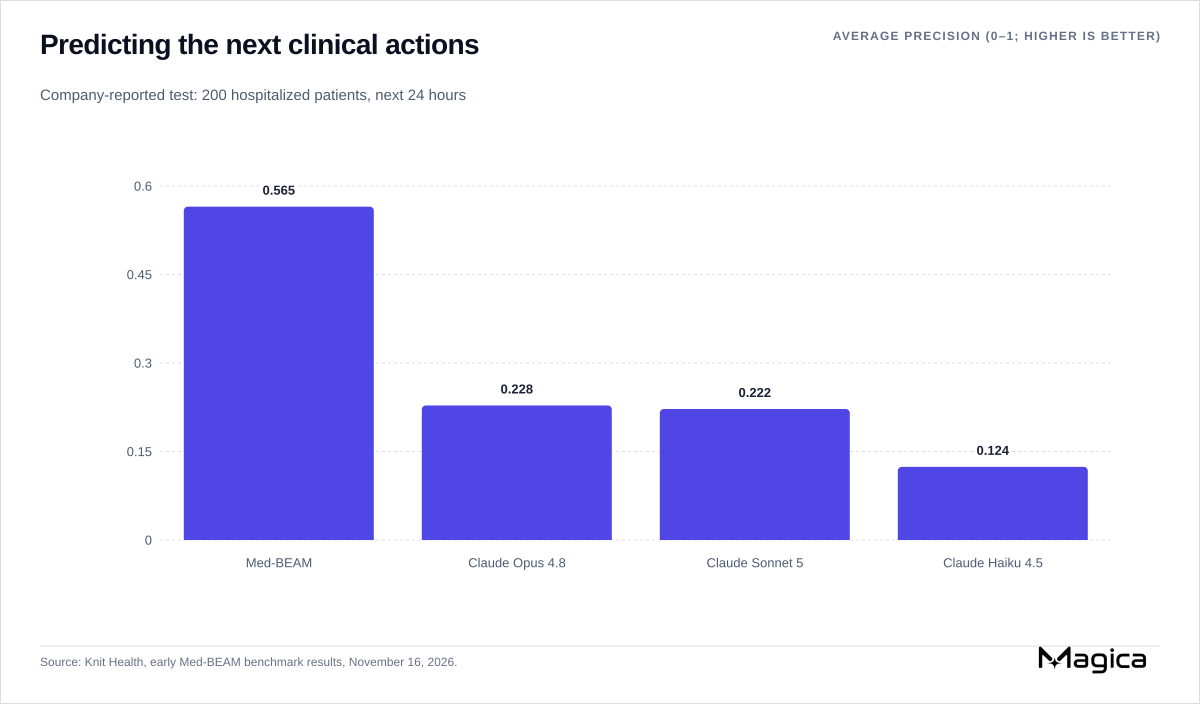
Company-reported average precision for predicting clinical actions over the next 24 hours in 200 hospitalized patients. Predicting recorded care does not establish improved patient outcomes. Source: Knit Health; chart: Magica. Source: Knit Health benchmark results.
Knit’s benchmark account describes a test using records from 200 patients admitted through an emergency department, none used to train Med-BEAM. Models received histories through admission and a list of possible actions, then predicted actions over the next 24 hours.
Knit measured accuracy using average precision, a score from zero to one that assesses how highly a model ranks actions that actually occurred across the possible actions for all 200 patients. It compared Med-BEAM with three of Anthropic’s Claude language models:
| Model | Average precision | Time per patient |
|---|---|---|
| Med-BEAM | 0.565 | About 2 seconds, estimated |
| Claude Opus 4.8 | 0.228 | 408 seconds, measured |
| Claude Sonnet 5 | 0.222 | 307 seconds, measured |
| Claude Haiku 4.5 | 0.124 | 216 seconds, measured |
Med-BEAM’s precision score was 2.48 to 4.56 times the scores of the three tested language models, all from Anthropic. The comparison supports a narrower claim than superiority over language models generally, or a fourfold improvement in patient care. The speed comparison also combines Med-BEAM’s estimated processing time with measured response times for the other models.
For cost, Knit used estimated inference time and compute prices for Med-BEAM, then applied a threefold multiplier to allow for a provider margin. The Claude costs reflected actual benchmark usage at Anthropic’s published rates. Under those assumptions, Knit estimated per-patient costs 37 to 257 times lower for Med-BEAM. The account gives no dollar price per patient. These estimates do not establish a customer tariff or hospital savings after deployment.
The measured target was what clinicians did. That does not, by itself, establish which intervention would have produced the best outcome.
Knit calls Med-BEAM the first healthcare world model, but the broader idea of learning future health trajectories already has research precedents. A September 2025 research paper described Delphi-2M, a disease-trajectory model based on a modified GPT architecture. Researchers trained it on 0.4 million UK Biobank participants and validated it on 1.9 million Danish individuals without changing its parameters. It predicted rates of more than 1,000 diseases.
That is not a like-for-like test against Med-BEAM’s prediction of clinical actions. It does show that adapting language-model architectures to structured health histories predates this financing. The paper also describes existing disease-specific risk models; breadth of prediction is a separate question from whether a tool beats the best alternative for a particular clinical decision.
The Delphi researchers found that their model learned patterns of missing records as well as disease progression, and cautioned against interpreting temporal dependencies as causal relationships. Those findings concern Delphi, not demonstrated defects in Med-BEAM. They nevertheless illustrate why predicting patterns in records requires separate validation before using predictions to change care.
Knit’s own announcement distinguishes predicting what happens from understanding how outcomes change when different decisions are made. It describes the latter as a central scientific challenge still being worked on.
Co-founder and chief scientist Maya Petersen, a Berkeley professor of biostatistics, epidemiology and computational precision health, brings causal-inference expertise to that problem. The university’s July account says she challenged the idea that learning doctors’ behavior was equivalent to knowing the right care. Her involvement helps explain both Knit’s causal-AI ambition and the gap that remains between reproducing decisions and improving them.
The company’s immediate applications offer a way to test the distinction. Evidence that routing gets patients to appropriate specialists sooner, reduces unnecessary visits or improves outcomes would connect prediction performance to the benefits Knit proposes. Its illustration of reaching a specialist in one visit instead of three is a company claim, not a clinical result established by the benchmark described here.
Knit says it plans broader benchmarking across prediction tasks, models and clinical settings in the coming months. For health systems considering deployment, the unresolved evidence is more specific: whether recommendations work in their own setting, improve access and outcomes when acted upon, and justify the full cost of introducing the system. The initial benchmark does not answer those questions.
Microsoft is pitching Copilot Workspaces as a shared environment for people and AI agents. Team collaboration is already in early access, but personal Autopilot integration is still coming soon, with final agent pricing unannounced.
Google is rolling out file references and sharing for Gemini skills as adult personal accounts lose the ability to use Gems. Automatic conversion preserves supported material, but file limits and missing tools can interrupt existing workflows.
Muddy Waters disclosed a short position in Nvidia while questioning a possible connection involving senior adviser Ajay K. Puri. Its own account leaves the key identity question unanswered, separating its new claims from an existing server-diversion prosecution.
Nvidia reported $115.8 billion in quarterly revenue in its first earnings release since co-founder Jensen Huang resigned. Strong demand gives interim CEO Colette Kress a financial cushion, while a campaign for Huang’s return collides with unresolved investigations and the board’s reported opposition.
OpenAI launched GPT-6.2 Astra and Sol for professional work, cutting Astra’s standard input and output token prices by 20%. The models offer cheaper paths through selected tasks, but research evaluations, reporting failures and unfinished independent safeguard testing complicate the case for broader autonomy.
Microsoft’s first live speech-to-speech model offers OpenAI API compatibility and planned enterprise integrations. Its published evaluations show a low-cost option, with several rivals completing more agentic tasks.
Canberra-based Trellis Data is offering its 220-billion-parameter Agentaus 1 model to business and government. Its pitch goes beyond keeping data in Australia, but performance, deployment costs and a planned capital raising remain key tests.
Perplexity is adding direct collaboration between frontier models to Computer, letting a lead agent coordinate up to 16 supporting agents. Company-reported benchmarks suggest mixed teams can outperform repeated copies of one model, but leave customer costs and production reliability unresolved.
Marsh reported 105 client cyber incidents in the last two weeks of October, against 48 in the final two weeks of May. The broker links the increase partly to AI, while warning that insurance panel access may not guarantee an available response team.
Meta’s Muse personal AI agent has launched in Australia, with some local shopping and booking connections to follow. Its browser and payment tools broaden its reach, while the company’s technical disclosures qualify its privacy promises.
Microsoft and Salesforce are extending their sales software alliance with Copilotforce, combining CRM workflows with Microsoft 365 context under existing permissions. The Copilot plugin enters public preview, while Teams remains in pilot; earlier Microsoft tools and a Claude beta raise the bar for proving its value.
Microsoft expands MAI Image 2.7 from an editing preview into image generation and API access, with cheaper Flash pricing and a Canvas workspace. Benchmark claims depend on the workload, while the MAI Labs interface carries restrictions on commercial use.
OpenAI is widening applications for its legal AI configuration after improving research scores and expanding its search index. Access still requires approval, and benchmark results show substantial limits alongside the gains.
Microsoft has made Word, Excel and PowerPoint creation generally available inside Copilot, combining editable files with workplace permissions and collaboration. The broader shift toward autonomous work remains staggered across previews, while its claimed cost advantage rests on company-funded testing.
Science Corporation’s Series D follows its European retinal-implant launch. Clinical results support improved central vision, but U.S. approval, eligible patients and commercial terms remain consequential questions for the startup, reportedly valued at $3.5 billion.
Google will let Gemini users save conversations while opting out of generative AI training on future chats. The global rollout also extends storage of history-off and temporary chats from 72 hours to around two months; human review and longer retention can still apply.
Google is removing the subscription requirement for Gemini’s task mode in six countries, while adding U.S. payment, calling and messaging features. The expansion broadens access to delegated work, but usage limits, permissions and website compatibility still govern what it can finish.
Eligible Pixel owners can join a Play Store beta to generate home-screen widgets from descriptions, but device, language and regional restrictions still apply.
Microsoft’s new in-house coding models compete with outside suppliers inside GitHub Copilot. Company tests show lower task costs at promotional prices, while its continuing financial ties to OpenAI complicate the rivalry.
Valkryn disclosed a $15 million seed round and early military testing contracts. Its evaluator-focused Battle Lab faces existing commercial tools, public testing capabilities and funding constraints that software alone cannot resolve.